


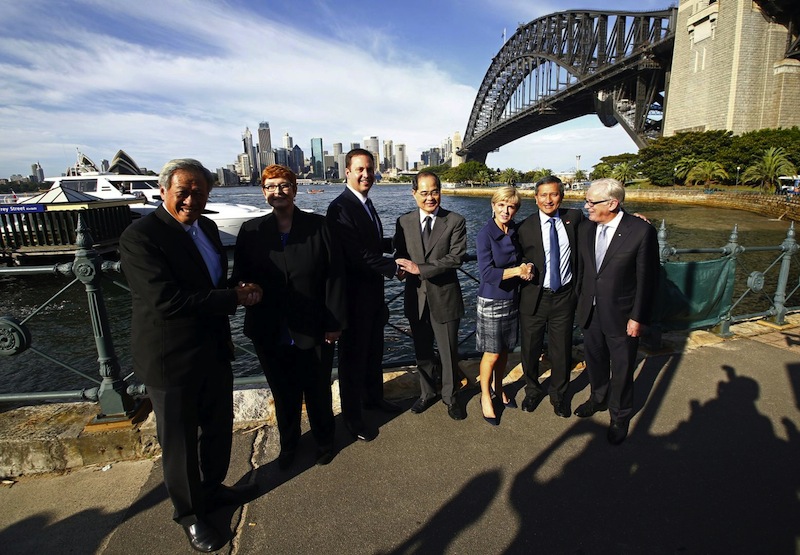


SINGAPORE, May 6 — Singapore and Australia have concluded a landmark agreement to deepen ties and strengthen cooperation in multiple areas ranging from defence, trade to innovation and people-to-people ties, building on a Comprehensive Strategic Partnership (CSP) agreed by both countries less than a year ago.
“I am delighted that we have concluded this landmark agreement with Australia. It is a win-win deal that will cement relations and benefit Australians and Singaporeans for years to come,” said Prime Minister Lee Hsien Loong in a press statement issued by the Ministry of Foreign Affairs (MFA) today.
“Our two countries are politically like-minded, strategically-aligned and economically complementary. We have much to gain by working closely together,” added Mr Lee.
He noted that the CSP – first agreed during the visit of then Australian Prime Minister Tony Abbott to Singapore last June – is an ambitious package covering many aspects of bilateral ties.
“The CSP will draw our two countries closer, economically, politically and at the people-to-people level,” said Lee.
“We will move quickly to implement the various measures, although some will take time to bear fruit.”
Since both sides agreed to elevate ties to a CSP last June, officials with both sides have been ironing out the details that led to the agreement this week.
Minister for Foreign Affairs Vivian Balakrishnan, together with Minister for Trade and Industry Lim Hng Kiang and Minister for Defence Ng Eng Hen had also travelled to Australia in March to meet their respective counterparts for discussions on the CSP.
Speaking to reporters yesterday, Dr Balakrishnan said the package of bilateral cooperation initiatives agreed by Singapore and Australia will put both countries “on a completely new trajectory for the next generation”.
“This (package of initiatives) sets out an unprecedented level of economic integration, unprecedented expansion of defence cooperation and collaboration, as well as joint pursuit of new areas involving innovation and enterprise,” said Dr Balakrishnan.
He noted that Singapore and Canberra are strategically aligned on many issues, including the way they viewed the world and common defence interests.
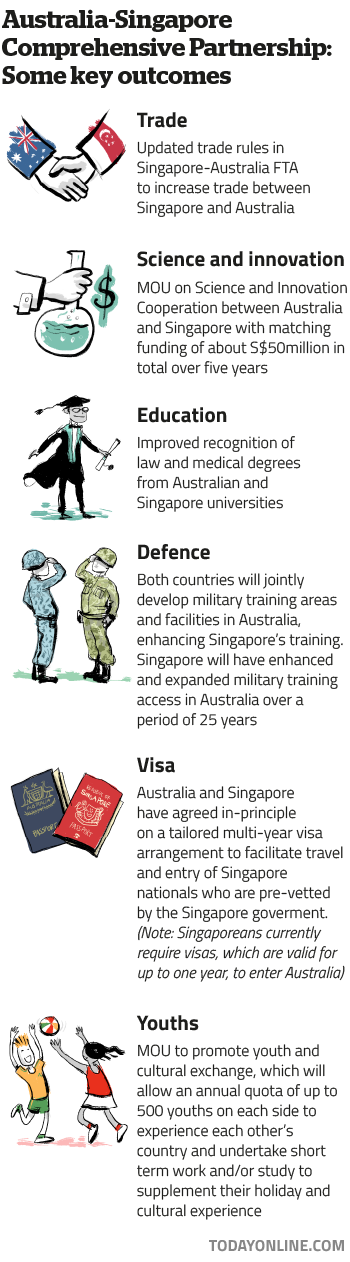
He outlined four pillars in the latest agreement under the ambit of the CSP. A key outcome is the decision to update and modernise the Singapore-Australia Free Trade Agreement (SAFTA) signed in 2003.
“As part of the Third Review of the SAFTA, both countries will adopt a package of measures to increase trade and investment flows. These measures will reinforce Singapore’s position as a trading and investment partner for Australia. It will also enhance Singapore’s position as a hub for Australian businesses and service providers to access expanding opportunities in Asia,” said the MFA statement.
Singapore is Australia’s fifth largest trading partner, with bilateral trade last year amounting to S$20.2 billion.
The Republic is the fifth largest foreign investor in Australia, with total investments amounting to A$80.2 billion (S$81.4 billion). Total stock of Australian investments in Singapore in 2014 was A$50.7 billion.
Dr Balakrishnan said yesterday that the Australian and Singaporean economies can complement each other. He noted that the Republic’s role as a global hub, logistics center and a portal into South-east Asia is viewed as essential to Australia’s economic growth.
 “For Singapore, (the partnership with Australia) gives access to a continental size economy with natural resources. It is also a sophisticated economy that gives us many opportunities.”
Another key agreement reached this week between both countries is the joint development of more military training areas and facilities in Australia.
This will provide Singapore troops with greater access to military training areas down under over a period of 25 years.
Exercise Trident - a component of the two-month long Exercise Wallaby, will also be elevated to a signature joint bilateral military exercise, according to MFA’s statement, which added that military personnel exchanges will be enhanced while civilian personnel exchanges will be initiated.
Both countries also pledged to enhance intelligence and information sharing, such as in counterterrorism.
When asked by reporters on how other countries in the region will perceive the growing defence ties between Singapore and Australia, Dr Balakrishnan said “it shows the level of strategic trust between us.”
“It also shows everyone that we take the SAF (Singapore Armed Forces) seriously… We live in an uncertain, troubled and sometimes difficult world but we have to do our best to stay strong individually, as well as to build a network of friends and good partners,” he added.
Besides trade and defence, a third pillar where both countries will deepen cooperation is in innovation and entrepreneurship.
“ There is great alignment in our policies and synergy to be gained from closer cooperation,” said the MFA statement, adding that both sides have agreed to bring together their research and scientific bodies and support their collaboration through matching funding provided by both governments to the tune of about S$50 million over five years.
The details will be worked out by the respective agencies, MFA added.
To build stronger innovation linkages, Australia has also decided to establish a “landing pad” to facilitate high tech Australian start-ups in Singapore.
“This will assist start-ups to “think global” by linking them into entrepreneur and capital networks and industry value chains, accelerating their business development and growth,” said a joint announcement by both countries.
Dr Balakrishnan said that greater cooperation in innovation will generate opportunities for cross-fertilisation of ideas.
“We are a city and we are in pursuit of urban solutions to meet the challenges of a city constrained by (lack of) natural resources, energy and space. They (Australia) have people, resources, ideas and the fact that we are different will also give our companies an opportunity to pick their brains and ideas.”
The fourth pillar of the agreement reached this week will see both countries strengthen people-to-people ties by facilitating tourism, cultural exchanges and educational opportunities.
Notably, Singaporeans will soon enjoy improved terms of entry into Australia through the implementation of multi-year visa arrangements. Youth exchanges will also be strengthened with the adoption of a 12-month arrangement for youths to travel and do short term work in both countries.
When asked if Canberra might change its mind about the deals reached given that federal elections are scheduled to be called in early July, Dr Balakrishnan expressed optimism that Australia would adhere to what has been agreed.
“We know that Australians are good for their word… There is also broad bipartisan support (in Australia) on the importance and relevance of the relationship with Singapore,” he pointed out.
“I am confident that they will fully commit to this agreement and our relationship will grow regardless of political changes in Australia.”
According to MFA’s statement, PM Lee and Australian Premier Malcolm Turnbull earlier this week re-affirmed the strength of bilateral relations based on strategic convergence and economic complementarities.
“They were pleased that the CSP and the successful negotiations for this agreement set out a long-term vision and roadmap for a major upgrade across all aspects of bilateral relations,” the statement added. — TODAY


