










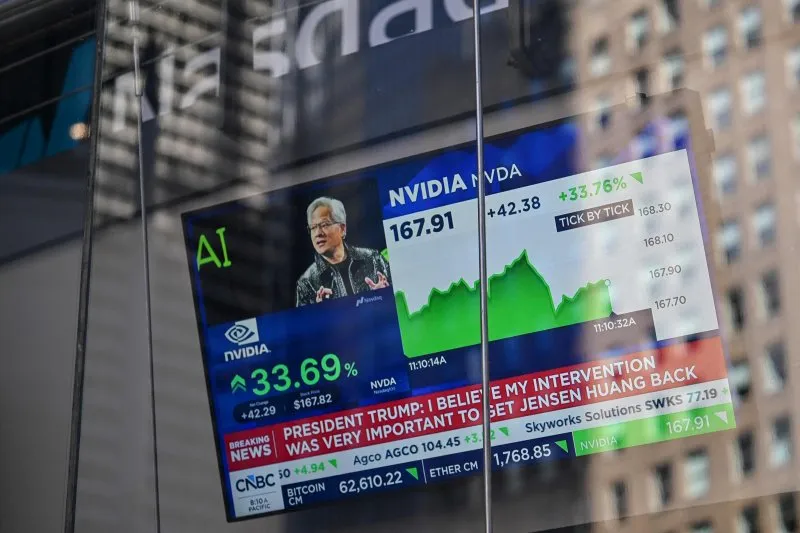
NOVEMBER 24 — The return of Jensen Huang to the helm of Nvidia has given the global artificial intelligence (AI) industry a much-needed psychological and financial boost.
Wall Street's strongest performance since April 2025, when President Donald Trump paused his Liberation Day tariffs, reflects the extraordinary importance of Nvidia to the contemporary global economy.
Yet the jubilation should not obscure the political, regulatory and economic challenges awaiting Nvidia and the wider AI industry. Huang may have returned, but the political environment in Washington is considerably less accommodating.
Nvidia’s centrality to the AI industry
Unlike many technology companies whose valuations are predicated on expectations of future earnings, Nvidia has been generating phenomenal revenues from the global expansion of AI infrastructure.
Its transformation from a supplier of graphics processors for gaming into an indispensable provider of advanced computing technologies is one of the most remarkable corporate achievements of the twenty-first century.
From Microsoft and Alphabet to Amazon and Meta, Nvidia has become a critical component of the technological ecosystem. Its importance extends beyond the United States, affecting Japan, South Korea, Taiwan, Europe, China and Southeast Asia.
Huang’s return therefore represents more than the restoration of a corporate leader. It reassures an industry upon which trillions of dollars in investment increasingly depend.
Nevertheless, confidence in Nvidia should not be confused with confidence in the entire AI economy. The enormous expenditure on data centres, semiconductors and electricity infrastructure must eventually translate into sustainable commercial returns. Nvidia may remain profitable even if some of its largest customers struggle to monetise their AI investments.
Congress will not look the other way
The political backlash against Huang’s reinstatement is equally consequential.
Democratic Senator Elizabeth Warren has described the decision as “reckless”, signalling that Nvidia could face extensive congressional scrutiny. Of particular significance is her determination to examine whether the company has fully complied with American export controls and whether senior Trump administration officials played a role in facilitating Huang's reinstatement.
These are legitimate questions of corporate governance and national security.
Even if the White House regards Nvidia as indispensable to American technological supremacy, this does not place the company beyond congressional oversight. Indeed, the greater Nvidia’s strategic importance, the stronger the argument for ensuring that its decisions remain transparent and consistent with American laws.
However, congressional scrutiny must not become an exercise in political persecution. Allegations of wrongdoing must be supported by credible evidence. The distinction between suspicion and proven misconduct remains fundamental to the integrity of American institutions.
The China dimension
At the heart of this controversy is Nvidia's commercial relationship with China.
Washington increasingly regards advanced AI semiconductors as strategic assets with implications for military computing, intelligence and technological competitiveness. This explains successive American efforts to restrict China’s access to sophisticated processors.
For Nvidia, however, China remains an important commercial market. The company must navigate between shareholder expectations and Washington’s national security priorities.
This is an increasingly difficult balancing act.
If export controls become excessively restrictive, China may accelerate its efforts to develop domestic alternatives, ultimately weakening American commercial influence. Conversely, relaxing restrictions without adequate safeguards could undermine Washington’s technological advantage.
The challenge is therefore not simply whether Nvidia should sell advanced chips to China. It is whether the United States can protect its national security interests without unnecessarily undermining its own technological competitiveness.
Huang’s return does not resolve this dilemma. If anything, it makes the debate more urgent.
Why Asean should pay attention
The implications extend well beyond Washington and Beijing. Nvidia's technological ecosystem depends on an intricate international supply chain, particularly the semiconductor manufacturing capabilities of Taiwan and South Korea, alongside Japan’s advanced semiconductor equipment and materials industries.
This interconnectedness means that any significant disruption to Nvidia’s operations could affect economies across the region.
For Asean, the lesson is particularly important.
Malaysia, Singapore, Vietnam, Thailand and Indonesia are increasingly positioning themselves as destinations for semiconductor investment, data centres and digital infrastructure. Malaysia, in particular, has sought to strengthen its position in semiconductor assembly, testing and packaging.
Yet attracting investment alone is insufficient. ASEAN must also develop domestic technological capabilities and ensure that its participation in the AI economy translates into meaningful economic value.
The Nvidia controversy demonstrates how technological interdependence can generate both opportunities and vulnerabilities. Companies operating across Southeast Asia may face increasingly complex compliance requirements as Washington tightens its export-control regime, particularly when their commercial activities involve China.
Asean should therefore avoid being drawn into a binary choice between Washington and Beijing. Its interests lie in maintaining an open, rules-based technological environment while strengthening regional cooperation in semiconductor supply chains, research and development, and export-control compliance.
Technological sovereignty does not mean isolation. It means possessing sufficient institutional capacity and strategic flexibility to make independent decisions amid intensifying geopolitical competition.
The real test lies ahead
Huang’s return is undoubtedly a victory for Nvidia’s investors, employees and business partners. But it should not be mistaken for the conclusion of the company’s difficulties.
Nvidia must still demonstrate that its commercial ambitions can coexist with regulatory compliance, corporate accountability and national security considerations.
For Congress, the responsibility is to scrutinise the company without undermining the innovation that has made the United States a global technology leader.
For Asean, the lesson is equally clear: the AI revolution must not become another arena in which Southeast Asian economies are merely consumers of technology developed elsewhere.
Huang’s return may have restored Wall Street’s confidence, but it has not settled the larger questions surrounding technological power, political accountability and the future of global semiconductor competition.
The celebration may be justified. The scrutiny, however, is equally necessary.
* Phar Kim Beng, PhD is the Professor of Asean Studies at International Islamic University of Malaysia and Director of Institute of International and Asean Studies (IINTAS). Lutfy Hamzah is a research fellow at IITAS.
** This is the personal opinion of the writers or publication and does not necessarily represent the views of Malay Mail.