


OCTOBER 21 — The reported deregistration of Perikatan Nasional (PN) has thrown Malaysia’s opposition politics into considerable confusion. Beyond the legal and organisational implications, the deeper consequences are psychological, potentially weakening the momentum of the much-vaunted Gelombang Biru, or Blue Wave.
Ten factors explain why the opposition faces mounting difficulties ahead of the 16th General Election (GE16).
First, coalition politics depends on credibility. When PN cannot demonstrate organisational stability, leaders, supporters and sympathisers naturally begin questioning whether Umno, PAS and Wawasan can collectively produce an electoral wave capable of defeating Prime Minister Anwar Ibrahim and Pakatan Harapan (PH).
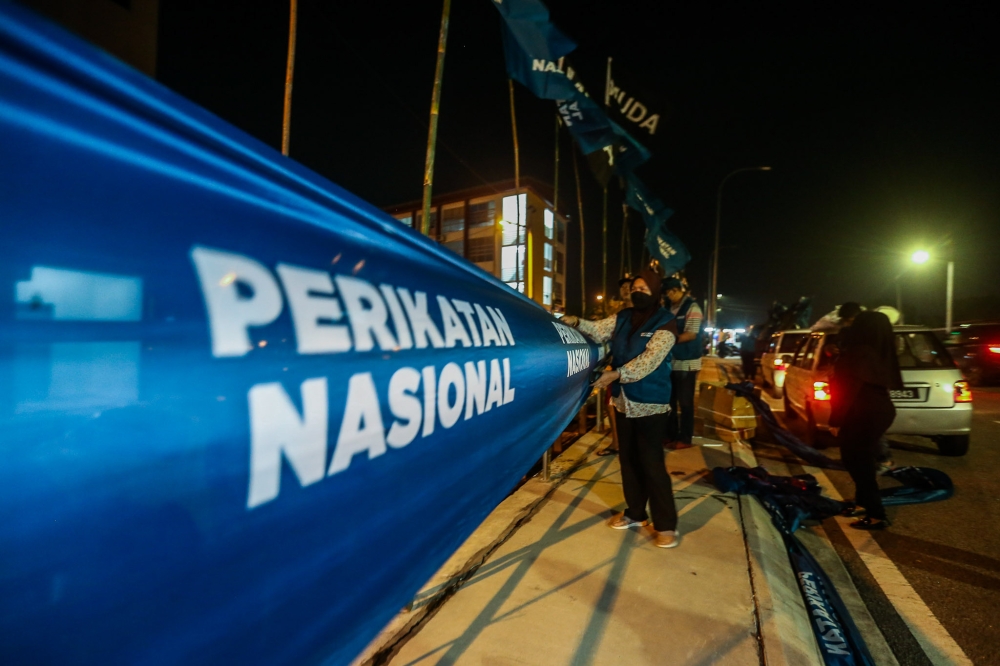
Political confidence cannot be manufactured through declarations alone.
Second, once Malay-Muslim voters begin doubting the possibility of dislodging Anwar, enthusiasm inevitably weakens. Supporters become reluctant to contribute resources, mobilise communities or invest their political future in an uncertain coalition.
The psychological momentum that once sustained the Blue Wave risks dissipating before the electoral contest begins.
Third, Deputy Prime Minister Ahmad Zahid Hamidi's reported withdrawal from the Mega Ummah rally in Kota Bharu illustrates this predicament.
As Umno president, Zahid understands that cooperation with PAS carries considerable political risks, especially while Umno remains part of the Unity Government.
His absence may therefore be interpreted as strategic caution rather than mere scheduling inconvenience.
Fourth, Zahid's stated priority of attending to Malacca ahead of its November 14 state election demonstrates where Umno's immediate interests lie.
Barisan Nasional (BN) may enter Malacca as the favourite, but victory cannot be presumed.
Umno's competing factions, commonly described as Teams A, B and C, have every reason to concentrate on securing their own electoral fortunes instead of gambling on an uncertain national realignment.
Fifth, Zahid's reported description of the Registrar of Societies' decision concerning PN as fair and non-politically motivated creates another contradiction.
If Umno accepts the deregistration as legitimate, how seriously can it simultaneously support efforts to restore PN as an alternative political vehicle?
Leaders associated with Zahid's camp, including Zambry Abdul Kadir, must recognise that Umno cannot indefinitely maintain contradictory political commitments.
BN and PH remain partners in the Unity Government. Their coexistence may continue until GE16, potentially in late 2027.
Sixth, PN's organisational uncertainty encourages Umno, PAS and Wawasan to explore alternative political arrangements.
Their leaders, supporters and sympathisers may increasingly consider cooperation with PH or political forces in Sabah and Sarawak.
Malaysian politics is becoming increasingly polytropous. Parties are spreading their options rather than committing themselves exclusively to one coalition.
The weakening of PN could accelerate this tendency.
Seventh, Sabah and Sarawak remain formidable obstacles to any exclusively Malay-Muslim electoral wave.
Sarawak's political establishment has little incentive to embrace a peninsula-centred alliance dominated by PAS, Umno and Wawasan.
Sabah's political parties similarly prioritise local autonomy, indigenous interests and state rights.
Even the possibility of a Sarawak election in December would reinforce these calculations.
A Blue Wave unable to penetrate East Malaysia cannot confidently claim that Putrajaya is within reach.
Eighth, Umno-PAS cooperation cannot succeed merely through repeated appeals to Malay-Muslim solidarity.
Hardline political elites may continue insisting that their parties can work together. Yet political declarations cannot replace organisational co
* Phar Kim Beng, PhD, is Professor of Asean Studies at the International Islamic University of Malaysia and Director of the Institute of International and Asean Studies (IINTAS).
** This is the personal opinion of the writer or publication and does not necessarily represent the views of Malay Mail.


