


OCTOBER 8 — Myanmar has reached a strategic impasse.
Neither the military authorities in Naypyidaw nor the numerous armed resistance movements opposing them have demonstrated the ability to produce a durable political settlement.
The country remains trapped in a prolonged conflict in which military advances have not necessarily translated into political legitimacy, while territorial resistance has not produced a coherent alternative national government.
For Asean, this situation demands a fundamental reassessment of its diplomatic approach.
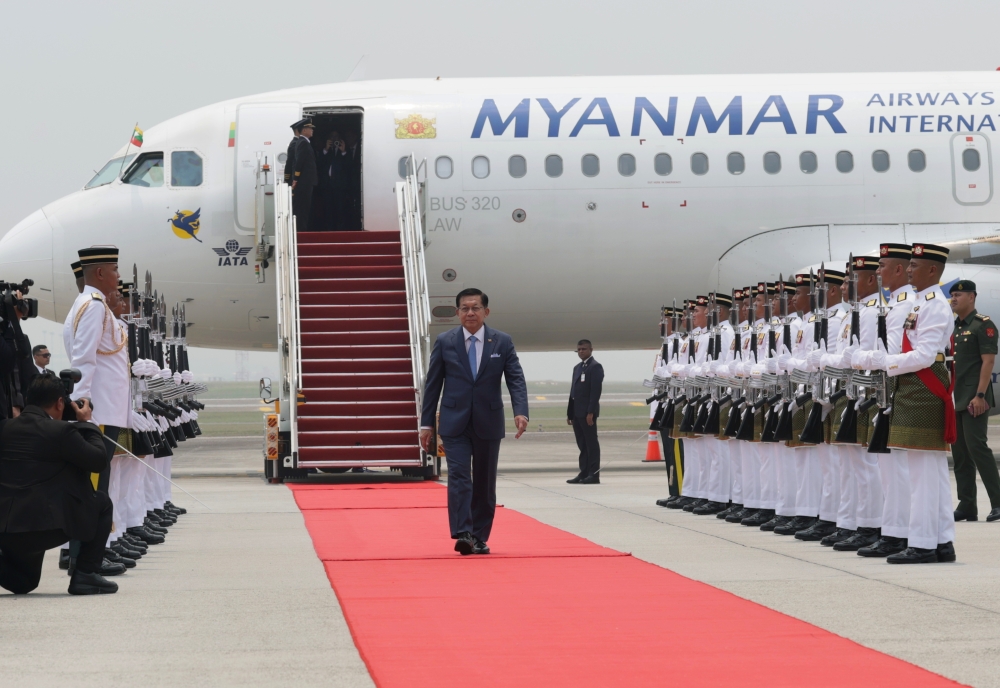
Firm engagement with General Min Aung Hlaing and the Tatmadaw, Myanmar's armed forces, is no longer merely one diplomatic option among many.
It has become a strategic necessity.
This does not mean endorsing military rule, overlooking human rights violations or abandoning the aspirations of Myanmar's people.
It means recognising that diplomacy must begin with the realities of power rather than with the political outcomes that external actors would ideally prefer.
The most important reality is that Myanmar's conflict has reached a series of military and political plateaus.
The Three Brotherhood Alliance, comprising the Arakan Army, Myanmar National Democratic Alliance Army and Ta'ang National Liberation Army, demonstrated remarkable operational effectiveness when it launched Operation 1027 in October 2023.
Its coordinated offensives exposed serious weaknesses in the Tatmadaw, particularly across northern Shan State.
The alliance captured important military positions, disrupted border trade and demonstrated that Myanmar's armed forces were far from invincible.
Yet battlefield successes do not automatically constitute a national political strategy.
The Three Brotherhood Alliance has encountered the limitations of its own military achievements.
Its constituent organisations have different territorial priorities, ethnic constituencies and relationships with neighbouring powers.
The Arakan Army's ambitions in Rakhine State are not identical to those of the MNDAA or TNLA in northern Shan State.
Indeed, the very diversity that made coordinated resistance militarily effective has also complicated the development of a unified political settlement.
The alliance's momentum has therefore encountered a plateau, although this should not be mistaken for the complete disappearance of its military capabilities.
A plateau is not necessarily a defeat.
It is a recognition that further advances may yield diminishing political returns.
The same difficulty confronts the wider resistance movement.
The National Unity Government has sought to establish an alternative source of political legitimacy.
People's Defence Forces and numerous ethnic armed organisations have challenged the Tatmadaw across substantial parts of the country.
Nevertheless, the opposition remains politically fragmented and militarily decentralised.
The ability to contest territory is different from the ability to govern an entire country.
Myanmar cannot indefinitely function as a patchwork of competing authorities, armed enclaves and disrupted economic corridors.
Nor can the Tatmadaw simply assume that military endurance will eventually restore the political order that existed before February 2021.
Its own limitations are substantial.
Prolonged conflict has weakened the economy, displaced millions, disrupted education and damaged the administrative capacity of the state.
Thus, Myanmar faces a paradox.
Almost every major actor possesses sufficient power to obstruct a settlement, but none has demonstrated the capacity to impose a universally accepted one.
This is precisely why diplomacy must become more realistic.
Engagement with the Tatmadaw is unavoidable because the institution continues to exercise coercive power, control important state structures and influence the conditions under which any nationwide ceasefire could emerge.
A political settlement that excludes it would remain exceedingly difficult to implement.
But engagement must be firm, conditional and accompanied by dialogue with the National Unity Government, ethnic armed organisations and civil society.
The objective cannot be to replace one form of exclusion with another.
It must be to create a political process in which the principal stakeholders have incentives to reduce violence and negotiate a sustainable arrangement.
Asean's Five-Point Consensus remains an important diplomatic reference.
Yet its implementation has been painfully limited.
The absence of meaningful progress should not become an excuse for diplomatic paralysis.
Asean must distinguish between maintaining principles and allowing those principles to harden into procedures that produce no tangible improvements.
This is where Thailand becomes particularly important.
Thailand understands Myanmar through a combination of geography, history, economic interdependence and longstanding security relationships.
The two countries share a lengthy border.
Developments inside Myanmar have immediate consequences for Thailand's border communities, trade routes, refugee management, energy security and domestic stability.
Bangkok cannot treat Myanmar as a distant diplomatic problem.
It is a neighbouring state whose instability can spill directly into Thailand.
Successive Thai governments have consequently maintained channels of communication with Myanmar's military establishment, even while participating in Asean's collective diplomatic framework.
This approach reflects practical necessity rather than unconditional political approval.
Thailand understands that a border cannot be managed through declarations alone.
It requires communication with those who exercise actual authority on the other side.
Malaysia and other Asean members should recognise the strategic value of this experience.
Thailand's familiarity with Myanmar should complement, rather than undermine, Asean's collective efforts.
A carefully coordinated Asean approach could combine Thailand's operational knowledge with Malaysia's diplomatic engagement, Indonesia's experience in inclusive consultations and the wider grouping's commitment to regional stability.
The purpose would be to develop incremental progress rather than demand an immediate comprehensive settlement that none of the parties currently appears capable of delivering.
Humanitarian access could be negotiated first.
Localised ceasefires could follow.
Cross-border trade and essential infrastructure could gradually be restored where conditions permit.
Political dialogue would then have a more credible foundation.
None of these measures requires Asean to abandon its insistence that violence must cease and that Myanmar's political future must ultimately be determined by its people.
Indeed, the protection of civilians must remain the central test of whether engagement is producing results.
There is also a broader geopolitical dimension.
Myanmar occupies a strategically important position between China, India, Thailand and the Bay of Bengal.
Its prolonged fragmentation creates opportunities for external powers to cultivate different armed and political actors, thereby deepening the country's dependence on outside intervention.
China has considerable interests in maintaining stability along its southwestern frontier and protecting economic corridors.
India has security concerns along its northeastern border.
Thailand has immediate humanitarian and commercial interests.
Asean cannot afford to surrender its diplomatic role to these overlapping bilateral calculations.
If Asean remains passive, Myanmar's future may increasingly be shaped by external powers and local armed actors operating without an effective regional framework.
This would weaken Asean centrality precisely when Southeast Asia needs greater strategic coherence.
The solution is neither diplomatic isolation nor premature normalisation.
It is structured engagement with clear benchmarks, including humanitarian access, reductions in attacks on civilians, verifiable ceasefire arrangements and an inclusive political process.
General Min Aung Hlaing must understand that engagement does not provide immunity from accountability.
Nor does it confer automatic legitimacy upon military authority.
But Asean must also understand that refusing meaningful communication with the Tatmadaw cannot, by itself, create peace.
Diplomacy is not an exercise in rewarding those whose actions are acceptable.
It is often the difficult task of negotiating with actors whose conduct has contributed to the crisis.
Myanmar's armed resistance has demonstrated that the Tatmadaw cannot easily impose a decisive military victory.
The Tatmadaw, in turn, has demonstrated sufficient institutional resilience to prevent its rapid disappearance.
The Three Brotherhood Alliance has encountered limits.
The wider opposition remains fragmented.
The military authorities have failed to restore national stability.
Asean's diplomatic mechanisms have struggled to produce breakthroughs.
These overlapping plateaus should not become permanent features of Myanmar's political landscape.
They should instead provide the strategic opening for a new diplomatic effort.
Firm engagement with General Min Aung Hlaing is therefore not a concession to authoritarianism.
Properly structured, it is an attempt to convert military stalemate into political negotiations.
Thailand's experience demonstrates why communication with the Tatmadaw remains indispensable.
Asean's collective legitimacy can ensure that such engagement serves a broader political and humanitarian purpose.
Myanmar does not need another cycle of diplomatic condemnation without implementation.
It needs a process capable of reducing violence, rebuilding confidence and gradually restoring the possibility of a functioning political order.
For Asean, the strategic necessity is clear: engage firmly, negotiate incrementally and insist that every diplomatic opening produces measurable progress towards peace.
* Phar Kim Beng is Professor of Asean Studies at International Islamic University Malaysia (IIUM) and Director at the Institute of International and Asean Studies (IINTAS).
** This is the personal opinion of the writer or publication and does not necessarily represent the views of Malay Mail.


