














SEPTEMBER 7 — On a shelf in my home sits a small plastic water pump that is now more than 50 years old. By today's standards, it is a very simple science kit. Yet it still works.
Every now and then, I pick it up, turn it over in my hands and find myself smiling. It reminds me not only of my school days, but also of an old bookshop in Kuala Lumpur where I first discovered it.
Curiously, I had never gone there looking for a water pump.
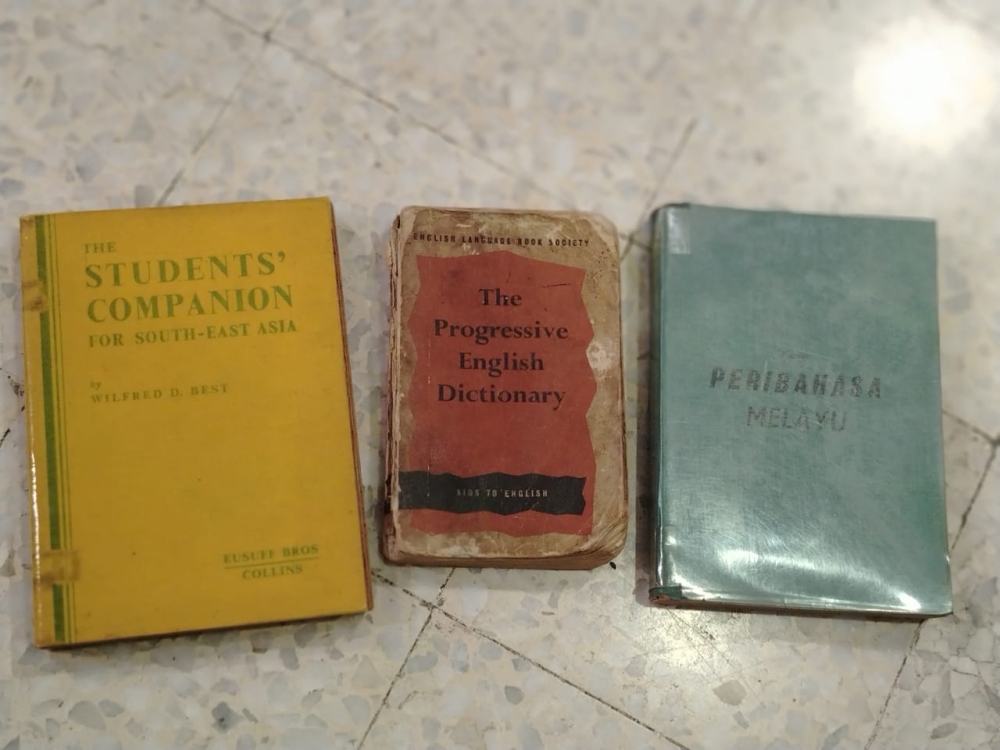
Like many students growing up in the 1960s and 1970s, I spent countless afternoons wandering through some of Kuala Lumpur's well-known bookshops.
There was Jubilee Bookstore along Batu Road, now Jalan Tuanku Abdul Rahman, Antonian Bookshop in Brickfields and Shanghai Bookstore along Jalan Sultan, not far from Methodist Boys' School where I studied.
Each possessed its own personality. Antonian was where many students bought textbooks and stationery, while Shanghai Bookstore fascinated me with its collection of science kits, educational toys and books that seemed to promise endless discoveries.
For many of us, these bookshops were never merely places to buy things. They became part of our education in ways we did not fully appreciate at the time.
We browsed shelves, met friends, compared comic books, examined new arrivals and occasionally spent hours there without buying anything at all.
The shopkeepers never seemed to mind. They understood that curiosity cannot be rushed.
Looking back now, I realise that those afternoons taught me something that extended far beyond books. They taught me the pleasure of wandering without knowing exactly what I hoped to find.
There is an important difference between searching and browsing. Searching begins with a destination already in mind. We know what we want, and our task is simply to find it as efficiently as possible.
Browsing, however, begins with curiosity. It allows us to follow an unexpected title, pick up a book by an unfamiliar author or become intrigued by a subject we had never previously considered.
We enter with one intention and leave with something entirely different.
That was precisely how I came across the little water-pump kit.
I had not gone into Shanghai Bookstore intending to learn about pumps or simple mechanical systems.
Yet there it was, sitting quietly on a shelf among other science kits.
I took it home, assembled it and spent hours experimenting with different valve configurations, fascinated by how such a simple device could move water in different ways.
Before long, I found myself wanting to understand not only how the pump worked, but why it worked.
Perhaps that small purchase did not determine the course of my life. But it certainly encouraged a habit of curiosity.
When I reflect on my years in research, I realise that scientific discovery often follows a remarkably similar path.
Researchers usually begin with a question, but the most interesting findings are not always the ones they originally expected.
A careful observation leads to another question. An unexpected result prompts a different experiment.
Sometimes what appears at first to be a mistake becomes the beginning of a completely new line of investigation. Curiosity has always possessed an extraordinary ability to take us somewhere we never intended to go.
The old bookshops quietly nurtured that same habit of mind.
A visit to buy a textbook might end with a book on astronomy, a biography of a scientist or a science kit that sparked an entirely new interest.
A comic magazine might lead to an interest in illustration or storytelling. None of these discoveries could have been predicted in advance because they depended on something increasingly uncommon today: allowing ourselves the freedom to wander.
Perhaps that is why I sometimes miss the culture surrounding those old bookshops more than the shops themselves.
Modern technology has undoubtedly made books more accessible than ever before.
Online searches are remarkably efficient, and recommendation algorithms have become increasingly sophisticated.
They are very good at suggesting books similar to those we have already enjoyed. Yet they also assume that we already know the direction in which our interests lie.
The old bookshops offered something rather different. They occasionally placed something entirely unexpected in our path.
As schoolboys, we often entered looking for one particular title and left talking excitedly about something we had never planned to discover. Those moments were not interruptions to learning. They were learning.
Perhaps this is why many of the books I still treasure today were not books I had originally intended to buy.
They found me while I was browsing, just as that little water pump quietly found me more than half a century ago. It still occupies a place on my shelf, no longer as a science kit, but as a reminder that curiosity often begins with the unexpected.
Looking back, I realise that those old bookshops were never simply selling books. They were creating spaces where curiosity could wander freely, where young minds could discover interests they did not yet know they possessed, and where an ordinary afternoon might quietly shape a lifetime.
In the end, that may have been the greatest gift they offered: they taught me the joy of not looking.
* Ng Kwan Hoong is an Emeritus Professor of Biomedical Imaging at the Faculty of Medicine, Universiti Malaya. A 2020 Merdeka Award recipient, he is a medical physicist by training but also enjoys writing, drawing, listening to classical music, and bridging the gap between older and younger generations. He may be reached at [email protected]
** This is the personal opinion of the writer or publication and does not necessarily represent the views of Malay Mail.


