














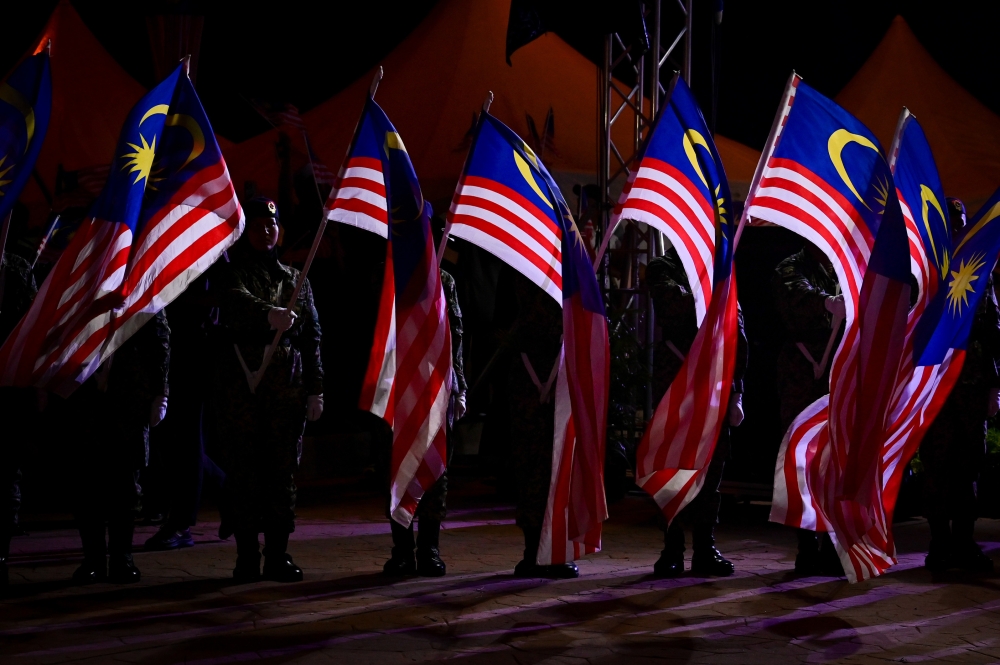
AUGUST 31 — As familiar patriotic songs return to our airwaves and Jalur Gemilang unfurls across our towns and cities, we know Merdeka is approaching. It is certainly a moment worth celebrating. But beyond flags, songs and ceremonies, it is also a moment to reflect. After all, Merdeka is not just about remembering the day we achieved independence. It is also about asking whether, after all these years, we have succeeded in building a Malaysia where every citizen feels that he or she truly belongs.
This question is especially important today.
Our public discourse has become increasingly divisive. More often than not, politics is framed through the narrow lenses of race and religion. The situation has worsened in recent years. At times, even our enthusiasm to demonstrate patriotism can have unintended consequences, particularly when punitive enforcement takes precedence over understanding and education.
If our country is to move forward with confidence, we need a more mature understanding of nationhood — one that moves beyond identity politics, fear and coercion.
I. Leadership is a sacred trust (Amanah)
The bedrock of every successful nation is a simple principle: political power exists to serve the people.
In our own tradition, leadership is an Amanah — a trust. Power and positions are not privileges to be enjoyed, nor weapons to be used against political opponents or communities that think differently. This rule applies to political leaders across all parties.
If irresponsible leaders rely on race and religion to mobilise support, society will gradually become divided into competing groups. Every sector of society thinks others are taking more than their fair share. This is a dangerous path for a multiracial and multi-religious country like Malaysia.
Good governance is the strongest safeguard against such an undesirable outcome.
Good governance requires institutions that are strong, professional and impartial. The law must apply equally. Public services must be delivered fairly. A Malaysian should not have to wonder whether his race, religion, political affiliation or social background will determine how he is treated by the state.
This point was powerfully made by His Royal Highness the Sultan of Perak, Sultan Nazrin Muizzuddin Shah, at the 8th World Conference on Islamic Thought and Civilisation. Addressing the conference themed “Everyone Matters: Pride and Unity in Islam,” His Royal Highness reminded us that good governance is not a luxury for prosperous times, but a precondition for prosperity itself. The Royal Address underscored that the principle of “everyone matters” must begin in the halls of government. A civil service acting in the interests of every citizen without regard to background embodies state unity in its most concrete form, and that leaders who govern with humility do far more to secure the loyalty and pride of their people than any slogan ever could.
II. Proportionality and grace
Patriotism is a deep, emotional affinity cultivated in the heart. It cannot be coerced through punishment or fear.
Of course, our national symbols deserve respect. The Jalur Gemilang is more than just a flag. It represents our history, our struggles and our hopes for the future. However, while preserving respect for and the sanctity of the national flag, we must guard against overzealous enforcement that punishes both deliberate disrespect and genuine mistakes.
When every error involving the national flag is immediately treated as a serious offence deserving public outrage, arrest or disproportionate punishment, we risk eroding the spirit of patriotism among our citizens. If displaying the national flag could invite severe repercussions, the only sound thing to do is not to put it up.
A confident and mature nation should know how to respond proportionately. If an honest mistake is made, education and guidance should come before punishment. This does not mean deliberate insults or acts of provocation should be ignored. How to differentiate? Intent matters, context matters, proportionality matters.
The role of government agencies should not simply be to arrest and punish citizens. Their responsibility is also to educate and guide. As members of society, we should not overreact or express outrage over genuine mistakes; we should instead show empathy and forgiveness. Our country has no place for those who constantly try to incite hatred and divide us over every single aspect of our life.
If we want Malaysians to respect our national symbols, we should assist them by creating a sense of pride and emotional connection. High-handed enforcement will not nurture patriotism.
Instead, it generates anxiety, resentment and fear. It risks turning a symbol of national affection into an object of apprehension.
III. Everyone matters
At the 8th World Conference on Islamic Thought and Civilisation, His Royal Highness Sultan Nazrin Muizzuddin Shah made a profound observation, “Unity built on coercion is brittle. Unity built on shared belonging is resilient.”
His Royal Highness further elaborated that “true national integrity rests on every citizen, regardless of ethnicity or faith, feeling that they have an equal stake in their nation’s future.”
That is the true meaning of the principle that “everyone matters.” And this is the vision of Malaysia we should strive for.
It must not remain merely a slogan. It must shape the way we govern, the policies we design and the way we speak to one another.
Everyone in the community must feel that they have a genuine stake in Malaysia’s success and be able to see itself fairly reflected in our laws, our economy, our schools and our national institutions.
Real unity is built on shared belonging. A nation can force people into silence, but it cannot force them to feel that they belong.
Unity does not require us to erase our differences. Our diversity does not weaken our national fabric. Our different cultures, faiths, languages and traditions can instead become threads that make that fabric richer and stronger.
The Malaysia we must continue to build
As we celebrate another Merdeka, perhaps the most important question is not how loudly we proclaim our love for the country.
The more pertinent question is: what kind of Malaysia are we creating for the next generation?
We should reject the temptation to divide Malaysians for parochial political ends. We should resist the instinct to use the machinery of the state in an excessive or heavy-handed manner.
And those entrusted with positions must always remember that leadership is an amanah to be exercised with humility, wisdom and responsibility.
Malaysia will not become stronger because we punish more severely or shout more loudly. It will become stronger when our institutions earn the trust of the people; when the law is applied fairly; when state power is exercised with restraint; and when every Malaysian feels that this country belongs to them.
That, perhaps, is the deeper meaning of Merdeka.
Independence gave us the right to determine our own future. The challenge now is to ensure that the future we build is one in which every Malaysian—regardless of race, religion, background or political belief — can look at the Jalur Gemilang and say with genuine pride:
This is my country too!
* Chang Lih Kang is Minister of Science, Technology and Innovation and MP for Tanjong Malim.
** This is the personal opinion of the writers or publication and does not necessarily represent the views of Malay Mail.