


AUGUST 24 — At a time when public attention is often drawn towards economic development, political contests and technological advancement, examples of leadership grounded in scholarship and civilisational consciousness have become increasingly rare. Yet over the past few years, a remarkable intellectual journey undertaken by Tengku Ampuan Pahang, Tunku Azizah Aminah Maimunah Iskandariah Sultan Iskandar Al-Haj, has quietly demonstrated the enduring relationship between knowledge, leadership and cultural heritage.
From the perspective of a Universiti Malaya academic concerned with Islamic legal thought and Malay intellectual history, this journey offers an important reflection on the relationship between scholarship, leadership and heritage.
This journey has unfolded in close association with the International Institute of Islamic Thought and Civilisation (Istac-IIUM), one of Malaysia’s most distinguished centres of learning dedicated to the study of Islamic thought, Malay civilisation and the philosophy of knowledge. More than a series of ceremonial visits, the relationship between Tengku Ampuan Pahang and Istac-IIUM reflects a deeper commitment to the preservation and revitalisation of the intellectual traditions that have shaped the Malay-Muslim world for centuries.
A royal visit with intellectual significance
The relationship became publicly visible in 2023 when Tengku Ampuan Pahang visited Istac-IIUM. While visits by members of royalty to academic institutions are not uncommon, this occasion stood apart because of the depth of engagement demonstrated throughout the visit.
Observers noted Her Royal Highness’s genuine interest in the institute’s intellectual mission, architectural heritage and scholarly environment. Rather than treating the institution as merely another educational establishment, she approached it as a repository of civilisation — a place where history, philosophy, religion and culture are studied not as relics of the past but as living traditions with relevance to contemporary society.
Particularly striking was her appreciation of the institute’s renowned library. In an age dominated by digital information and rapid communication, the library remains a symbol of contemplation, intellectual discipline and the pursuit of wisdom. Her Royal Highness recognised its significance not merely as a collection of books but as a space where future leaders can cultivate depth of thought and moral discernment.
Knowledge as a foundation of leadership
Perhaps one of the most meaningful moments associated with the visit was Tengku Ampuan Pahang’s expressed desire that Tengku Hassanal Ibrahim Alam Shah, the Crown Prince of Pahang, be introduced to the intellectual environment of Istac-IIUM. This gesture carried symbolism that extends far beyond a simple campus visit.
Historically, the most respected rulers in Islamic civilisation were not only administrators and statesmen; they were also patrons of knowledge who understood the importance of intellectual cultivation. From the Abbasid caliphs in Baghdad to the Ottoman sultans and the Malay rulers of Melaka, scholarship was regarded as an essential component of leadership.
By encouraging the Crown Prince’s engagement with an institution devoted to intellectual and civilisational studies, Tengku Ampuan Pahang reaffirmed this classical understanding of leadership. The message was clear: authority and responsibility must be accompanied by knowledge, reflection and an appreciation of cultural heritage. Leadership, in this view, is not simply inherited through lineage or attained through position. It must also be nurtured through intellectual formation.
From visitor to scholar
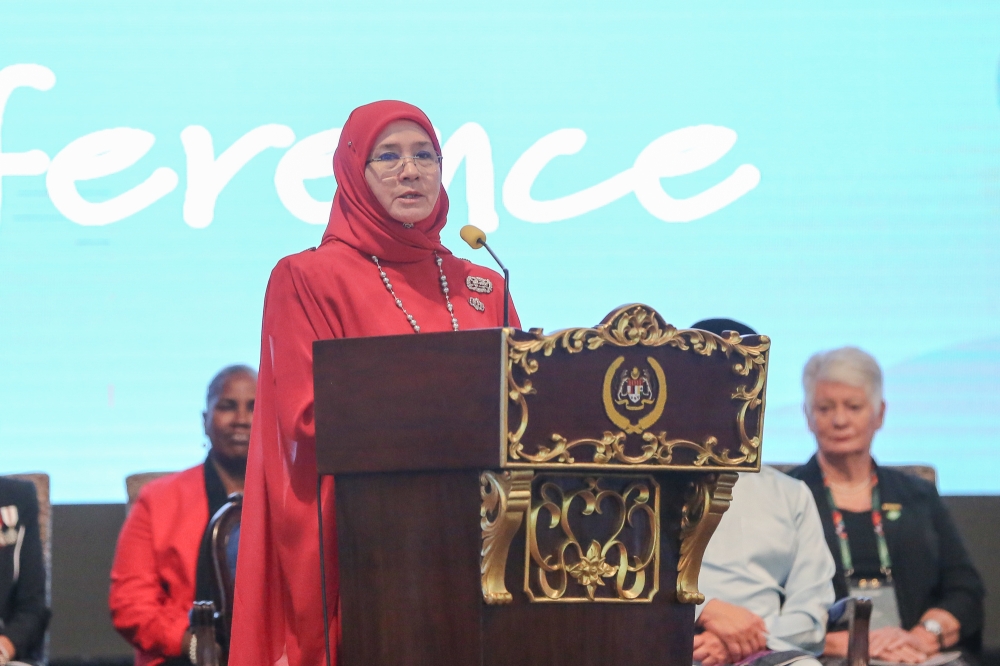
Her Royal Highness’s academic engagement with Istac-IIUM is particularly significant given her role as the Constitutional Head of the International Islamic University Malaysia (IIUM). While the position carries important ceremonial and institutional responsibilities, her decision to participate directly in scholarly life demonstrates a commitment that extends beyond formal leadership. Rather than remaining a patron of higher education from a distance, she has chosen to engage with the intellectual tradition of the university from within, embodying the classical Islamic ideal that leadership and learning should remain inseparable.
This development attracted attention not merely because a member of royalty had joined an academic programme, but because it embodied the ideal of lifelong learning. In many societies, education is often viewed as something completed during youth. Yet the classical Islamic tradition regarded the pursuit of knowledge as a lifelong obligation.
The Prophet Muhammad S.A.W. famously encouraged the seeking of knowledge from the cradle to the grave. Great scholars throughout Islamic history continued their studies well into old age, recognising that intellectual growth is a continuous journey rather than a finite achievement.
In this context, Tengku Ampuan Pahang’s decision to undertake advanced academic study represents an important public example. It communicates that learning remains valuable regardless of age, rank or social status. More significantly, it demonstrates intellectual humility — the recognition that there is always more to learn.
Such humility is often cited by historians and philosophers as one of the defining characteristics of exemplary leadership.
Rediscovering Hukum Kanun Pahang
Central to Her Royal Highness’s current academic engagement is her research on Hukum Kanun Pahang, one of the important legal and constitutional texts in the history of the Malay world. As the research remains at the stage prior to viva voce, it should be understood as an ongoing scholarly inquiry rather than a completed academic work. Her current research, tentatively titled The Hukum Kanun Pahang: A Sovereign Malay-Islamic Constitution, explores the significance of this classical text within broader discussions of sovereignty, law, ethics and Islamic civilisation.
For many years, discussions of constitutionalism, governance and legal theory in South-east Asia have frequently been framed through colonial or modern Western paradigms. While such perspectives remain important, renewed attention to indigenous legal traditions reveals a richer historical landscape than is often acknowledged.
Hukum Kanun Pahang stands as evidence that sophisticated legal thought existed within the Malay world long before the emergence of modern nation-states. It reflects an intellectual tradition that integrated Islamic jurisprudence, local customs, royal authority and ethical governance into a coherent legal framework.
Through her ongoing research on Hukum Kanun Pahang, Her Royal Highness has helped stimulate renewed interest in an important component of Malay-Islamic legal and intellectual heritage. Her research engagement with Hukum Kanun Pahang reflects a growing scholarly effort to re-examine the legal and constitutional traditions of the Malay world.
Reclaiming a civilisational heritage
The significance of Tengku Ampuan Pahang’s work extends beyond academic research. Across the Muslim world, there has been growing interest in recovering neglected intellectual traditions and reassessing historical contributions that were overshadowed during periods of colonialism and modernisation. Scholars increasingly argue that meaningful civilisational renewal requires more than economic development or technological advancement; it requires reconnecting with the intellectual foundations that shaped a society’s identity.
Within the Malay context, texts such as Hukum Kanun Pahang represent important components of this heritage. They reveal that the Malay world possessed its own traditions of governance, jurisprudence and constitutional thought rooted in both Islamic principles and local realities.
By bringing renewed scholarly attention to these traditions, Tengku Ampuan Pahang’s research contributes to a broader conversation about cultural memory, intellectual continuity and national identity.
Scholarship, memory and continuity
As Constitutional Head of IIUM, Tengku Ampuan Pahang’s presence at the 41st IIUM Convocation Ceremony in 2025 formed part of her official role. Yet the occasion also reflected a wider truth about the university: that knowledge is sustained not only through teaching and research, but also through memory, recognition and continuity.
In that formal academic setting, the earlier encounters at Istac-IIUM found a quiet sense of completion. The visit to the library, the encouragement of intellectual formation, and Her Royal Highness’s own engagement as a learner all pointed to the same principle: leadership gains depth when it remains close to knowledge.
Such moments need not be overstated. Their value lies in reminding us that universities are custodians of more than qualifications. They preserve memory, cultivate wisdom and transmit values across generations.
A model for the future
The relationship between Tengku Ampuan Pahang and Istac-IIUM offers a compelling example of how leadership and scholarship can reinforce one another. It demonstrates that the preservation of civilisational heritage is not solely the responsibility of academics, nor is leadership merely a matter of administration and public service. Rather, both are united by a shared commitment to knowledge, reflection and the pursuit of the common good.
At a time when societies around the world are searching for models of responsible leadership, Tengku Ampuan Pahang’s engagement with scholarship and her ongoing research on Hukum Kanun Pahang offer an important reflection. They remind us that the strength of a civilisation lies not merely in economic power or political influence, but in the depth of its intellectual traditions, the integrity of its leaders and the wisdom it is able to transmit from one generation to the next.
* The author is a Lecturer at the Department of Shariah Economics and Governance, Academy of Islamic Studies, Universiti Malaya.
** This is the personal opinion of the writer or publication and does not necessarily represent the views of Malay Mail.


