


AUGUST 18 — I teach politics, and I have never believed that politics can be understood without history. Institutions, identities and the way we see ourselves as a country all come from somewhere. That is why I get angry when I see how easily we treat heritage as something disposable.
We talk so much about nation-building, belonging and identity, but we are still lousy at protecting the physical traces of the histories that made Malaysia what it is. Old buildings, archaeological sites, prisons, temples, caves, cemeteries and neighbourhoods are not just old things standing in the way of something new. They carry memory. They tell us who was here, how people lived and what this country has gone through. Once they are gone, they are gone. A plaque, a photo exhibition or a nice coffee-table book afterwards does not bring them back.
The controversy surrounding the century-old Sakyamuni Caves Monastery at Gunung Kanthan in Perak is not simply about one religious site. Rather, it is about the way we repeatedly reduce heritage to a dispute over land ownership, quarrying rights, development plans and economic value, as though history itself is somehow less significant because it cannot be calculated in ringgit per square foot.
The monastery has existed there for generations, while the limestone hill itself carries geological and ecological significance that predates the Malaysian state by an unimaginable span of time. It is a place where religious practice, community memory, biodiversity and local history meet. Yet here we are again, debating how much of it can be sacrificed in the name of development.
What is maddening is that Malaysia has been here before, many times, and apparently learned very little.
Pudu Jail should have been one of those moments that forced us to rethink what heritage means. Built in the 1890s, it stood for more than a century in the heart of Kuala Lumpur and carried with it the history of colonial rule, punishment, crime, urban transformation and the development of the modern state. It was not a beautiful heritage site in the conventional sense, and that made it even more important. A country must preserve the places that make it uncomfortable, because those places tell us something about power, exclusion, violence and how institutions were built. Instead, much of Pudu Jail was demolished in 2010, with redevelopment presented as the future of the site.
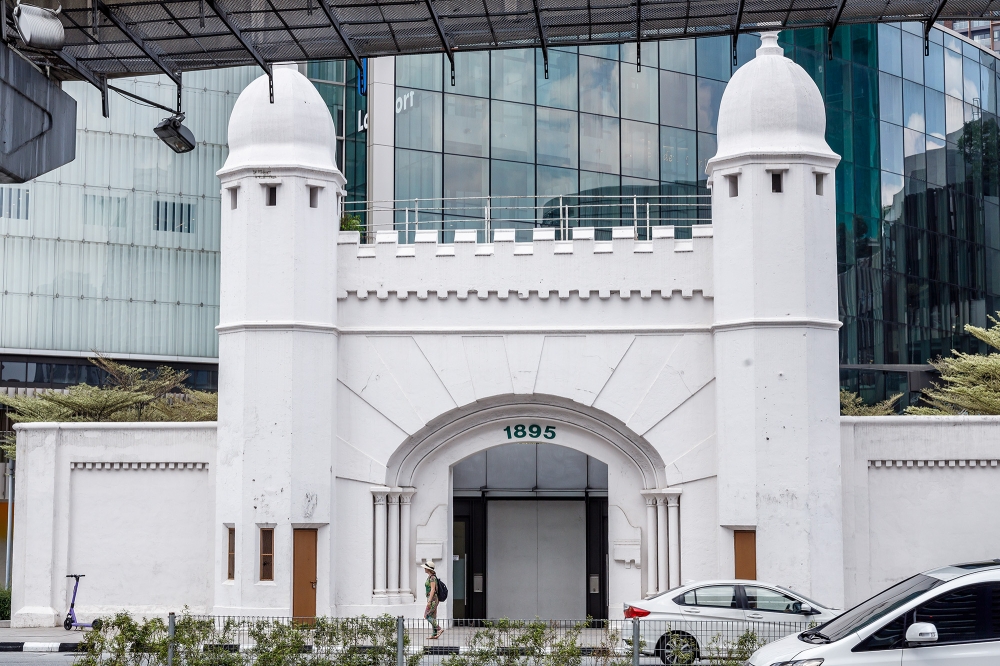
Then, as we so often do, we retained fragments and told ourselves that memory had been preserved. A wall here, a gate there, that’s simply nonsense. A wall separated from the world that gave it meaning is not the same thing as preserving a place.
Bok House on Jalan Ampang disappeared in 2006 despite efforts to save it. The Wong Ah Fook mansion in Johor Bahru was demolished in 2014, taking with it another tangible link to the history of one of the city’s most significant early figures. In Lembah Bujang, the destruction of Candi No. 11 in 2013 should have embarrassed us nationally.
We remain far too comfortable treating preservation as something that must defend itself against development, rather than something that should be built into development from the beginning. A site is often expected to prove that it is sufficiently historic, sufficiently unique or sufficiently valuable only after plans have advanced and economic interests are already in the process. Communities then have to protest, historians scramble to explain why the place matters, activists raise the alarm, and only when the excavators are already there does everyone suddenly pay attention.
Why does heritage always have to defend its right to exist, while development is treated as the default?
As someone who teaches politics, I find this particularly troubling because memory is political. What a state chooses to preserve tells us whose histories it values and what kind of national story it wishes to leave behind. Malaysia’s history is not contained only in national monuments, official ceremonies and textbook narratives. It is embedded in mining towns, kampung settlements, prisons, plantations, places of worship, archaeological remains, old neighbourhoods and landscapes shaped by generations of ordinary people. Malay, indigenous, Chinese, Indian, Islamic, Hindu, Buddhist, colonial and labour histories overlap here. They are not competing histories. Together they are Malaysia.
Of course development matters. Malaysia needs jobs, infrastructure, housing and economic activity. I reject the assumption that protecting heritage somehow means standing in the way of progress. It has become just a convenient excuse.
Cities around the world have adapted historic buildings, incorporated old structures into new developments, created conservation zones and found ways to grow without systematically erasing themselves. If the only model of development we can imagine is demolition followed by construction, then the problem is not heritage. The problem is that we seem unable to imagine development without destroying what is already there.
Gunung Kanthan makes the issue even more serious because some destruction cannot be disguised as redevelopment and later repaired. Limestone formations created over millions of years do not grow back. Rare ecosystems do not reappear because we suddenly discover their value after quarrying is completed. A century of spiritual life connected to a particular cave cannot simply be moved somewhere else. Places accumulate memory through time. Their meaning comes partly from being where they are.
And this is where anger is justified. How many times must Malaysia lose something before we stop pretending every loss was unavoidable? How many sites must disappear before heritage protection becomes preventive rather than ceremonial? How often must citizens fight at the very last minute to save something that should have been identified and protected years earlier?
I teach politics because politics shapes the future, but history reminds us that we did not begin the story ourselves. If we continue demolishing the evidence of what came before us, future generations may know that Malaysia developed, but they will increasingly have to rely on photographs to understand what was sacrificed along the way.
We cannot keep destroying the past and hiding behind the language of progress. There comes a point when what we are doing is not development at all, but destruction we have chosen to justify.
* Khoo Ying Hooi, PhD is associate professor at Universiti Malaya.
** This is the personal opinion of the writer or publication and does not necessarily represent the views of Malay Mail.


