


AUGUST 17 — The supposed wave of Malay-Muslim unity created by the combination of Barisan Nasional and Perikatan Nasional deserves considerably more scrutiny than it has received.
What looks like a wave may actually be something considerably more tactical: an electoral power play designed to overwhelm Pakatan Harapan by concentrating votes against it under Malaysia’s first-past-the-post electoral system.
This distinction matters.
Even the hype is somewhat of a sensationalism to put Pakatan Harapan on the back foot. With defeats in Sabah, Johor and Negeri Sembilan, there seems to be a “wave”.
Only that partisans who see a “wave” do not understand that this is not necessarily the truest form of Malay-Muslim unity, which is not under-sieged or in crisis anyway.
Every right and privilege of the Malay and Muslims remain enshrined and protected by the Constitution and customs. Why?
A genuine political wave normally represents a substantial and reasonably durable movement of voters towards a political idea, party or coalition.
Take into consideration the first, second and third wave of “Democratisation” from 1974 onwards, which is of course receding due to the tilt to right wing politics driven by fake news.
A tactical electoral arrangement in Malaysia, in Peninsula alone to boot, is different.
BN and PN can produce spectacular numbers without necessarily demonstrating an equally spectacular transformation of public opinion towards a fairer system of representation even economic growth or more constitutional rigor to protect the rights of the minority. In any democracy, the majority shall not exercise tyranny over the minority. A test that BN-PN experimental collaboration can’t even fulfil.
Numerically, Negeri Sembilan offers an important example.
The informal BN-PN arrangement produced 25 seats in a 36-seat legislature. That is an impressive state assembly number.
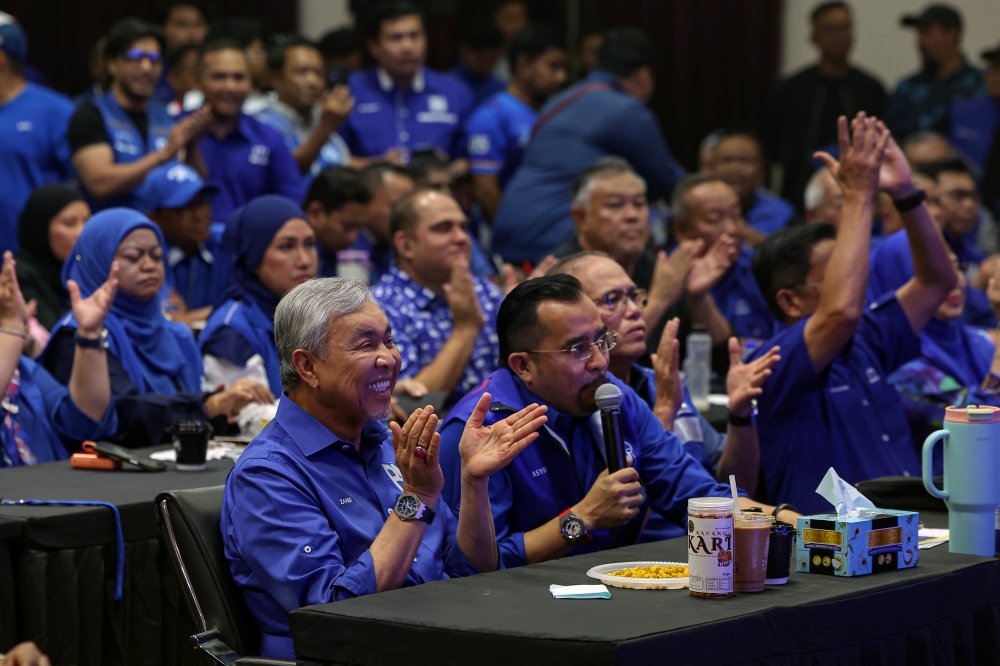
Yet the size of the majority itself cannot tell us whether Malay voters have permanently realigned themselves behind some new doctrine of Malay-Muslim unity.
With RM9 billion in reserves in the coffer of the government of Negeri Sembilan, assiduously saved by the previous administration of Amiruddin the Chief Minister from Pakatan Harapan, this money is now available to BN and PN to do whatever they like.
Invariably, seats are not votes. More importantly, seats are certainly not a set of strong ideals. It is a clarion call to unite to allow Malay majority to ride rough shod over all else. Nothing substantive.
After all, Malaysia uses a first-past-the-post electoral system. Under such a system, preventing two parties appealing to overlapping constituencies from competing against each other can dramatically change the distribution of seats even without an equivalent transformation in the underlying electorate.
This is the political logic behind the apparent wave.
If BN and PN fight each other while PH contests the same constituency, their votes can fragment. PH may consequently win with a plurality.
If BN and PN instead coordinate their candidates, however, the combined anti-PH electorate can suddenly be concentrated behind one candidate.
The resulting victory may look enormous.
But the wave has partly been manufactured by changing the denominator of political competition. Malaysian Chinese who joined DAP and gained some mileage is not the scape goat of all things seemingly wrong with BN especially PN.
This is precisely why developments in Melaka are so revealing.
BN chairman Ahmad Zahid Hamidi has not committed BN exclusively to PN.
He has authorised Melaka BN chairman Ab Rauf Yusoh to negotiate with any coalition. Meanwhile, PN and PAS have themselves been discussing electoral arrangements with BN.
If Malay-Muslim unity were truly the overriding ideological principle governing these parties, there should be considerably less uncertainty over who contests where.
Instead, the negotiations revolve around seats.
Who gets which constituency? Who possesses the stronger machinery? Who should surrender a seat? Which party gains most from avoiding three-cornered contests?
These are perfectly legitimate questions in democratic coalition politics. But they are questions about political power rather than civilisational unity.
Indeed, the tension became sufficiently obvious that the supposed Malay-unity rhetoric surrounding BN-PN cooperation was publicly questioned once negotiations moved to Melaka.
The lesson is important.
The so-called Blue Wave should not be dismissed. PH would be committing a serious strategic error if it did so. But neither should PH become psychologically paralysed by treating every BN-PN victory as evidence of an unstoppable sociological transformation of Malay Malaysia.
The wave is potentially much more vulnerable than that.
BN and PN are trying to solve an electoral coordination problem. Both understand that fighting each other can allow PH to come through the middle. Cooperation offers them an obvious solution: suppress internal competition temporarily and direct their combined electoral strength against PH.
It amounts to a swift political counterattack.
But the very success of this formula creates its next contradiction.
BN and PN ultimately want many of the same seats.
Umno and PAS especially depend heavily upon Malay-majority constituencies. Every seat surrendered by Umno to PAS potentially strengthens PAS institutionally. Every constituency surrendered by PAS to Umno potentially prevents PAS from expanding its own territorial reach.
Thus, electoral cooperation simultaneously creates political competition.
This is why the Melaka negotiations matter far beyond Melaka.
They are testing whether the impressive numbers produced in Negeri Sembilan can be converted into a durable political architecture.
There is no guarantee that they can.
Even analysts examining the BN-PN relationship have cautioned that its real durability will be tested when cooperation reaches territories where the parties’ interests collide more directly. A spectacular electoral result therefore should not be confused with permanent political compatibility.
Nor should Pakatan Harapan concede the psychological battlefield by accepting the language of an unstoppable wave.
PH faces serious problems. It must rebuild Malay confidence, address bread-and-butter concerns, strengthen its machinery and demonstrate much greater administrative competence. It cannot explain away electoral defeats merely by pointing towards tactical cooperation between its opponents.
But neither should it misunderstand what confronts it.
PH may not be fighting an irresistible ideological wave.
It may be confronting a highly effective electoral counter-manoeuvre.
That requires a different response.
The objective should be to force BN and PN to confront the contradictions concealed by their temporary cooperation. The more seat negotiations move from abstract appeals for Malay-Muslim unity towards the concrete allocation of constituencies, the clearer these contradictions become.
Melaka may already be demonstrating precisely this.
Zahid’s willingness to keep BN’s negotiating options open is strategically significant. It suggests that BN understands the danger of allowing tactical cooperation with PN to harden into permanent dependence upon PN.
Prime Minister Anwar Ibrahim, meanwhile, has publicly reaffirmed his preference for maintaining cooperation with BN at the federal level in the interests of political stability.
Malaysia therefore has two political processes occurring simultaneously.
At the state level, BN can experiment with cooperation with PN to maximise electoral returns. At the federal level, BN remains an essential component of the government headed by Anwar and PH.
That is hardly evidence of a settled political realignment.
It is evidence of manoeuvre.
The great danger for PH is therefore not merely a Blue Wave. It is allowing the appearance of such a wave to become a self-fulfilling prophecy.
Numbers can intimidate. Large state assembly majorities can create momentum. Momentum can influence donors, party workers, candidates and eventually voters themselves.
But numbers must still be interpreted correctly.
The BN-PN combination has demonstrated that tactical coordination can be electorally devastating to PH.
It has not yet demonstrated that BN and PN have resolved their internal contradictions, much less created a permanent Malay-Muslim political bloc.
The wave may therefore be better understood as a power play: a rapid concentration of electoral forces intended to upend Pakatan Harapan before PH can recover its footing.
And power plays have one characteristic that genuine political waves do not necessarily possess.
They depend upon the players continuing to believe that cooperation serves their individual interests.
The moment BN and PN conclude otherwise, the apparent wave can begin breaking against itself.
* Phar Kim Beng is a professor of Asean Studies and a director at the Institute of International and Asean Studies, International Islamic University Malaysia.
** This is the personal opinion of the writer or publication and does not necessarily represent the views of Malay Mail.


