


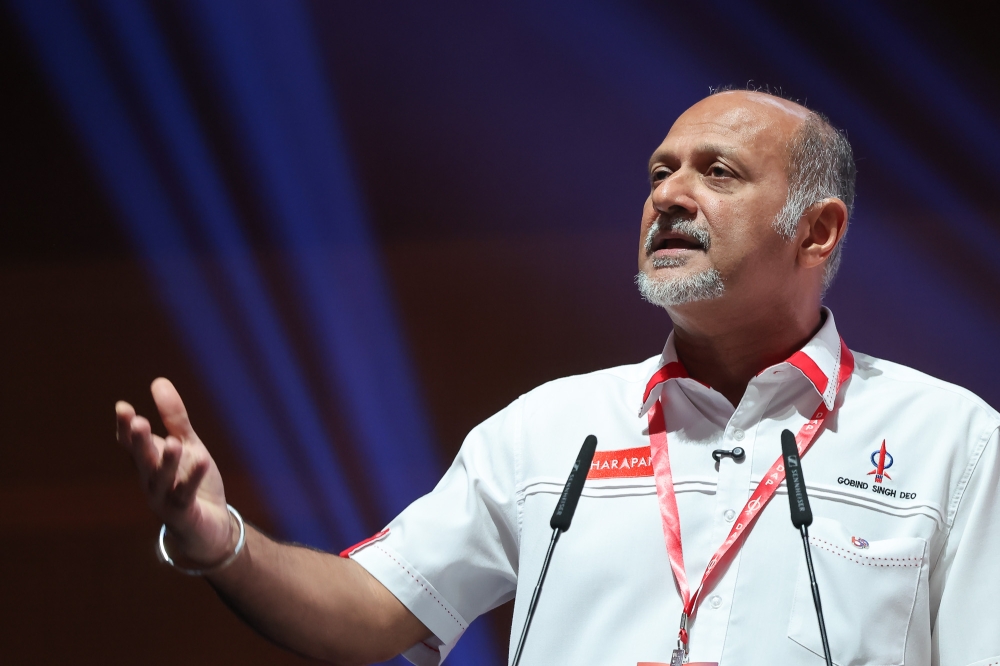
AUG 17 — DAP chairman Gobind Singh Deo has called for several important institutional reforms to be expedited, including amendments to the Security Offences (Special Measures) Act 2012 (Sosma) and the Peaceful Assembly Act by the end of 2026.
There is nothing inherently objectionable about these reforms.
Indeed, many have been central to the reform agenda of Pakatan Harapan for years.
The objectives are legitimate. The strategic method, however, deserves much greater care.
DAP has decided overwhelmingly to remain in the Unity Government for the remainder of the parliamentary term. Having made that decision, the party must recognise its strategic implications.
It has chosen to pursue reform from within a complicated coalition rather than exercise pressure from outside it.
This makes the language of deadlines particularly problematic.
There is a fundamental difference between establishing reform targets internally and appearing publicly to impose deadlines on Prime Minister Anwar Ibrahim and the Unity Government. The former is coalition management.
The latter can easily be portrayed as an ultimatum.
That distinction is especially significant in the present political climate.
DAP is already being singled out for incessant attacks. Its opponents repeatedly portray it as the hidden hand behind the government, a party allegedly capable of dictating policies to Anwar and threatening Malay-Muslim political interests.
Much of this narrative is exaggerated, if not outright fictitious.
DAP does not possess anything approaching unilateral control of the Federal Government.
The architecture of the Unity Government itself makes such domination virtually impossible.
More importantly, Anwar himself does not possess sufficient parliamentary votes to make sweeping legislative or constitutional changes merely because he wishes to do so.
This is the elementary arithmetic of coalition government that is too frequently forgotten.
Pakatan Harapan cannot govern as though it commands Parliament by itself. DAP cannot legislate by itself. PKR cannot legislate by itself.
Even the prime minister cannot transform major reforms into law simply through political determination.
Anwar requires the continued support of the MPs who constitute the Unity Government, crucially including those from Barisan Nasional.
For ordinary legislation, the government must maintain a working parliamentary majority. For constitutional amendments requiring a two-thirds majority, the numerical hurdle is substantially higher.
Any sweeping reform programme consequently depends not merely upon what DAP wants or what Anwar prefers, but upon whether sufficient MPs across the political spectrum can be persuaded to support it.
BN’s participation is therefore indispensable.
This is precisely why DAP should be particularly cautious about issuing deadlines.
If DAP publicly demands that reforms be completed by a particular date, the political burden appears to fall upon Anwar.
Yet Anwar may have to negotiate intensively with BN and other components of the Unity Government before those reforms acquire the parliamentary numbers necessary to proceed.
Placing Anwar against an artificial deadline does not strengthen his negotiating position.
It may actually weaken it.
BN MPs cannot simply be treated as parliamentary numbers that will automatically fall into line with every reform proposed by Pakatan Harapan.
BN has its own history, constituencies, internal dynamics and political interests.
The same consideration applies to the parties from Sabah and Sarawak.
The Unity Government survives because these different political forces have agreed to govern together. It does not follow that they have suddenly developed identical positions on security legislation, institutional reform or constitutional change.
There is also a larger strategic consideration that Gobind and DAP should confront.
If these reforms are genuinely intended to strengthen Malaysian democracy rather than merely fulfil Pakatan Harapan’s electoral commitments, their ownership should not stop at the boundaries of the Unity Government.
Perikatan Nasional should be challenged to embrace them too.
Indeed, PN politicians are openly seeking to become the next government.
Their aspiration to capture Putrajaya makes their position on institutional reform highly consequential.
A democratic reform acquires greater durability when political forces that may alternate in government agree upon the basic rules of the system.
If Sosma requires amendment because some of its provisions are regarded as excessive, that principle should not suddenly become valid only when PH is governing Malaysia.
If the Peaceful Assembly Act requires improvement because Malaysians deserve stronger protections for peaceful political participation, those protections should apply regardless of whether demonstrators support PH, BN, PN or no political party whatsoever.
If Malaysia needs a clearer separation between the Attorney General and Public Prosecutor to reinforce institutional independence, PN should support the principle too.
And if limiting the tenure of the prime minister is considered necessary to prevent excessive concentration of executive power, PN politicians aspiring to Putrajaya should be prepared to commit themselves to precisely the same restriction.
This is where DAP can transform its strategy.
Instead of merely giving Anwar a deadline, Gobind should challenge the entire Parliament to embrace reform.
BN should be persuaded to support it.
The parties of Sabah and Sarawak should be brought into the discussion.
Most importantly, PN should be asked to put its parliamentary votes behind reforms that would continue to bind the government even if PN itself eventually takes power.
Such an approach would shift the political burden dramatically.
The debate would no longer be reduced to whether “Anwar has obeyed DAP’s deadline.”
It would become a far more consequential test of which Malaysian political parties are genuinely prepared to institutionalise reforms that may one day constrain their own exercise of power.
That is a more meaningful test of democratic commitment.
Reform is easy to demand when one is in opposition.
The harder commitment is supporting rules that will limit one’s own authority when one becomes the government.
PN therefore cannot remain peripheral to this discussion when it repeatedly presents itself as a government-in-waiting.
If PN believes it is ready to govern Malaysia, it should demonstrate that readiness not merely through electoral mobilisation but through parliamentary responsibility.
Opposition parties are not elected simply to oppose everything proposed by the government. They are legislators.
Where legislation strengthens democratic institutions, PN MPs should consider supporting it on its merits. Where amendments are inadequate, they should propose improvements.
Where safeguards are necessary, they should negotiate them.
This would also allow DAP to escape the political corner into which it risks placing itself.
Instead of DAP versus Anwar, the debate becomes one of Parliament confronting institutional inertia.
Instead of demanding that the prime minister somehow manufacture votes he does not possess, DAP could concentrate on constructing a parliamentary consensus capable of producing those votes.
This becomes even more important for reforms requiring constitutional amendments. Malaysia’s Parliament has 222 seats.
A constitutional amendment requiring a two-thirds majority of the total membership needs 148 votes.
Pakatan Harapan alone plainly does not possess them.
Political arithmetic therefore imposes its own discipline.
Anwar cannot reform Malaysia by prime-ministerial fiat. Gobind cannot reform Malaysia by setting a deadline.
DAP cannot reform Malaysia by repeatedly reminding its coalition partners what PH promised before entering government.
Sweeping reform requires correspondingly broad political support.
BN is indispensable to the stability and legislative capacity of the present government. Sabah and Sarawak parties provide another essential component of the governing architecture.
PN, meanwhile, represents a substantial parliamentary opposition whose cooperation could become decisive when genuinely far-reaching institutional changes are contemplated.
Gobind could therefore turn the entire argument around by publicly inviting PN leaders to declare which reforms they are prepared to support before the next general election.
Would PN support amendments to Sosma ?
Would it support improvements to the Peaceful Assembly Act ?
Would it support separating the offices of Attorney General and Public Prosecutor ?
Would it support limiting the tenure of future prime ministers, including potentially one of its own ?
Obtaining clear commitments on these issues would be considerably more consequential than announcing another deadline for Anwar.
It would also expose an important contradiction in Malaysian opposition politics.
A coalition cannot continuously proclaim itself ready to govern while refusing to participate constructively in strengthening the institutions it hopes one day to inherit.
DAP therefore needs to think beyond its own reform constituency.
There are Cabinet meetings, coalition leadership councils, parliamentary committees, ministerial consultations and direct discussions with the prime minister through which reforms can be advanced.
Parliament itself must also become the arena in which a broader democratic consensus is constructed.
The stronger approach would consequently be to make these reforms the collective property not merely of the Unity Government but, wherever possible, of Malaysia’s parliamentary democracy.
Institutional reforms, after all, should outlive governments.
A good law should remain a good law whether Anwar Ibrahim, a BN leader, a PN leader or someone else occupies Putrajaya.
That is precisely why bipartisan or cross-party support gives institutional reform greater durability.
DAP should therefore push hard inside Cabinet, negotiate relentlessly, demand measurable progress, ensure legislation reaches Parliament, work with BN MPs, engage Sabah and Sarawak representatives, and challenge PN directly to support reforms that strengthen the democratic system it aspires to govern.
But it should avoid turning every reform timetable into a public test of Anwar’s authority.
PAS and other political opponents already have powerful incentives to keep DAP permanently at the centre of controversy. Every deadline can be repackaged as supposed evidence that DAP is ordering Anwar around.
DAP should not make their work easier.
An amendment to Sosma should not become “DAP’s reform.” Changes to the Peaceful Assembly Act should not become “DAP’s deadline.” Institutional reforms should become Malaysian reforms.
DAP has already chosen to remain in the Unity Government.
It should now concentrate on helping that government succeed while simultaneously compelling the opposition to reveal where it stands on the institutional architecture of Malaysia’s democracy.
That would be considerably more strategic than issuing deadlines.
Anwar needs BN votes to govern and advance major reforms.
For the most sweeping changes, the search for parliamentary support should extend even further.
If PN wants to become the government, it should also be prepared to help construct institutions strong enough to constrain whichever coalition governs Malaysia next.
Deadlines can become political traps.
Cross-party reforms can become national achievements.
For Gobind Singh Deo and DAP, the stronger strategy is therefore not merely to ask how quickly Anwar can deliver reform.
It is to assemble enough parliamentary support to make those reforms achievable, durable and politically difficult for any future government to reverse.
That is ultimately the difference between demanding reform and actually delivering it.
* Phar Kim Beng is a professor of Asean Studies and a director at the Institute of International and Asean Studies, International Islamic University Malaysia.
** This is the personal opinion of the writer or publication and does not necessarily represent the views of Malay Mail.


