


AUGUST 16 — The celebration of a so-called “Blue Wave” sweeping Malaysian politics risks confusing electoral arithmetic with political cohesion.
Barisan Nasional (BN) and Perikatan Nasional (PN) may discover that combining or “topping up” their respective vote banks can produce impressive electoral outcomes.
But votes that can be aggregated are not necessarily political organisations that can be integrated.
This distinction has been systematically overlooked.
The experiences of Johor and Negeri Sembilan can easily create the impression that BN and PN have discovered a formula capable of challenging Pakatan Harapan (PH): minimise competition among Malay-based parties, prevent excessive vote splitting and exploit Malaysia’s first-past-the-post electoral system.
Yet beneath this seemingly elegant formula are fissures that will become more acute as BN and PN attempt to extend cooperation from one state to another.
The Blue Wave has its own blues.
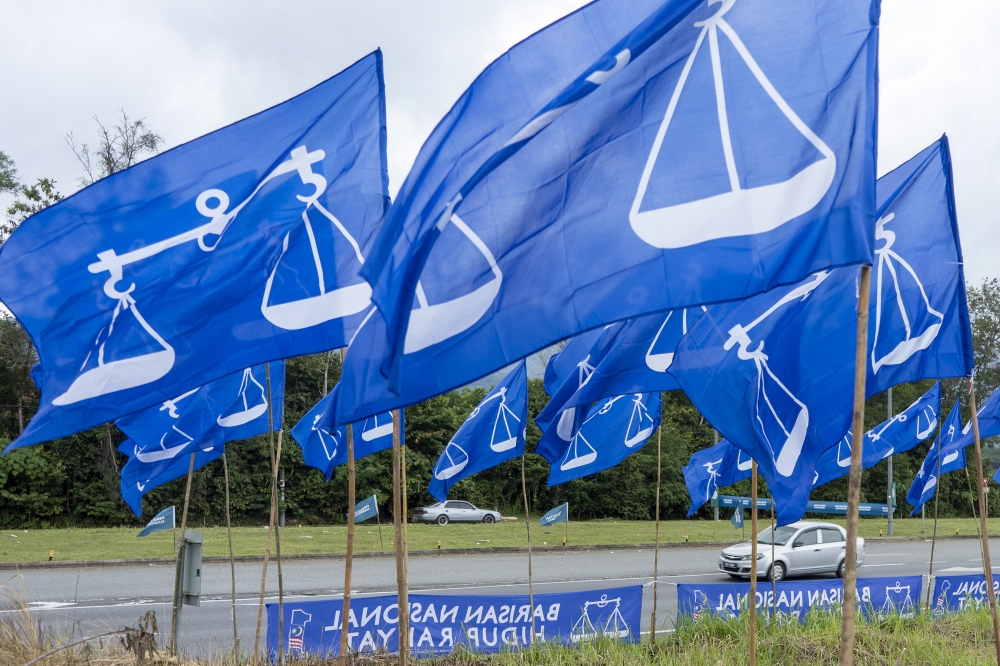
Johor should be the first warning. Umno does not regard Johor as merely another electoral battlefield.
It is the birthplace of Umno and remains central to the party’s historical identity.
BN’s organisational infrastructure there cannot simply be subordinated to an external narrative of Malay-Muslim political consolidation.
PAS, meanwhile, has every incentive to expand.
If PAS provides votes that help BN candidates win, it can subsequently argue that its electoral machinery deserves recognition through additional constituencies, appointments or influence.
What begins as vote transfer therefore becomes bargaining leverage. Umno confronts an uncomfortable dilemma.
The more useful PAS becomes electorally, the greater PAS’s justification for demanding political compensation.
Yet the more Umno accommodates PAS, the greater the danger that Umno gradually concedes its position as the principal political vehicle of the Malay electorate.
That is not unity. It is a struggle over primacy.
Negeri Sembilan demonstrates another dimension of the same problem.
The electoral arithmetic there may encourage proponents of BN-PN cooperation to believe they have discovered a winning formula.
But an election result does not eliminate structural disagreements. It can merely conceal them beneath victory.
The moment attention shifts from defeating a common opponent to dividing the political rewards of victory, the fissures reappear.
There is, however, an additional dimension that makes the present situation considerably more complicated: the continuing institutional and investigative consequences surrounding the Royal Commission of Inquiry into Tabung Haji, together with the controversies and investigations associated with Felda and the Littoral Combat Ship programme.
These are not minor political files. They concern institutions, projects and financial commitments of enormous national significance.
They also reach backwards across different periods of government and potentially touch individuals associated with previous administrations. This creates an unusual strategic dilemma for BN.
There may be elements within BN who see closer engagement with PN as useful political leverage against the momentum or scale of investigations.
A larger Malay political alignment could conceivably increase political pressure for investigations to be slowed, narrowed or framed differently.
But this must be distinguished from evidence that BN as a coalition is actually seeking to obstruct investigations.
There is an important difference between analysing a political incentive and asserting that such a strategy exists.
Indeed, Deputy Prime Minister and Umno president Ahmad Zahid Hamidi’s own position on the Tabung Haji RCI points in another direction.
He has supported disclosure and the principle that those against whom credible evidence of misappropriation, criminal breach of trust, negligence or other wrongdoing exists should face due legal process.
That creates turbulence inside the BN itself.
If accountability is accepted at the leadership level, any attempt by particular factions to use cooperation with PN as political insulation would collide with Zahid’s publicly stated position.
More importantly, even tactical reliance on PN carries enormous strategic costs.
BN cannot simply pivot towards PN across the entire Peninsula without considering Sabah and Sarawak.
The governments and political establishments of the two Borneo states possess their own sensitivities toward Peninsula-centric political arrangements, particularly those that could significantly strengthen PAS’s influence over the Federal Government.
A sweeping BN-PN alignment dominated numerically or ideologically by PAS could therefore generate political backlash across the South China Sea.
This matters enormously because no serious calculation of federal power can now treat Sabah and Sarawak as peripheral.
The political arithmetic of Putrajaya increasingly runs through Borneo.
BN must therefore calculate not merely how many Malay votes cooperation with PN might produce in Perlis, Negeri Sembilan, Melaka or Johor, but what such cooperation could cost it in its relationships with Sabah and Sarawak.
Then comes an even more immediate constraint: BN remains part of the Federal Government with PH.
The relationship may contain tensions, disagreements and mutual suspicions, but it nevertheless carries the responsibilities of government.
This becomes especially important as Malaysia approaches the federal budget cycle.
The passage of the Budget is not another routine parliamentary skirmish. Supply lies at the constitutional heart of the parliamentary government.
Salaries, ministries, development programmes, public administration and innumerable government commitments ultimately depend upon Parliament authorising expenditure.
BN therefore cannot behave simultaneously as though its federal partnership with PH is dispensable while expecting all the benefits of remaining inside government.
If BN were to destabilise the Federal Government while cultivating an alternative arrangement with PN, it would have to consider the consequences not merely among politicians but throughout the public service.
Malaysia’s civil servants need administrative continuity. Government agencies need allocations.
Ministries need predictable financing. Development projects require appropriations. The machinery of the state cannot be subjected indefinitely to coalition experimentation.
Any political manoeuvre that appeared to jeopardise passage of the Budget in October or subsequent supply measures could consequently expose BN to public and bureaucratic anger far beyond partisan politics.
This is why the Blue Wave is considerably more complicated than its enthusiasts suggest.
BN potentially faces four directions simultaneously
It must manage competition and possible cooperation with PN. It must maintain sufficient cohesion with PH to sustain the Federal Government.
It must preserve politically viable relationships with Sabah and Sarawak.
And it must navigate the consequences of major accountability processes involving Tabung Haji, Felda and the LCS programme.
PN has its fissures too.
Any discussion of a BN-PN alignment that treats PN as synonymous with PAS overlooks Bersatu.
PAS and Bersatu have their own unresolved questions involving leadership, constituencies and PN’s strategic direction.
If PAS increasingly negotiates with BN, Bersatu must ask what political space remains for itself.
The resulting structure is inherently complicated: BN contains internal fissures; PN contains internal fissures; and then BN and PN must negotiate the fissures between themselves.
Perlis may expose the problem because the political space is small. As things are, Perlis Umno wants to go solo.
With relatively few constituencies available, every seat conceded becomes proportionately more valuable.
Melaka could prove even more difficult. PAS alone wants 16 seats out of a state assembly of 28 seats. Umno wants 21 of them.
Umno has deep historical and organisational interests there. PAS wants expansion. Bersatu needs constituencies to maintain existential relevance.
MCA and MIC remain BN components whose political interests cannot simply be erased by the rhetoric of Malay-Muslim consolidation.
Johor presents yet another configuration because Umno’s institutional roots there are exceptionally deep.
Thus there is no single BN-PN formula capable of being mechanically reproduced across Peninsula Malaysia.
Political cooperation will have to be negotiated state by state, constituency by constituency and eventually candidate by candidate.
And behind every negotiation lies another calculation: what does BN gain from PN that compensates for what it might lose from PH, Sabah and Sarawak?
This is where the Blue Wave metaphor begins to break down.
A wave suggests movement in one direction.
Malaysian politics is moving in several directions simultaneously.
There are Umno interests, PAS ambitions and Bersatu anxieties.
There are federal responsibilities, Borneo sensitivities and unresolved investigations.
There is also the approaching necessity of passing supply and maintaining confidence in the Federal Government.
BN therefore cannot afford to confuse tactical cooperation with strategic realignment.
It may cooperate with PN in particular constituencies.
It may discover circumstances where preventing three-cornered contests benefits both sides. Some factions may even calculate that greater PN leverage could alter the political environment surrounding major investigations.
But transforming these calculations into a Peninsula-wide alliance would create consequences reaching far beyond electoral mathematics.
Sabah and Sarawak would be watching as would PH, indeed, the Malaysian Civil Service too.
And Malaysian voters would certainly be conserving keenly how the political establishment responds to the Tabung Haji RCI and the continuing controversies surrounding Felda and the LCS programme. Investigation for the sake of investigation would not be inspiring.
The real test of BN’s future therefore lies not in whether it can ride a Blue Wave.
It lies in whether BN can navigate several competing currents without being pulled under by any of them.
Negeri Sembilan and Johor may have temporarily masked these contradictions through electoral success. Perlis and Melaka could expose them much more severely.
At the federal level, the combination of accountability, parliamentary supply, coalition stability and Borneo’s political weight makes the balancing act harder still.
The Blue Wave may look formidable from the shoreline.
But beneath it are powerful crosscurrents.
Those are the blues of the Blue Wave that Malaysian politics can no longer afford to overlook.
* Phar Kim Beng is a professor of Asean Studies and a director at the Institute of International and Asean Studies, International Islamic University Malaysia.
** This is the personal opinion of the writer or publication and does not necessarily represent the views of Malay Mail.


