


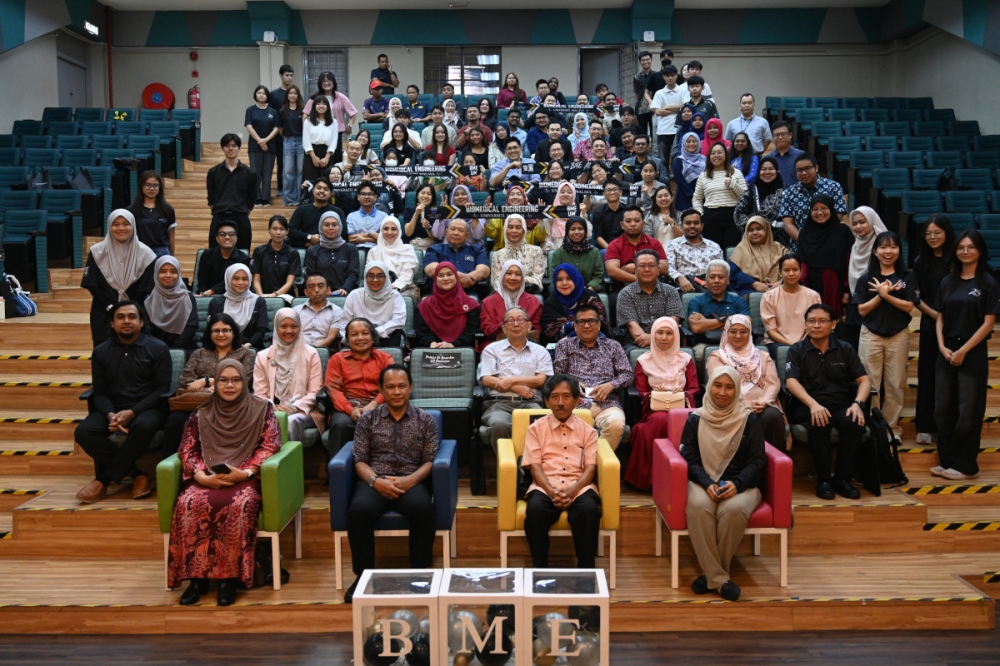
NOVEMBER 14 — On October 24, 2026, I returned to the Faculty of Engineering, Universiti Malaya, to celebrate the Silver Jubilee of its Department of Biomedical Engineering.
It was a memorable occasion, bringing together former and current lecturers, alumni, students and colleagues from the industry. For someone who had been involved in the early development of biomedical engineering at the university, the gathering brought back many memories of a time when the future of this relatively new discipline was far from certain.
One of the highlights was listening to Professor Wan Abu Bakar, the founding Chair of the Department, recount how it all began. His recollections reminded me of something that may surprise those who know biomedical engineering today as an established academic discipline.
Before there was a Department of Biomedical Engineering at Universiti Malaya, there were already students studying for a degree in the field.
The Bachelor of Biomedical Engineering programme had begun as an academic programme within the Faculty of Engineering, before it acquired the status of a full-fledged department in 2001.
That same year, its first cohort of students graduated. Among them was Nahrizul Adib Kadri, now a professor in the same department, who received the Anugerah Pelajaran Diraja, the university’s highest honour for graduating students.
It was an encouraging achievement for a programme that was still finding its place within the university and the wider professional community.
Looking back, I find something rather remarkable about those early years. We were preparing young people for careers in a discipline whose future in Malaysia had yet to be clearly established.
Unlike conventional engineering fields, biomedical engineering was still unfamiliar to many employers, prospective students and even fellow academics.
Its professional identity was developing, and the opportunities awaiting its graduates were not always obvious. Yet students enrolled, lecturers committed themselves to teaching, and the programme continued to grow.
Those involved in its development had many practical challenges to overcome. Bringing engineering and medicine together required more than combining subjects from two faculties.
We had to develop an appropriate curriculum, establish laboratories, acquire equipment and create meaningful connections with clinicians and hospitals.
As someone representing the medical faculty, I was particularly involved in strengthening the biomedical and clinical dimensions of the programme.
My own experience in medical physics had taught me that collaboration between different disciplines required patience, mutual understanding and a willingness to learn from one another.
There were also questions that nobody could answer with certainty. Would employers recognise the qualifications of our graduates? Would hospitals and healthcare institutions see the value of biomedical engineers? Could the programme attract enough students and academic staff to sustain itself over the years?
Twenty-five years later, the answers to many of those early questions were standing before us at the Silver Jubilee celebration. I was delighted to meet members of the pioneering student cohorts, although I must confess that I initially struggled to recognise some of them after so many years.
We exchanged stories about their university days, recalled familiar lecturers and laughed about experiences that had somehow survived the passage of time.
Their journeys had taken them in different directions. Some had become professors and researchers, while others had established careers in hospitals, industry, government agencies and regulatory bodies.
Their achievements were not identical, nor should they have been. What mattered was that a field once regarded as unfamiliar had opened doors to careers and contributions that were difficult to imagine when the programme first began.
Over the years, I have continued to enjoy teaching in the department, particularly Medical Imaging and Perspectives in Healthcare Technology. The latter has evolved considerably as healthcare technology has advanced, with greater attention to clinical engineering and the practical challenges of applying technology in healthcare settings.
The biomedical engineering of today encompasses developments in medical imaging, rehabilitation, medical devices, regenerative medicine, artificial intelligence and digital health that were still emerging, or scarcely imaginable, during the programme’s early years.
The Silver Jubilee gathering, thoughtfully organised under the leadership of the current Head of Department, Associate Professor Dr Juliana Usman, offered an opportunity to appreciate the many people who have contributed to this journey.
Dr Juliana herself belonged to that pioneering student cohort, a particularly meaningful reminder of how far the programme has come.
The founders provided the initial vision, successive generations of lecturers sustained and expanded the programme, and the students carried its influence into workplaces and institutions far beyond Universiti Malaya.
Anniversaries naturally encourage us to celebrate achievements. They also have a curious way of making the past appear more orderly than it actually was.
Looking back from the comfort of 25 years, it is easy to imagine that the department’s development followed a carefully laid plan, with each milestone leading inevitably to the next.
Those of us who remember the early years know that the journey involved uncertainty, difficult decisions and considerable faith in possibilities that had not yet been demonstrated.
Perhaps this is what I will remember most about the celebration. Before the department had its present identity, before its graduates had established their careers, and before biomedical engineering became a familiar part of Malaysia’s higher education landscape, there were people willing to begin.
There were academics who believed the discipline deserved a place in the university, and there were young students willing to invest their futures in something whose promise was still unfolding.
Looking at the people gathered for the Silver Jubilee, I felt grateful to have played a small part in that beginning, and even more grateful to see how much they had made of it.
* Ng Kwan Hoong is an emeritus professor of Biomedical Imaging at the Faculty of Medicine, Universiti Malaya. A 2020 Merdeka Award recipient, he is a medical physicist by training but also enjoys writing, drawing, listening to classical music and bridging the gap between older and younger generations. He may be reached at [email protected].
** This is the personal opinion of the writer or publication and does not necessarily represent the views of Malay Mail.


