


JULY 20 — A few weeks ago, the new intake of pre-university students arrived on campuses all over the country, including Universiti Malaya.
Back then, everything felt unfamiliar to these students. They walked around clutching maps on their phones. Lecture halls seemed impossible to find.
New friendships were tentative. Even ordering lunch at the right café felt like a small achievement. And just a few weeks later, things look very different.
Students now know where their classes are. They know which bus routes are reliable and which ones are best avoided when it rains.
They know which café serves the best nasi kukus, which one closes early, and which one remains open when hunger strikes late at night.
Tutorial groups have been formed. WhatsApp groups are active. Assignments have started appearing. From the outside, everyone seems settled.
And that is precisely when an interesting illusion begins to take hold. The illusion, of course, is that everyone else knows what they are doing.
At that age, it is easy to mistake confidence for certainty, and certainty for competence.
The student who asks questions in class appears confident. The student who already talks about becoming a doctor, lawyer, or engineer appears certain.
The senior students seem to know where they are going. The lecturers appear to have everything under control. Yet the longer I spend in universities, the more I realise that certainty is far rarer than it appears.
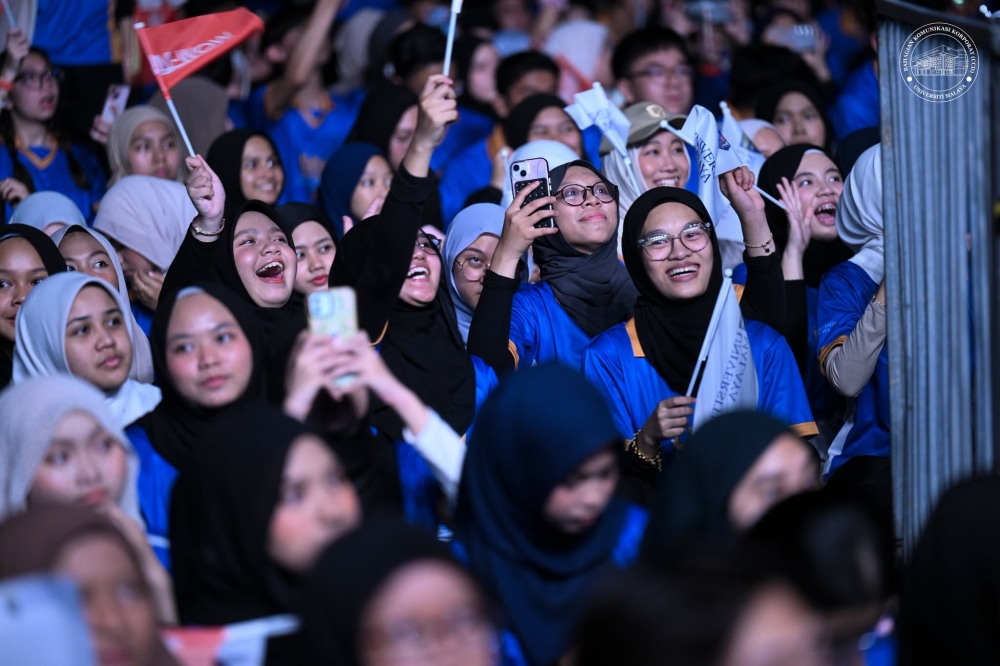
Most people are figuring things out as they go. Not recklessly, and certainly not aimlessly. They are learning, adjusting, and making the best decisions they can with the information available at the time.
What experience gives us is not perfect foresight. It simply helps us make slightly better guesses.
I was reminded of this when thinking about one of the more unexpected chapters in my own career. For most of my professional life, my work revolved around engineering, research, teaching, and healthcare technologies.
So when I was appointed Director of Universiti Malaya’s Corporate Communications Centre in 2022, many people understandably raised an eyebrow.
To be fair, communications was not entirely foreign territory. For several years prior to the appointment, I had worked closely with journalists, helped connect media organisations with university experts, and occasionally contributed articles of my own. I understood the media side of things reasonably well.
What I underestimated was how much larger the communications function actually was. Suddenly, the work was no longer limited to newspapers, television interviews, or press releases.
There were internal stakeholders to engage, institutional messages to coordinate, strategic priorities to communicate, and reputational considerations that often extended far beyond a single news story.
The learning curve was steep, not because I knew nothing, but because I quickly discovered how much I did not know.
Looking back, I think many important transitions in life feel exactly like that. You are not completely lost. You are not starting from zero. But you have stepped beyond the edge of your current experience, and that can feel uncomfortable.
The discomfort is not a sign that something is wrong. More often than not, it is a sign that growth is taking place.
And the same thing happens to students too. The first-year student assumes final-year students have everything figured out.
Final-year students assume working adults know exactly where their careers are heading.
Young professionals assume managers possess a level of certainty they themselves have yet to attain.
Then, one day, they become the manager. And they discover that the questions have simply changed.
Perhaps this is one of the most important lessons that university teaches, although not through lectures or examinations.
The people around you are human. The class representative is figuring things out. The lecturer is figuring things out. The dean is figuring things out. Your parents are probably figuring things out too.
The difference is not that some people have all the answers while others do not. The difference is that some people have become more comfortable moving forward without having all the answers.
That, in my mind, is a more useful definition of adulthood than the one many of us grow up with. As children, we often imagine adulthood as a destination where uncertainty finally disappears.
We assume that one day we will arrive at a stage of life where everything makes sense, every decision feels obvious, and every problem has a clear solution. What actually happens is far less dramatic, unfortunately.
The questions change, but uncertainty remains. What grows over time is not our ability to eliminate it, but our ability to work with it.
We learn that confidence is not certainty. Confidence is the willingness to act despite uncertainty. Maturity, meanwhile, has less to do with having every answer and more to do with continuing to show up while searching for them.
And perhaps that is the message I would offer to students who have recently begun this chapter of their lives.
If you sometimes feel as though everyone around you has things figured out, take comfort in knowing that appearances can be misleading.
The student sitting next to you is still learning. The lecturer standing in front of you is still learning.
And if I am being completely honest, the professor writing this article is still learning too.
You see, the goal was never to know exactly what you are doing. The goal is to keep showing up, and moving forward anyway.
* Nahrizul Adib Kadri is a professor of biomedical engineering at the Faculty of Engineering, the Director of UM Press, and the Principal of Tuanku Bahiyah Residential College, Universiti Malaya. He may be reached at [email protected]
** This is the personal opinion of the writer or publication and does not necessarily represent the views of Malay Mail.


