


JUNE 24 — “You do not have to blow up a whole building because there is one Hezbollah member in it. There are many innocent people too.”
Donald Trump said that recently of Israel’s bombing in Lebanon. It was an unusually blunt description of the civilian cost of war from a man not usually accused of excessive tenderness towards international law.
But there is another kind of demolition now under way: the demolition of the independence of the International Criminal Court’s prosecutor, Karim Khan.
And Malaysia should not be silent.
Three senior judges, appointed by the ICC’s own governing Bureau, examined the United Nations investigation into allegations against Khan. They reviewed the report and a vast body of underlying material. Their conclusion was unanimous and unambiguous: the factual findings did not establish misconduct or breach of duty under the relevant legal framework.
Not one judge dissented.
That should have been the end of the matter, or at the very least the beginning of a legally proper next step. Instead, the Bureau — a political body made up of state representatives — has chosen to substitute its own view for that of the judges it appointed.
This is the point that must not be lost in the noise.
No one is saying Karim Khan is above scrutiny. No one is saying serious allegations should be ignored, minimised or politicised in his favour. The complainant is entitled to dignity, protection and a fair process. But so is Khan. And when three judges appointed to assess the investigation conclude that the material before them does not establish misconduct, it is not for diplomats in a room to don judicial robes and announce the opposite result.
If the Bureau believed that the legal standard applied by the judges was wrong, then it had a proper path available: send the matter to a competent judicial body, clarify the standard, ensure a transparent process and let law do its work.
What it must not do is discard the finding of judges because the result is inconvenient.
That is not accountability. It is institutional improvisation with a political scent.
The Bureau may technically have the power to proceed. It is made up of governments, after all. But power and legitimacy are not the same thing. A political committee can vote. It can suspend. It can circulate memoranda. What it cannot manufacture is the moral authority of a judicial determination it has chosen to ignore.
That distinction matters enormously.
Karim Khan was elected to do a job few others were willing to do. He pursued Vladimir Putin. He pursued Hamas leaders. And he pursued Israeli leaders over Gaza. In doing so, he crossed the line that the world’s most powerful states insist exists only for everyone else.
The United States sanctioned Khan and other ICC officials after the Court’s action against Benjamin Netanyahu and Yoav Gallant. The message was plain enough: investigate our adversaries and you are supporting justice; investigate our allies and you become the problem.
Khan has said that, in a 2024 call, US Senator Lindsey Graham told him that the ICC was meant for African leaders and “thugs like Putin”, not for democracies such as Israel and the United States. Whether those were Graham’s exact words or not, the sentiment has been visible in neon lights for years.
The ICC, in this worldview, is acceptable when it pursues African warlords, Russian presidents and the enemies of the West. But the moment it approaches the military and political leadership of a protected ally, suddenly the Court is an outrage, the prosecutor is suspect, the judges are biased and the entire institution must be tamed.
That is why the treatment of Karim Khan matters beyond Karim Khan.
This is not merely about whether one individual stays or goes. It is about the warning being sent to every future prosecutor, judge, investigator and international civil servant: cross the wrong geopolitical line and the legal process around you may be rewritten by politicians.
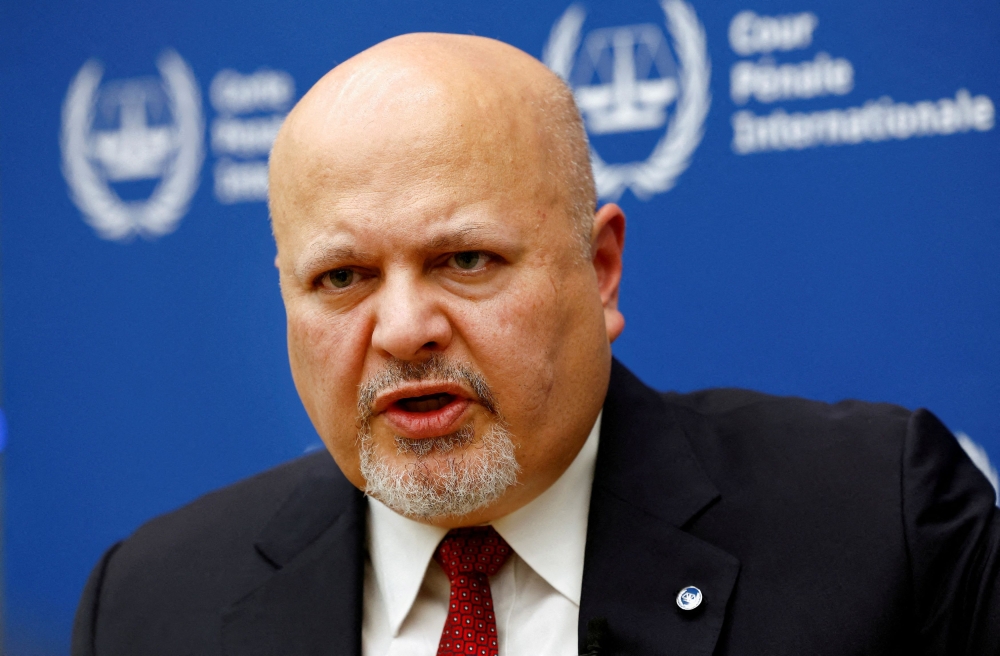
Today, it is Karim Khan.
Tomorrow, it may be any prosecutor who dares to investigate a state with powerful friends in Washington, London, Berlin or elsewhere.
The chilling effect will be immense. Prosecutors will understand that some cases are career-ending not because the evidence is weak, but because the accused are too powerful. Judges will understand that their legal reasoning can be treated as optional. Investigators will understand that the rule of law operates under a diplomatic supervision clause.
And the ICC will understand that it is allowed to be brave only in the safe direction.
Malaysia cannot credibly claim to stand for Palestine while remaining mute when the institutional independence of the Court pursuing accountability is placed at risk.
Malaysia joined The Hague Group because it said international law must not become a decoration for speeches while civilians are buried under rubble. Malaysia has repeatedly argued that no state should be above the law. Malaysia has condemned the killing of civilians, collective punishment and the failure of the international community to act with courage.
Those were not merely good lines for press conferences. They were commitments.
This is where those commitments are tested.
Malaysia should publicly call on the Assembly of States Parties to respect the unanimous conclusion of the three judges who were appointed to examine the evidence. It should insist that a political Bureau must not replace a judicial finding with its own preferred conclusion. It should demand that any further process be legally rigorous, transparent and free from external political pressure.
Most importantly, Malaysia should say plainly that the ICC cannot survive as a court if the most powerful states in the world can decide who may investigate them.
That is the real issue.
Malaysia should stand with Karim Khan not because he is beyond scrutiny, but because no prosecutor should be removed for doing his job. If political pressure succeeds where legal process should prevail, the victim will not be Karim Khan.
It will be the independence of international justice itself.
And then the ICC will become exactly what its critics have long feared: a court for Africa and thugs, but never for the powerful.
* This is the personal opinion of the writer or publication and does not necessarily represent the views of Malay Mail.


