


JUNE 21 — Universities around the world produce thousands of patents, inventions and research breakthroughs each year. Yet many never progress beyond the laboratory, prototype or patent stage to create tangible benefits for industry and society. Studies of university patent commercialisation have repeatedly highlighted the same challenge: generating knowledge is only the first step, and turning it into real-world impact is often far more difficult.
This raises an uncomfortable but important question: why do so many university innovations struggle to travel beyond campus? The answer is not always weak science or a lack of novelty. In many cases, the research is rigorous, the evidence is strong and the technology works as intended. The missing piece often lies elsewhere. Researchers may spend years refining a solution before fully understanding who needs it, what problem it solves, how it fits into existing practices and why potential users would adopt it. As a result, ideas that perform well in laboratories, clinics or pilot studies can struggle to gain traction in the real world.
This is where entrepreneurship matters — not entrepreneurship as merely starting a business, and not as turning every researcher into a salesperson. Rather, it is a way of seeing the world carefully, much like design thinking: listening before proposing, validating the problem before the solution, testing before claiming, simplifying before pitching, and building with others instead of only presenting to them at the end. For universities, this mindset is no longer optional. Challenges in health, climate, food security, digital transformation and ageing societies do not sit neatly inside one faculty or ministry. They move across sectors and require researchers, policymakers, industry players, communities, funders and students to speak to one another. Good research may begin in a laboratory, clinic, classroom or field site, but impactful research rarely ends there.
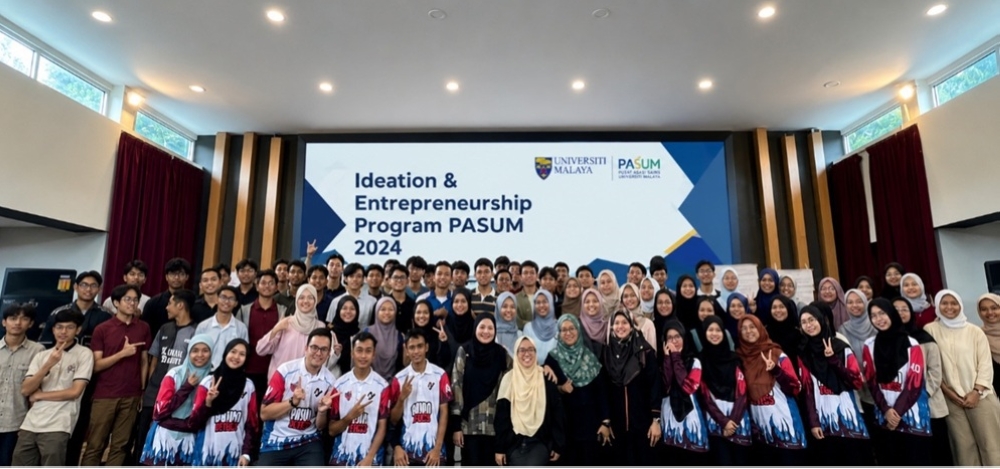
Recognising this gap, Universiti Malaya took a deliberate step to strengthen entrepreneurial and innovation capabilities among both staff and students. The goal was not merely to encourage more ideas, but to equip the university community with the skills needed to identify meaningful problems, validate opportunities and develop solutions that can create real impact beyond the campus. One of the initiatives introduced was the Programme on Ideation and Entrepreneurship, launched in 2022 through a collaboration between Universiti Malaya, the University of Suffolk and ChangeSchool, with funding support from the British Council. It began by training 24 academics as trainers, who in turn trained more than 400 students over a two-week period. The idea was simple but powerful: build capacity within the campus so that an innovation mindset becomes part of how people teach, learn and develop ideas.
Since its launch, the initiative has grown steadily across the university, involving academics, support staff and students from different disciplines. More importantly, its impact can now be seen in the ideas, projects and collaborations that have emerged from it. One example is DegreeMate, a web application conceived during a staff-focused programme to help align university programmes with industry needs while supporting students in making smarter, more personalised career choices. What began as a discussion during a workshop has since evolved into a funded prototype, illustrating how a carefully defined problem can grow into a practical solution. In many ways, this reflects the very challenge that inspired the programme itself: helping knowledge move beyond discussion and into practical use.
The impact has also been visible across different faculties. Within the Faculty of Pharmacy, which offers more than 10 professional programmes, entrepreneurship modules were embedded into a management course. This initiative is led by Assoc. Prof. Dr. Baharudin Ibrahim, who was part of the first cohort trained in the workshops facilitated by the UK collaborators. The initiative has also been sustained by the dedicated involvement of Mdm. Thibashini Nair Sathasivan, another passionate participant from the same first cohort. Through the course, students learned to identify problems, generate ideas, develop business models, influence others, tell persuasive stories and manage finances for entrepreneurial projects. In doing so, they were not merely studying management as theory, but connecting their professional knowledge with real challenges in their field.
The longer-term outcomes have been particularly encouraging. Participants from the Centre for Foundation Studies in Science (PASUM), under an initiative led by Dr. Norli Abdullah, later advanced from campus innovation activities to national and international competitions, earning awards for projects they continued to develop after the training. More importantly, some remained active in innovation after entering their degree programmes, demonstrating that the programme was not simply a one-off workshop but an early exposure that helped build confidence, problem-solving ability and a willingness to turn ideas into action. As one participant, Muizzah Aznam, now pursuing her bachelor’s degree in law reflected, the experience introduced her to the startup and innovation ecosystem while strengthening the critical thinking, communication and problem-solving skills that continue to support her journey today.
One lesson surfaced repeatedly during the programme: a good idea must be understood before it can be supported. Researchers often focus on technical details, but potential users first want to know three things: what problem is being solved, who benefits and why it matters. A strong solution alone is rarely enough; researchers must also communicate these points clearly. This becomes particularly important when ideas are tested with users and assumptions are challenged, because often it is the original problem, not only the solution, that must be validated against what people are actually facing.
While these examples emerged within a university setting, the underlying lessons are relevant far beyond campus. So what can people outside the university learn from this? Do not wait for a perfect idea. Start by paying attention to a real problem around you. A small inconvenience at home, a repeated customer complaint, a wasteful process in an office, a learning gap among students or an unmet community need can each become the beginning of innovation.
Malaysia needs more than excellent research. It needs pathways that help ideas move from discovery to adoption, from prototypes to practice and from academic discussion to societal benefit. This requires universities, industry, government and communities to work together from the outset, rather than meeting only at the end of the innovation process. Entrepreneurship begins when we stop focusing only on what we know and start asking, “Who needs this, and how can we make it useful together?” The future impact of our research may depend not only on how many ideas we generate, but on how well we engage the people who will ultimately use them.
* Dr. Azizi Abu Bakar is a Research Officer at the UM Sustainable Development Centre (UMSDC). Prof. Shaliza Ibrahim is the Honourary Professor at Institute of Ocean and Earth Sciences (IOES) and she is the AAIBE Chair of Renewable Energy at Universiti Tenaga Nasional (UNITEN).
** This is the personal opinion of the writer or publication and does not necessarily represent the views of Malay Mail.


