


AUGUST 30 — Three years ago, then MP for Langkawi Tun Dr Mahathir Mohamad and three other MPs (the Plaintiffs) filed an application in the High Court by way of Originating Summons (OS) seeking, among others, declarations that the appointment and/or election of then Speaker and Deputy Speaker of the Dewan Rakyat (First and Second Defendants) as invalid on the ground that as it was unconstitutional and/or inconsistent with Article 57 of the Federal Constitution (FC) C and/or Standing Orders (SO) 3, 4, 6 and 47 of the Standing Orders of the Dewan Rakyat (SODR).
In support of their application, the Plaintiffs contended that the parliamentary privilege afforded by Article 63(1) of the FC is not absolute and subject to the power and/or jurisdiction provided for the Dewan Rakyat, whether or not it is inherent or expressly provided for.
The Plaintiffs were essentially saying that the Dewan Rakyat had, through its appointments of the First and Second Defendants as the Speaker and the Deputy Speaker, acted outside of the power or jurisdiction provided for it.
This rendered the said appointments unconstitutional and unlawful, justifying judicial intervention in the Dewan Rakyat’s decision.
Given the Plaintiffs’ contention, the High Court was drawn to consider the effect of Article 63 of the FC which incidentally had been discussed in a plethora of cases.
The first is the case of Teng Chang Khim (appealing as speaker of Selangor State Legislative Assembly) v Badrul Hisham bin Abdullah & Anor [2017] where the Federal Court held that Parliament and State Legislative Assemblies are immune from judicial interference. The apex court said:
“The courts have no power to interfere with the internal management of Parliament or any State Legislative Assembly. This immunity arises from the doctrine of separation of powers between the three principal organs of government, namely, the executive, the legislature and the judiciary.”
The second is the case of Speaker of Dewan Undangan Negeri of Sarawak Datuk Amar Mohamad Asfia Awang Nassar v Ting Tiong Choon & Ors And Other Appeals [2018] where the Court of Appeal had the opportunity of referring to the above case where the issue of justifiability of parliamentary privileges had been discussed fairly extensively in a line of cases starting with Lim Cho Hock v. Speaker Perak State Legislative Assembly [1979] and Fan Yew Teng v. Government of Malaysia [1976]. The appellate court duly noted:
“The doctrine of separation of powers between the executive, legislative and the judiciary requires the business of and how parliament and the State Legislative Assemblies manage themselves in the conduct of their business, to be immune or protected from judicial interference.... There is no change in the court’s stance on this principle.”
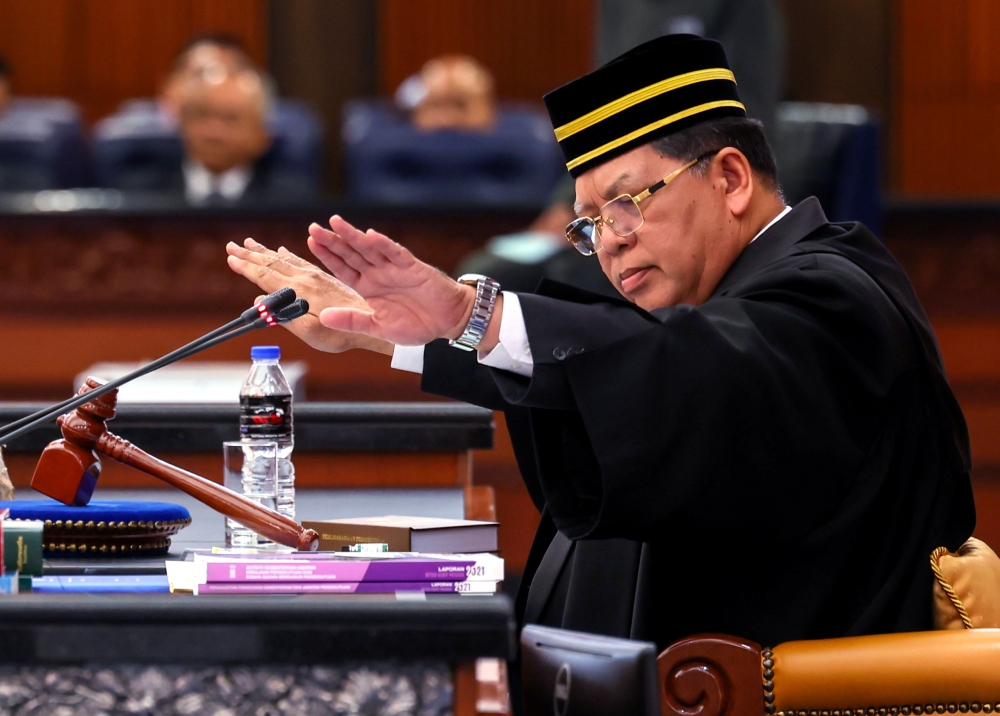
The third is the recent case of The Speaker of Dewan Undangan Negeri of Sarawak Datuk Amar Mohamad Asfia Awang Nassar v Ting Tiong Choon & Ors And Other Appeals [2020] where the Federal Court affirmed the principle that the decision of the Dewan Rakyat “shall not be questioned in any court”, but only so long as the Dewan acted within the limits of its power.
The court would be in breach of Article 72(1) of the FC if it were to interfere with the exercise of that power.
That Parliament must act within the limits of its power is illustrated in the case of Dewan Undangan Negeri Selangor & Ors v. Mohd Hafarizam bin Harun [2016].
In that case a lawyer, acting upon instructions of his client, issued a letter of demand to the then Speaker of the State Legislative Assembly demanding the payment for the costs of a civil suit initiated by the lawyer’s client against the then Speaker.
The letter of demand was brought to the attention of the State Legislative Assembly (SLA) which then passed as motion resolving that the lawyer and his client be referred to the Committee of Rights and Privileges on a charge of contempt.
The Secretary of the Committee issued a summons against the lawyer to appear before the committee and explain the alleged contempt.
The lawyer then filed an OS on the grounds, among others, that the summons issued by the Secretary of the Committee violated the FC and the Selangor State Constitution and was therefore unconstitutional.
The High Court found that resolution prescribing the alleged contempt and referring the lawyer to the Committee was unconstitutional, being ultra vires the Schedule of the Selangor State Constitution and the Standing Orders of the Assembly made pursuant to the Selangor State Constitution.
The decision was upheld by the Federal Court on the ground that no provision had been made to provide for the offence of contempt which the lawyer was charged with. The Federal Court said:
“It is our judgment that the SLA must act within its constitutional and legal powers before passing a resolution of an act of contempt having been committed beyond the walls of the SLA.”
Accordingly, the court must ascertain whether a particular power that has been claimed has in fact been provided for.
Bersatu’s application for leave to initiate a judicial review against Dewan Rakyat Speaker Datuk Johari Abdul and four MPs from Sabah may well turn on the question whether the Speaker has been provided with the power to establish that an MP has ceased to become a member of the Dewan and that his seat has become vacant immediate.
Is the power provided for in Article 49A of the FC?
High Court Judge Amarjeet Singh will deliver his decision on November 16.
Salam Hari Merdeka 2023.
* This is the personal opinion of the writer or publication and does not necessarily represent the views of Malay Mail.


