













NAGANO, Nov 10 — There is no doubt travellers love Japan, drawn to its culture, food, technology and wealth of experiences. But if you want to start understanding, and fully appreciating, a country as complex as Japan, you need to get beyond the bright lights, intensity, and gadgets of Tokyo, and venture out into the countryside, where there is time and space to properly absorb what is around you.
Our rendezvous point was at Tokyo Station, a vast maze spread across multiple levels, where beneath the fluorescent lights you have no idea if it is day or night.
Everyone in the vicinity is in a rush to get somewhere else. It was with some relief, then, to find Takuya, buried beneath an over-sized rucksack, joking and laughing with the half-dozen or so foreigners already around him. At last I had found the right spot.
Takuya is a man of the mountains. As a guide at Walk Japan, he has made it his mission to introduce as many people as possible to Japan’s snow country, reviving ancient pilgrimage routes that the modern world has largely forgotten, and forging new paths through the magical, wintery wonderland which engulfs much of Japan each year.
Although at the back of my mind I knew Japan had ski resorts, it had never occurred to me that as much as a third of the country is snow country, with 3,000m peaks and snow up to 7m deep.
Though there are other places in the world which experience similarly heavy snowfall — Patagonia and the Canadian Rockies among them — Japan is unique in that in spite of the abundance of snow, its snow country is still heavily populated, the people having adapted their lifestyle to accommodate the extreme environment.
Entering Snow Country
There were 13 of us — 11 guests from Singapore, the United Kingdom and the United States, plus Takuya and his co-guide, Daniel — who boarded the Shinkansen bullet train and sped from the city to Nagano, 170km northwest of Tokyo.
Though the air temperature remained mild and the sun shone brightly in the blue sky, the scenery began to change.
At first, the hills had just a dusting of snow upon them, but as we left the train and continued into the mountains by bus, the snow around us deepened.
Winding our way into the lowest reaches of Togakushi, university students on a field trip were already frolicking in the snow drifts, building substantial igloos to sleep in overnight, and careening down a steep slope on a plastic sledge, showering powder in their wake.
Togaskushi is a complex of five ancient Shinto shrines, spread out across a thickly forested plateau.
Though channels have been cleared through the snow to enable cars to access the villages, most of the shrines are too remote to justify such effort, and the only way to reach them is on foot.
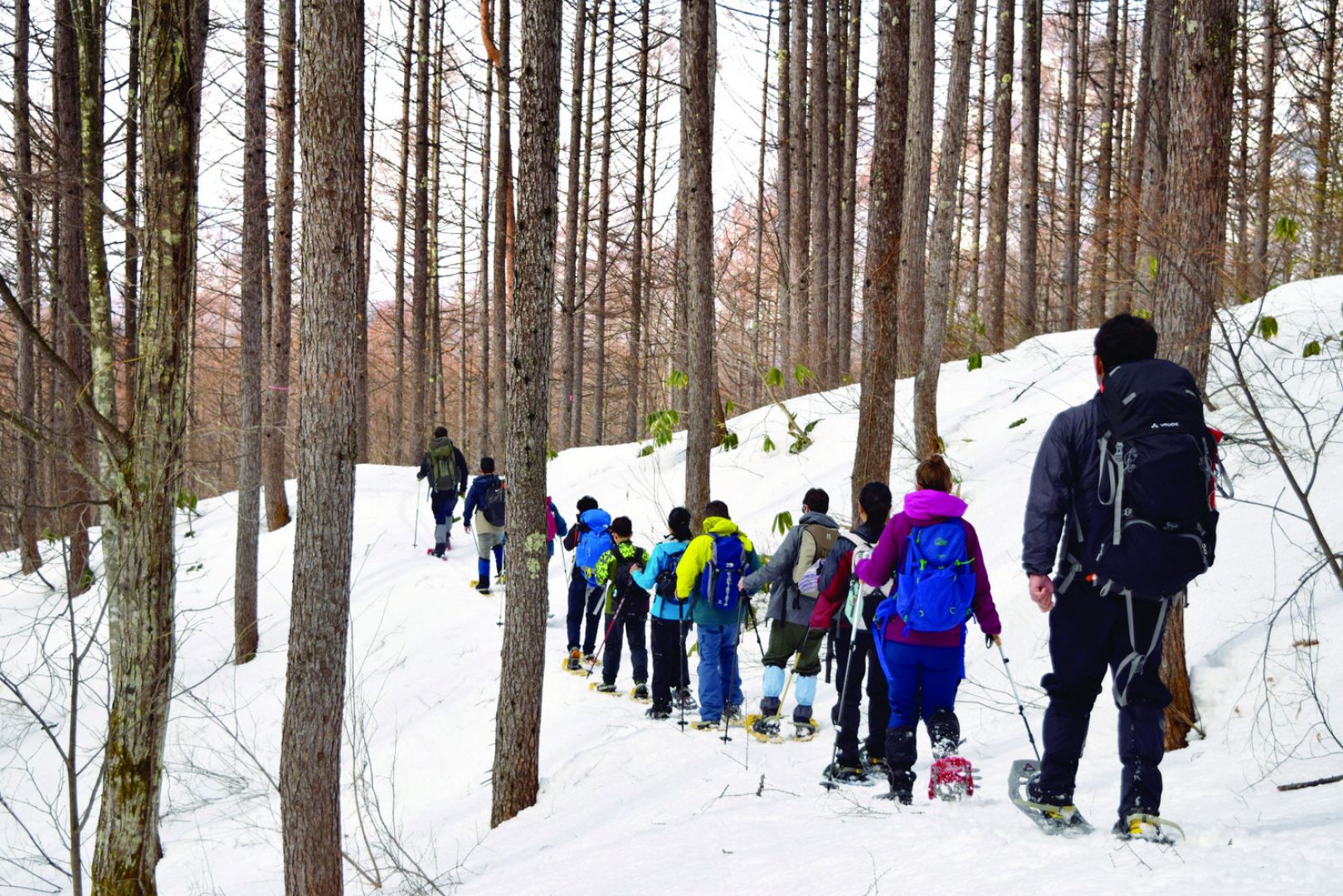
In conventional walking boots, you sink into the snow with every step, often as deep as your thigh, and so the only way to make steady progress is in clunky plastic snowshoes.
Initially, the snowshoes feel unwieldy, and akin to walking in flippers, but gradually you learn to stamp your toes forward into the snow, the metal teeth on the base of the snowshoe biting in, giving much-needed grip.
Gingerly, we stomped our way uphill to Chusha, Togakushi’s central shrine, its site marked by three towering cedar trees. The shrine’s elaborately carved facade, unusual in the Shinto tradition, is accounted for by the fact it was originally built as a Buddhist temple, but changed under political pressure in the 19th century.
This pragmatic fusion of faiths is far from unusual in Japan: Devotees see no contradiction in following both Buddhist and Shinto traditions, and in any case those traditions are often inextricably entwined.
For centuries, pilgrims visiting Tokagashi have stayed in an extensive inn with a thick thatched roof and simple wooden furnishings.
The priest in charge is a former rally driver who competed at Monte Carlo. He welcomes relatively fewer pilgrims these days, but those who do venture out to his inn, now a Registered Cultural Property, feel like honoured guests.
Having cast off my boots, snowshoes and gaiters in the drying room, I was ushered into the onsen, a scalding communal bath fed by natural thermal springs. The mere thought of stripping naked in the presence of strangers, even when divided by sex, was most alarming.
But with my body numb from the cold, and my fellow bathers too busy engaged in conversation to even notice my entrance, any embarrassment lifted. I sat on a low stool and showered, then slid into the onsen with relief as the heat soothed away stiffness from my muscles.
Walking tales
The delight of a pilgrimage on foot is the stories you discover along the way. Each well-trodden path through the forest, each vista point, has a marker, a sacred tree, or a shrine.
Stopping by a large, dark-coloured rock, Tokuya pointed out the natural well in its surface. The water it contained was frozen now, but I could see that in summertime, the shallow pool would have shown my reflection.
A bandit named Oman, wild and ugly, with long matted hair and ferocious features, stalked this mountainside, so they say. The pilgrims feared her as though she were a demon, and more than one lost their life at her hands.
But one day, pausing here to drink from the pool, Oman caught sight of her reflection in the water, and leapt back in absolute horror.
She saw not only the ravages of her lifestyle on her body, but that her character was hideous, too. That moment, she vowed to change, and reformed as a Buddhist nun. Her legs were strong, and her feet forever calloused, but Oman now used her stamina for good, and when she died, she became the goddess of pilgrims and travellers.
In the following days, we walked our way across Nagano, exploring different parts of the prefecture.
At Mori No Ie (“The House in the Woods”) we put our plastic snowshoes aside and replaced them with bamboo kanjiki.
We cooked oyaki (Japanese dumplings stuffed with pickled vegetables) over an open fire.
We summited Mt Hanatate-yama, looking out above the clouds towards the Sea of Japan; and then slid most of the way back down again on our backsides, finding that technique considerably easier than picking our way on foot through the snow.
In every place, more stories unfurled. The region of Akiyamago receives deep snowfall, even by Japanese standards: 7.85m once fell in a single season, and so hunting, not farming, has always been the principal source of income.
At Koakasawa, a remote hamlet, I met the local matagi (bear hunter) and his protege, a city boy who had given up life in Tokyo to understand and preserve rural ways. Over a traditional lunch, the bear hunter explained how every part of the bear, including its skin and meat, was once used, but now there is little appetite for such things.
He is teaching his apprentice to study the mountains, and how to track in the old-fashioned way, but the likelihood of them actually catching and killing a bear is slight. Although they have a permit to do so, a bear-hunting expedition takes a group of men many days, and scarcely anyone still has the skills.
I asked the bear hunter if a woman could hunt, and he looked at me in horror. No, he explained. The mountain goddess is a jealous woman, and she likes to have the attention of the hunters to herself. If a woman strays onto the mountainside during a hunt, the goddess will be affronted and hide the bear.
That is why a woman cannot hunt, he said.
Another Japan
Japan is not just one place: it is many. It is a country of icy streams and frozen waterfalls, of Shinto shrines where pilgrims still pray, and of bear hunters who rarely hunt bears.
It is a place where bandits become goddesses, and even the self-conscious can bathe publicly naked.
Tokyo, Kyoto and Osaka are vital pieces in the national jigsaw, but you cannot hope to complete the picture, even in your mind, without knowing what the snow country is like. — TODAY