

BERLIN, May 17 — Last year, after nearly a decade of long sojourns in Berlin, I signed the lease on an apartment in a pre-World War I, or altbau, building on a tree-shaded block just off Guntzelstrasse, a quiet neighbourhood southwest of the city centre.
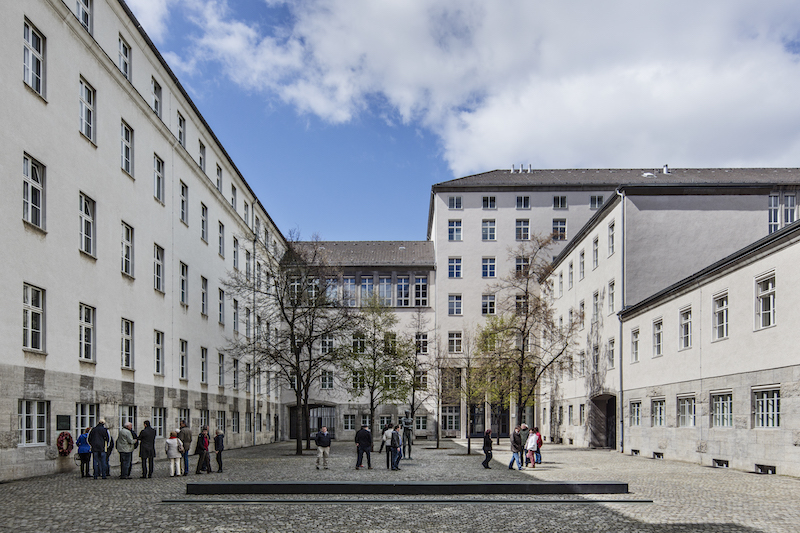
Although I was vaguely aware that the city’s Jewish community had once been centred here, I found it unsettling to discover that Nazi terror had unfolded just outside my front door. Beginning in 1942, the Gestapo arrested dozens of Jews on my street, Jenaer Strasse, and shipped them to Theresienstadt and Auschwitz, where almost all were killed.
Today, whenever I’m back in town from my reporting around the world, I walk past a handsome apartment building just down the street from mine, where 23 Stolpersteine — small brass memorial plaques embedded in the sidewalk — lie in three neat rows, and try to imagine what had happened here: police wagons stopping in front, Hitler’s uniformed enforcers marching up the stairs. In the 1910s and 1920s, about 20,000 Jews lived in this neighbourhood, known as Wilmersdorf. By the time World War II ended, there were virtually no Jews left.
Spending large amounts of time in Berlin requires a constant reckoning with the past. And yet the German capital, as I long ago discovered, doesn’t allow you to linger too long over the dark side of its history. It is an astonishingly varied city, an urbanscape in a constant state of change, blending Kaiser-era glories, vestiges of Nazism, slapdash postwar architecture, multiple cultures and new creations — bars, restaurants, museums and open public spaces that are continuously altering the face of the city.
In recent months, the pace of change has accelerated, with the arrival in Germany of more than 1 million refugees from Afghanistan, Somalia, Eritrea, Iraq and, most of all, Syria, drawn here by Chancellor Angela Merkel’s promise of sanctuary, a pledge that she has since drastically dialled back in the face of rising opposition from Germany’s right wing.
About 50,000 of those immigrants have settled in Berlin, many of them taking up residence in makeshift camps and hostels, and infusing the city with a new multicultural dimension, a burst of energy and an element of tension.
Though unflinching about its past, Berlin is also looking toward the future. In just the past year, for instance, I’ve watched the neighbourhood of sex shops and shoddy 1970s architecture around Zoo Station — once the main train station of West Berlin — undergo an ambitious redevelopment scheme. A new Waldorf Astoria, and the renovated Bikini-Haus complex, which includes the 25hours Hotel Bikini, the Israeli-owned rooftop Neni Restaurant, the Monkey Bar and the Gestalten Book Shop — are transforming this once-dowdy corner of the west into an uncharacteristically trendy neighbourhood. Berlin carries you along on a wave of reinvention and revival.
Nowadays, whenever I’m in Berlin, my daily routine revolves around Wilmersdorf, a quiet neighbourhood of playgrounds and leafy plazas that some Berliners deride as burgerlich — a word connoting haut-bourgeois complacency. There’s little cafe life, little of the immigrant culture that has transformed the face of the city in the past decade. To find that, take a shortish bike or U-Bahn ride east to Kreuzberg, Neukolln or Mitte, where you’ll find vibrant markets, heterogeneous street life and a vibrancy that Wilmersdorf lacks.
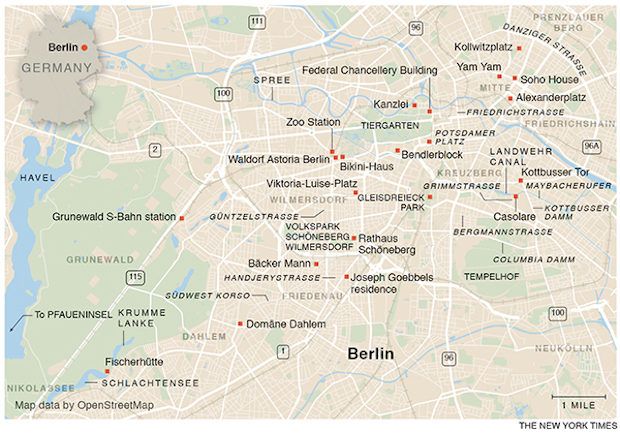
But within walking distance of my apartment stand two landmarks that are among my favourite places: Viktoria-Luise Platz, a turn of the 20th-century square with a gushing fountain and one of the city’s best gelatoshops; and the Volkspark Schoneberg-Wilmersdorf, a sliver of lawns, copses, playgrounds, duck ponds and bike paths that terminates at the Rathaus Schoneberg, the imposing district hall where President John F. Kennedy gave his “Ich bin ein Berliner” speech in June 1963.
Moreover, just down the road lies Friedenau, a near-perfectly preserved island of Old World Berlin. A one-time settlement for convalescing veterans of the Franco-Prussian War, it developed over the next decades into a prosperous enclave of high-level civil servants, artists, writers and some Jewish families.
I often cycle with my son to his preschool down Handjerystrasse, a long street of half-timbered mansions with rounded galleries and gabled red-tile roofs; palatial villas with marble lintels, grey-shingled cupolas and columned porticos; and English-style country manors marked by handsome brickwork and tidy front gardens.
The place is rich in history, both tragic and inspirational: On Stubenrauchstrasse, the extension of Handjerystrasse, stands the home belonging to the founder of the Comedian Harmonists — an all-male, mostly Jewish vocal group that achieved worldwide fame during the 1920s but fled Germany soon after the Nazis came to power. At Fregestrasse 76, unmarked by a plaque, is the house that belonged to Friedenau’s most infamous resident, the Nazi propaganda minister Joseph Goebbels. Marlene Dietrich is buried in the neighborhood cemetery, and on Niedstrasse, just off Handjerystrasse, one of Germany’s greatest novelists, Gunter Grass, lived for 30 years.
The neighbourhood’s central location also makes it easy to reach the near-unbroken swath of lakes, forests and meadows that lie at the western edges of the city. On many Saturday mornings when I’m in town, we set out on bikes with our 4-year-old down the Sudwestkorso, a boulevard that cuts a diagonal swath through western Berlin. We often stop along the way at the BackerMann, one of Berlin’s most popular bakeries, for zimtschnecken (cinnamon rolls) or my son’s favourite, Ampfelmannchen — red and green cookies baked in the shape of the little figures that signal “stop” and “go” at western Berlin traffic lights. The boulevard spills directly into the Domane Dahlem, a working organic farm in the rustic Dahlem neighbourhood, built around a restored manor house originally constructed in 1560.
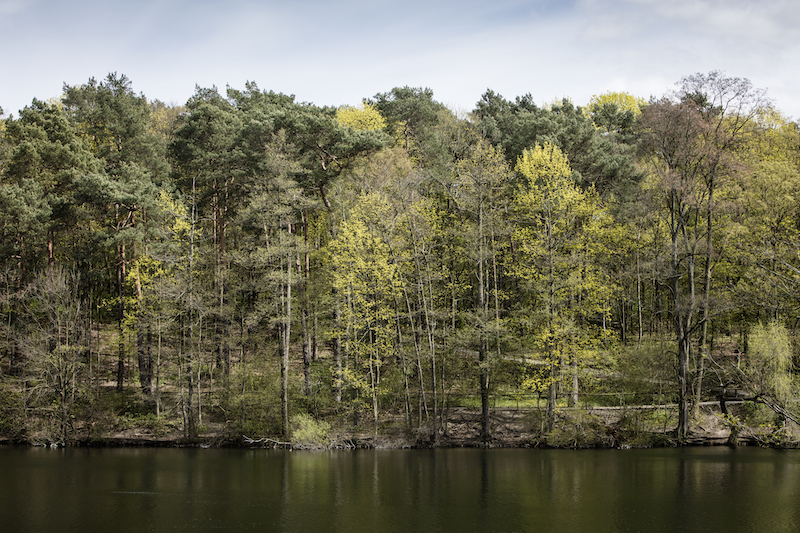
Farther afield lie two of our other weekend getaway spots, Schlachtensee and Krumme Lanke, twin swimmable lakes inside the Grunewald, the wilderness on the outskirts of the capital that began as a private hunting ground of the Electors of Brandenburg in Prussia in the 16th century. Wildschwein still dwell deep in the forests, and I sometimes catch sight of these furtive, tusked and bristly beasts in the thick woods in the early morning. On fine weekends Fischerhutte, a pleasant biergarten and restaurant between the two lakes, is packed with affluent Berliners munching bratwurst and potato salad at picnic tables.
Occasionally, I take a break from writing to ride my bike through the Grunewald, past the Jagdschloss Grunewald — a hunting lodge built by the Prince-Elector Joachim II in 1542, and remodelled as a Baroque palace in the early 18th century. I head down a path through a forest to run or swim across the Schlachtensee, blissfully deserted during the workweek and best avoided on hot summer weekends. In the winter, we huddle under blankets at Fischerhutte and sip mulled wine and hot chocolate and, on the increasingly rare occasions when the lakes freeze over, haul our blades onto the ice for a day of skating.
At Pfaueninsel, a one-time private island retreat for the Prussian King Frederick William II, paths meander through idyllic woodlands and meadows, frequented by peacocks and bordered on one end by a minicastle constructed by the monarch for his mistress. We’ve attended children’s birthday parties here, thrown Frisbees and picnicked on the wide lawns. A couple of years ago I learned that the Nazi leadership, too, appreciated the island’s pristine charms, and celebrated the closing of the 1936 Olympics by hosting a lavish “Italian Night” party here with 1,000 invited guests, including members of the SS. The experience for me has never been quite the same.
Kreuzberg, a sprawling quarter just south of the former Berlin Wall, and bisected by the Landwehr Canal, epitomises for me the flip side of Berlin — edgy, dishevelled and multicultural. Known in the 1970s and 1980s for its squatter houses and borderland hipsterism, today it consists of a gentrified and touristy stretch along Bergmannstrasse and the grittier area clustered around the elevated U-Bahn tracks of the Kottbusser Tor — Turkish markets, cobblestone streets, excellent cafes and still-cheap rents.
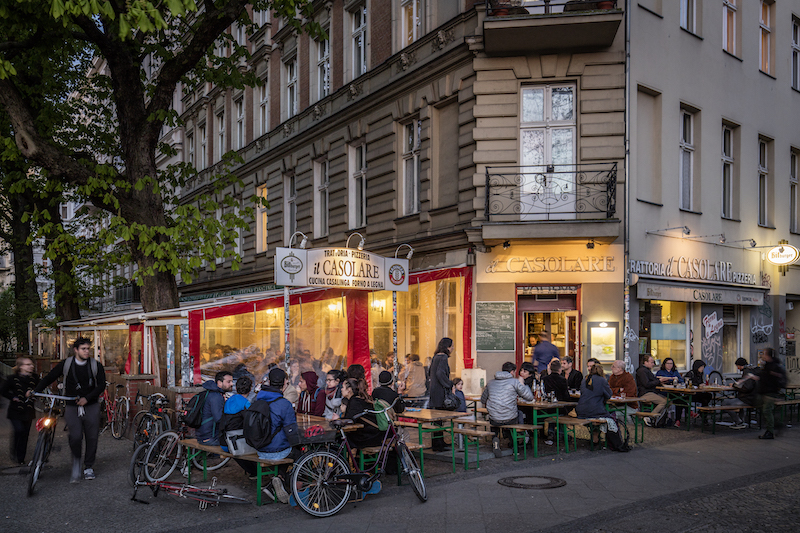
One of my favourite corners of this neighbourhood is the broad green plaza at the end of Grimmstrasse, where the Admiralbrucke, or Admiral Bridge, crosses the Landwehr Canal. On one corner, Il Casolare, perhaps the best Neapolitan pizzeria in Berlin, draws hundreds of people on hot summer nights; the gelato shop across the road packs them in as well. The Planufer, a cobblestone street that follows the canal, winds past outdoor cafes and handsome prewar apartments before spilling into the Kottbusser Damm.
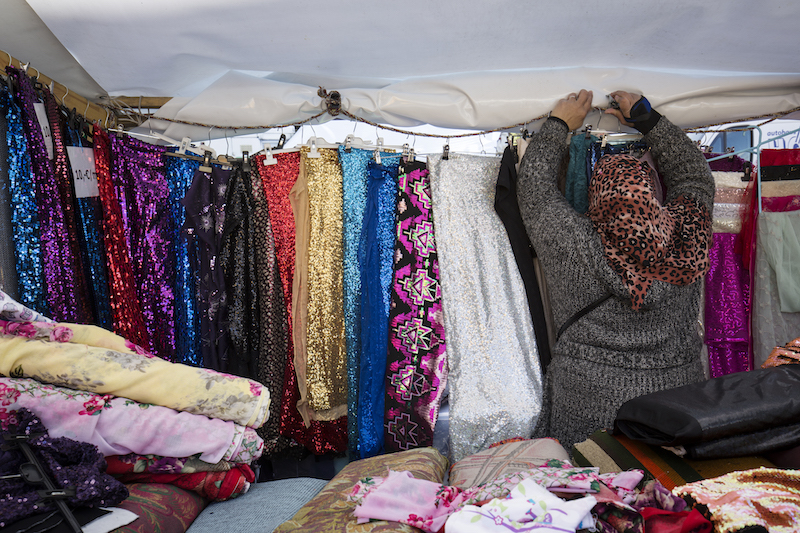
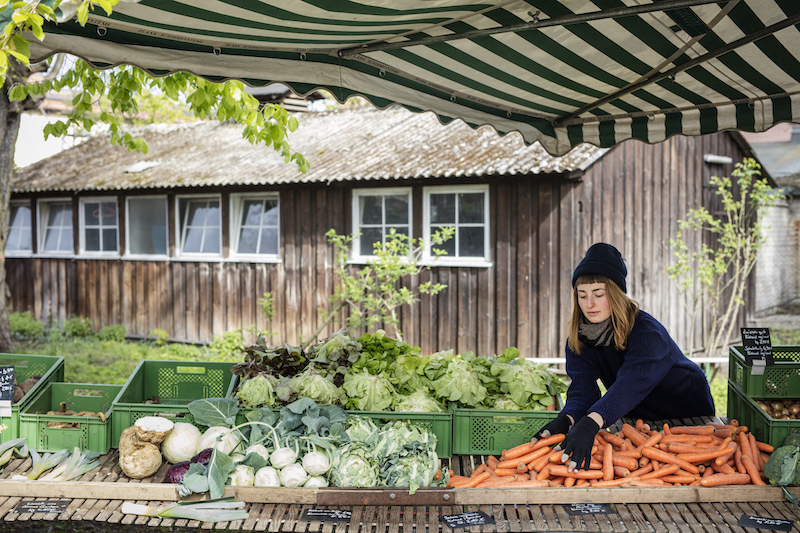
Here Kreuzberg segues into Neukolln and the Planufer changes its name to the Maybacherufer, where, on Tuesdays and Fridays, one of the city’s biggest Turkish markets transforms the area into a patch of Istanbul. In the dozens of crowded stalls that line both sides of the street, you can buy Turkish fabrics, glittery shoes, flatbreads, hummus, baba ghanouj, goat and sheep cheese and a bounty of produce ranging from fresh mint to pomegranates.
Half a mile south of Potsdamer Platz stands the Gleisdreieck Park, another experiment in urban redesign. From the end of World War II until 2011 this was one of Berlin’s most blighted areas — in the shadow of the Berlin Wall, sprawling beneath three sets of elevated tracks. The city redeveloped the eyesore into an oasis of play areas, lawns, running tracks, a halfpipe and even a dance floor, while incorporating vestiges of the old rail yards. We often take our son here with his scooter and watch him glide with delight across the park, still divided by a scruffy old railway line.
Tempelhofer Park and the Park Am Gleisdreieck represent complementary approaches to urban renewal: the former preserving an abandoned space, the latter dramatically reinventing one.
Shortly after I first moved to Berlin 15 years ago, I began making forays to the eastern half of the city. My wife-to-be lived in a walk-up apartment just off Danzigerstrasse in still gritty Prenzlauer Berg, and we spent much of our time in the cafes and restaurants of Kollwitzplatz, before an influx of young professionals turned the area around it into one of the highest-priced real-estate markets in the city. Fellow foreign correspondents were slowly shutting down their offices in the west and moving to the Pressehaus across the Spree from the Reichstag. There was a pioneering and raw quality to the place, a sense of flux and possibility.
Today, I still get to the east on a regular basis — a healthy jolt out of my sedate Wilmersdorf existence — though even once-frontier neighbourhoods like Neukolln and Friederichshain have been tamed and gentrified during the past decade. But the vibrancy of the street life, the variety of the restaurants — from the fashionista hangout on the roof of Soho House near Alexanderplatz in Mitte to the wildly popular Korean hole-in-the-wall Yam Yam on Alte Schonhauser Strasse, also in Mitte — can’t be matched by anything in the west.
And a walk along the Spree on a darkening July evening — the Reichstag’s glass dome glowing pink in the setting sun, the lights of the postmodernist Federal Chancellery Building, the official residence of Angela Merkel, reflecting off the river — captures for me the essence of a confident, fully realised city that has swept away both its east-west divisions and the horrors of World War II. It’s the perfect counterpoint to the Stolpersteine and other vestiges of the darkest period of German history, another reason that I find the city such an optimistic and astonishingly varied place. — The New York Times