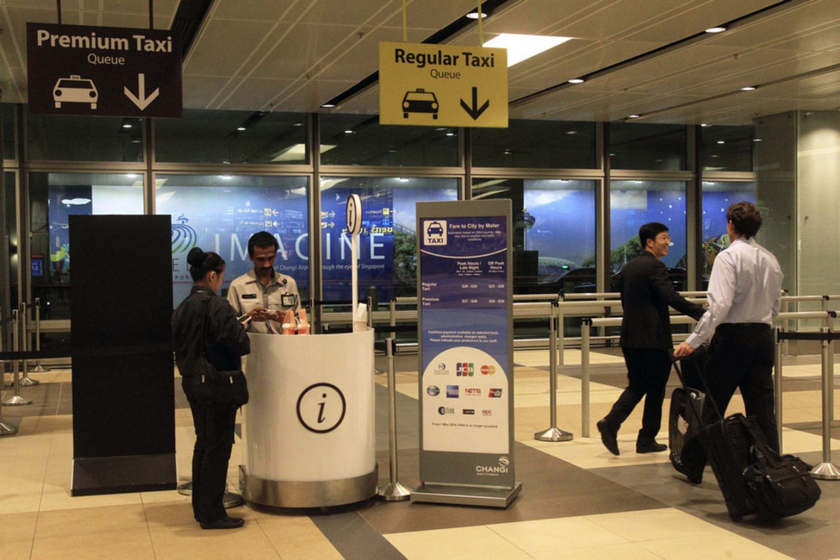


SINGAPORE, Dec 12 — In the aftermath of the kerfuffle over Changi Airport Terminal 1’s short-lived trial of a separate queue for premium cabs, commuters and transport experts have questioned the relevance of such taxis in today’s market, given how the gap between premium taxis and regular ones has narrowed sharply in terms of vehicle make. In addition, there is a limit to the extra services that premium-taxi drivers can offer.
David Teng, 34, a professional photographer, who takes cabs frequently, said: “Taxis are about convenience. I just want to go from point A to point B,” he said. Nevertheless, he said he does not mind hailing a premium taxi and paying a few dollars more if he is in a rush.
“I haven’t noticed any difference in service level (between premium cabs and regular ones),” he said.
Another commuter, Alex Woon, 25, an engineer, added: “You just want to get to the destination as soon as possible. The extra fare is not really worth it.”
All six taxi operators here have a small proportion of premium taxis in their fleets. For example, SMRT Taxis has 411 limousine taxis in a fleet of more than 3,000. Premier Taxis operates more than 2,000 taxis, 40 of which are premium cabs.
Depending on the vehicle model, premium taxis can cost S$3 to S$5 (RM8 to RM13.30) more for a 20-minute trip.
At Trans-Cab, a regular cab such as the Toyota Wish charges S$3.40 for the first kilometre or less, followed by 22 cents for every 400m or less after that, up to 10km. A Trans-Cab premium Mercedes-Benz taxi charges S$3.90 and 30 cents, respectively.
On Monday, Changi Airport started what was intended to be a one-month trial of a separate queue for premium taxis at T1. However, it abruptly discontinued the trial after only a day, following strong discontent expressed by cabbies at the arrangement. Premium-taxi drivers felt the new system made it difficult for them to attract customers, with fewer people in the premium-cab queue.
But Nanyang Technological University Associate Professor Michael Li said: “If they want to behave like a normal taxi, then they should charge like a normal taxi.” Noting that commuters are frustrated over the different fares charged by various taxi operators here, Assoc Prof Li added that while better services are expected of premium taxis, there is little a premium-taxi driver can provide that a regular taxi driver cannot on a typical taxi trip lasting 10 to 20 minutes.
Both Assoc Prof Li and transport consultant Tham Chen Munn said premium taxis should stick to pre-bookings and serve as an alternative — and more expensive — option for those who are willing to pay more when regular cabs are difficult to get, for example.
SIM University urban transport expert Park Byung Joon noted that premium taxis, when they were first introduced, had a distinct advantage over regular cabs. However, the gap has been closed, given that old models, such as the Toyota Crown, have been replaced with newer models.
Premium-taxi drivers TODAY spoke to pointed out that many of their cabs are getting old and this may have affected their quality and appeal to commuters. Maxi Cab driver Henry Tay noted that some commuters avoid taking premium cabs to work as they were worried that their employers might reject their transport claims.
Currently, he relies solely on pre-bookings from tourists and corporate clients for business.
“It is getting harder these days. A lot of customers think, ‘why must I pay more?’ Whether it is a limousine cab or not, it’s still a taxi,” he said. — TODAY