


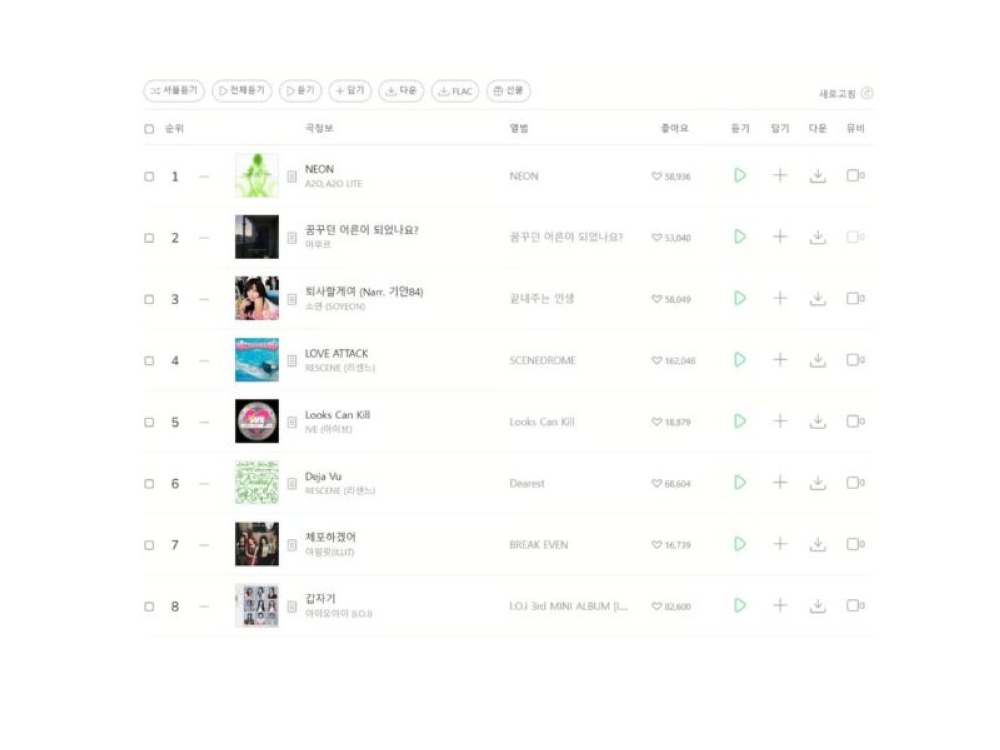
SEOUL, Nov 1 — A song with no human singer has climbed to No 2 on South Korea’s Melon Top 100, and the country is now asking what counts as an artiste.
The Adult I Dreamed Of, by the little-known act Meomuru, reached the flagship streaming chart earlier this week and has made it one of the most-talked-about acts in South Korea, the South China Morning Post (SCMP) reported today.
Behind it is Glorywave, a songwriting and production duo of Lee Yong-seok and Choi Sung-hyuk, who have worked with South Korean artistes for more than a decade.
The pair came up with the concept and wrote the lyrics, then used the AI platform Suno to generate the melody, arrangement and vocals, before editing, mixing and mastering the track themselves.
So the ideas and the words are human, while the voice and the tune are not.
That sets Meomuru apart from virtual boy band Plave, whose animated characters are driven by motion capture and facial tracking, but whose human members sing, dance and interact with fans.
It is closer to American R&B act Xania Monet, whose Suno-generated vocals sit over lyrics by poet Telisha “Nikki” Jones, and whose chart success has drawn fire from musicians such as Grammy-winning Victoria Monet, who say AI acts undercut working performers.
Listeners in South Korea are split, and largely by age.
Lee Sun-mi, a 41-year-old housewife in Daejeon, found Meomuru’s other songs “a bit too generic” and does not plan to seek out AI music again.
Shin Ji-hye, a 19-year-old university student in Jecheon, said knowing about the AI did not change her view of the song, and that tools like Suno let people who cannot sing or afford a studio make music.
The law offers little clarity, as South Korea’s Copyright Act protects only works with human creative input, but does not say where machine generation ends and human contribution begins.
Glorywave told the Kyunghyang Shinmun daily that they have not registered the song with the Korea Music Copyright Association (Komca) and are not collecting standard songwriting or arrangement royalties.
Komca brought in criteria in August to allow registration of AI-assisted music with a substantial, leading human role, only to withdraw them 22 days later after pushback from the creative community.
Lawmakers are now examining whether the AI Basic Act should be expanded, amid renewed calls for mandatory labelling of AI-generated music.
Suno, meanwhile, faces lawsuits in the United States from labels including Universal Music Group and Sony Music Entertainment, which allege its models were trained on copyrighted recordings without permission.
Music critic Kim Sung-hwan told SCMP that the key is “the original idea behind an AI-generated song”, and whether it came from a human.


