


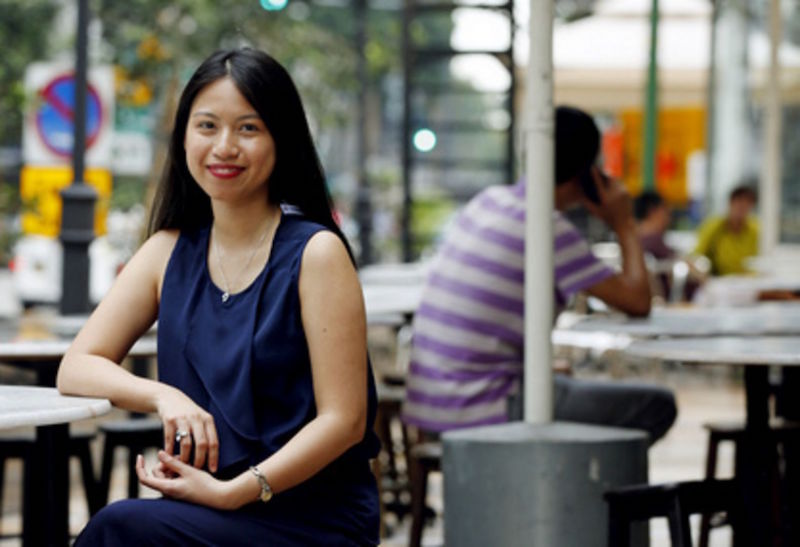


SINGAPORE, May 18 — For Dr Danica Salazar, world English editor at Oxford English Dictionary (OED), the Singaporean expression “blur like sotong” is poetry to be proud of, and not something to be embarrassed about.
“I think the phrase is wonderfully evocative. When I hear it, I think of this squid lost in a cloud of its own ink. It’s so creative,” said Dr Salazar, who is Filipino. “It strikes me as strange when people think of (such words) as things that are ruining the language.”
Like creole in almost all countries, such “Singapore English” words and phrases reflect the speaker’s creativity and add to the richness of the English language, she said, noting that language is a convention where people agree to use words for specific meanings.
“As long as these words have fulfilled a need, something that Singaporeans needed to express, there is nothing wrong with them,” added Dr Salazar in an interview at Lau Pa Sat yesterday. She is in Singapore for two talks happening today and this Saturday about the inclusion of Singapore English in the OED.
She cited that while only Singaporeans use “HDB” to refer to public housing, the emergence of this word was a legitimate linguistic process, similar to how the British use “flat” and Americans use “apartment”.
These indigenous variations were the spark for the OED to start a dedicated project in 2013 to add words to the historical dictionary from the English lexicology of different countries. With English now a global language spoken in different places, people will have different things to talk about and the vocabulary will adapt, said Dr Salazar.
In varieties of English used across the world, new words are often borrowed from other languages, such as from Malay and Chinese in Singapore, she said.
However, Dr Salazar pointed out that Singapore English is not the same as Singlish. While the former is a variant of English, Singlish is a language on its own with a different grammatical structure. It is also used mostly orally.
As a dictionary that records the history of English, the OED needs to reflect the parts that Singaporeans, Filipinos, Indians and other English speakers play in the vocabulary, she added.
In the OED’s latest update in March this year, 19 Singapore English words were added to the dictionary, such as “ang moh”, “lepak” and “shiok”.
To add new words to the dictionary, editors track new words in local books, newspapers and other publications. They also consult local vocabulary experts, while readers highlight new words to the editors. Each entry is accompanied by authentic examples of the word being used.
Often, the new words are gleaned from “normal everyday things that people read”, said Dr Salazar. When she visited Singapore in 2013, for example, she returned to Oxford with a pile of magazines — teenage, entertainment and gossip magazines. These platforms are where people write “more naturally” and new words crop up, she noted.
Another observation that Dr Salazar has about studying Singapore English: Many of the new Singapore English words are food-related, such as “char siew” and “chilli crab”.
“The difficult thing about working on Singapore English is it makes you hungry,” Dr Salazar quipped.
The department also pores through historical material to find instances of a word’s use in the past. Probably unknown to many is the fact that the phrase “ang moh” was used as early as 1899, in an article in the Singapore Free Press.
When the OED is next updated in June, Singaporeans can expect more Singapore English words to be added to the dictionary, said Dr Salazar. To be sure, there will be more food-related words, such as “chicken rice” and “rendang”, she added.
Once a word is in the OED, it is a part of the history of English and is never removed. “Singaporeans can be rest assured that ‘chilli crab’ will be in the OED forever,” said Dr Salazar. — TODAY


