


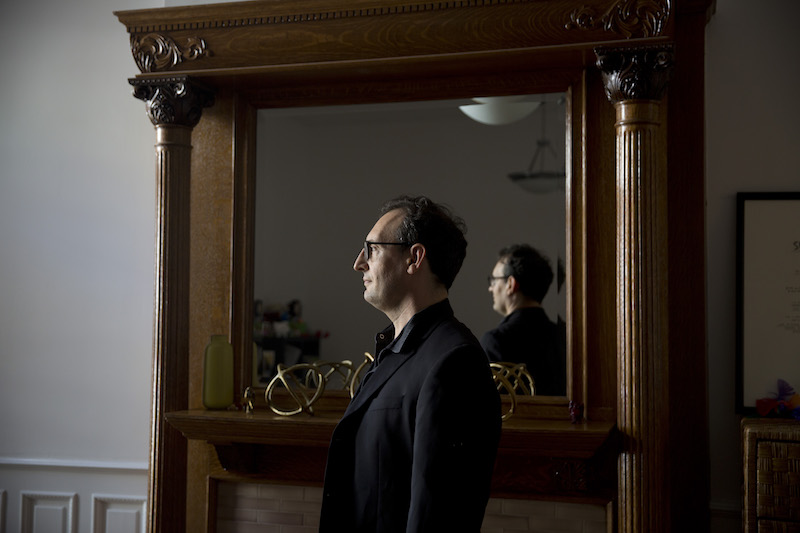
NEW YORK, April 4 — After Diana Colbert died of leukaemia in 2011, her husband, the novelist Charles Bock, began reading through the journals she kept when she was sick. Colbert had hoped to write an inspirational book about her experience, and she took notes while she was undergoing gruelling chemotherapy and transplant procedures, often through the haze of medication.
It was a year and a half before Bock could bring himself to read them. When he did, the journals unexpectedly helped shape his novel Alice & Oliver, which comes out tomorrow and is about a New York couple whose lives are upended when Alice is given a diagnosis of leukaemia.
Much of the story unfolds in the claustrophobic confines of a cancer ward, where Alice struggles to stay upbeat for her husband and baby, and Oliver tries to suppress his grief and rage as he negotiates with insurance companies and tries to decode impenetrable medical jargon.
Reading the journals helped Bock pull off one of the most difficult narrative feats in the novel: writing from the perspective of a dying woman who is torn between accepting her fate and fighting it.
“They became a baseline,” Bock, 46, said during a recent interview at his apartment in Park Slope, Brooklyn, which is cheerfully accented with art by his seven-year-old daughter, Lily. “I would write over them, or take moments, and I would change them, but I felt like, ‘I get to keep her spirit in the world.’”
The journals also gave Bock insight into the surprising ways his wife had coped with her illness. In one entry, he came across a passage that stunned him. “Charles is often miserable,” she wrote. “I am not.”
Bock knew that for the story to work as a novel, it had to be more than just a devastated husband’s tribute to his wife. Fictionali’sing elements gave him some distance and helped him focus on the structure and arc of the book. He changed the time period — it takes place in the 1990s — and made Alice a fashion designer and Oliver the head of a software startup. To give the story a broader scope, he broke up the narrative with recurring “case studies,” which feature compressed portraits of other people in the ward.
One of Bock’s friends, the novelist Matthew Thomas, said writing the book took an obvious toll on Bock, but it also gave him an outlet for his grief.
“He never insulated himself from the potential pain of entering material like this,” Thomas said. “He went into it vulnerable and allowed it to work on him.”
Bock and Colbert met at a party in Williamsburg, Brooklyn, in 1998. He was instantly smitten. He went with her to another party and walked her home in the rain.
At the time, he was writing Beautiful Children, a sweeping story about young runaways, strippers, hustlers and meth addicts in Las Vegas, where Bock grew up. Colbert, who taught yoga and worked as a massage therapist, supported him through years of tortured rewrites.
They had been married for about four years, living in a one-bedroom apartment in the Gramercy Park neighbourhood of Manhattan with six-month-old Lily, when Colbert’s leukaemia was diagnosed in 2009.
After several rounds of chemotherapy and radiation and two bone marrow transplants, Colbert’s cancer went into remission in spring 2011, but she remained frail. The cancer returned, and she died that year, at 41, three days before Lily’s third birthday.
Bock told friends he didn’t expect to find romantic love again. But two years ago he met the writer Leslie Jamison at Paragraph, the writing space where they both work. An email flirtation developed after Bock wrote to her to say how moved he was by one of her essays. Shortly after, they started dating.
Bock brought Lily, who wore a fox mask for the occasion, to a reading Jamison gave from her book The Empathy Exams. Lily and Jamison immediately hit it off. A few months later, at another literary event, Lily joined Jamison onstage and the two of them sang Let It Go, the ballad from Disney’s Frozen. After an intense courtship, Jamison and Bock were married in Las Vegas. Lily started calling Jamison Mommy.
They moved to Park Slope about a year ago, and settled into a busy domestic routine of writing and raising Lily. Bock recently read a draft of Jamison’s forthcoming book about addiction. Jamison offered him feedback on Alice & Oliver.
“The craftsman in Charles, the part of him that’s so committed to thinking about structure and form and character, really makes him come alive,” she said. “He wasn’t just being crushed by the weight of the past.”
Bock isn’t letting go of the past, either. He has Colbert’s journals and papers for Lily to read one day, and photos of her in her final months. In one series of photos, Colbert is sleeping, bald and emaciated, with Lily nestled by her side. Both mother and daughter look completely content, soothed to sleep by each other’s presence. — The New York Times


