


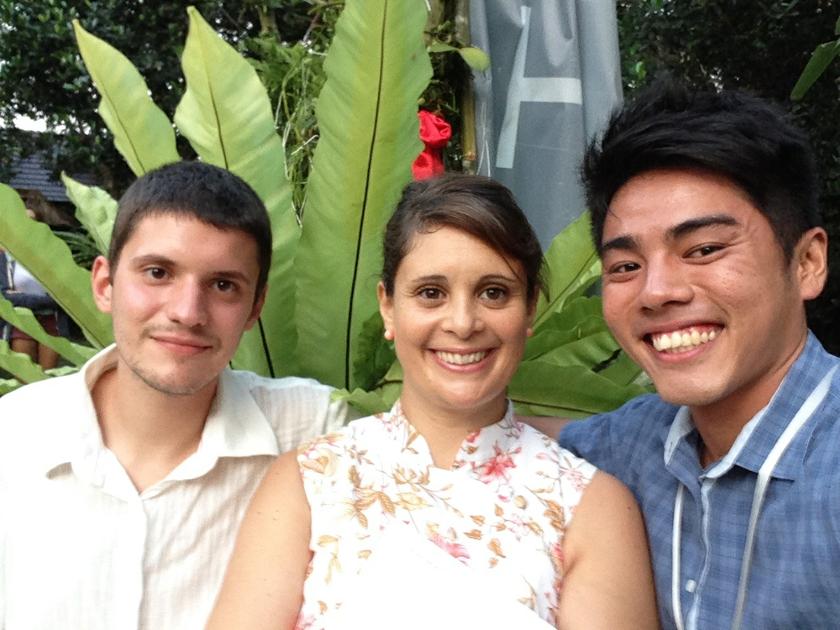
OCT 18 — On the third day of our visit to the 13th Annual Ubud Writer's and Readers Festival (UWRF13), my new friend - one Yordan Radichkov from Bulgaria - and I decided that we were going to kick it back a little at our hotel, and just relax for a little while before turning in to bed. The past few days had been a whirlwind of panel session after panel session, event after event and it was the first night in a string of nights that we were back at the hotel at a decent time.
As we sat there in the garden of the Safari Elephant Park Lodge, the hotel that the Festival had put the both of us up at, we got to talking. A lot. Fueled with three days worth of intellectual discourse – the sort dispensed only by the most celebrated writers from around the world - and two large bottles of Bintang beer, we exchanged buckets of anecdotes about each others' lives; our hopes, our dreams, our fears, our thoughts about everything that we have seen and heard in the past few days. It was Yordan's first ever trip to Ubud and his first to the Festival, my third trip to the former and my second to the latter, and there was plenty to discuss, rip apart (I make no apologies for this; there were moments aplenty in the Festival ripe for satire and derision) and laugh over.
At some point, our conversation turned to matters of a more philosophical nature and the one subject that we tossed about like a football on the field was with regards to the existence of evil (aka the baddies) on this earth, their purpose as well as ours (assuming that we represent the goodies).
While I didn't disagree with Yordan's view that the goodies had a duty inherent to do battle against the baddies, I found myself taking the position that evil would never really ever go away. I argued - has it not been seen in the history of mankind that many acts of great evil have grown out of the desire to do good and vice versa? A huge argument to be made under the influence of what little alcohol we had in our systems I'm sure, but I wondered - and in not as many words - is it not the purpose of evil to give good a purpose of its own? One certainly can't exist without the other; without evil good would hold no value of worth - without ugliness there would be no beauty, without indifference there would be no compassion, without dark there would be no light.
The 13th Annual Ubud Writers and Readers Festival has for this years' theme 'From Darkness to Light' (the more melodic Indonesian translation reading 'Habis Gelap, Terbitlah Terang') and as we sat there in the semi darkness - the indistinct rumbling of slumbering Sumatran elephants providing a tranquil white noise to our buzzing and somewhat buzzed thoughts – it occurred to me that this was exactly what we had witnessed ever since the Opening Gala of the Festival.
The UWRF13 was first organised by an Australian businesswoman, Janet DeNeefe, who had adopted the idyllic island of Bali as her home in the wake of the devastating bomb attacks of 2002 perpetrated by religious extremists.
When thrown into a situation of extraordinary adversity, one can choose to be consumed and to surrender (and I write this right now with absolutely no judgement; surrender is a position and decision with as much validity as is the refusal to submit given the specifics of any given circumstance). One can also choose to rise from the ashes of destruction, brush off the dust from ones shoulders and to hold up high one's middle finger to his aggressor in a show of pride, defiance and fearlessness. Miss DeNeefe is one such individual. In fact, I can all but almost see - in the fiercely single minded manner members of Miss DeNeefe's tireless team exhibits in the running of the Festival - a distant reflection of what must have transpired in the aftermath of the Bali bombing.
While I have been fortunate enough not to have experienced the event and its aftermath first hand, I can only appreciate with much admiration the immense courage and will it must have taken for the Balinese to recover from the attack – and recover it certainly has. In its official literature, the UWRF13 touts itself as having come full circle on the 10th anniversary of its founding - a healing project in response to the first Bali bombing that has since grown into a premier celebration of life and the living of it through the arts.
When I attended the UWRF six years ago (then in its fourth year running), I was blown away – pun completely unintended – by the sheer immensity of the Festival. Once the subject of my wildests fantasies, I suddenly found myself sharing the same air space with writers I had long admired (I mean, come on; Tan Twan Eng and Kiran Desai!). In fact, so overwhelmed was I by this exposure that I remember precisely zero detail from the experience. I departed from the Festival with mixed feelings; an acute awareness of my smallness and the smallness of the world as I once saw it and the glimmer of a hope that I will one day be able to rank these literary and intellectual giants as peer.
Well from darkness to light it is; I returned to the Festival this year as one of two winners of its first ever short story award (shortlisted from a submission ocean of nearly 500 entries, if I may be allowed to brag just a little), organised in collaboration with the Asia Europe Foundation. I also walked away from this year's Festival feeling a little less small but still no less overwhelmed or humbled (I mean, come on; Bernice Chauly and Lionel Shriver! Cate Kennedy and Salena Godden!).
As for the Festival itself - if this year's events is anything to go by - I imagine it will continue to grow and to prosper in the many, many years to come and in its fair wake inspire much goodness, wisdom and beauty. All these in spite of – nay, as a result of – the hideous crime of hate and ignorance done onto the island and the people of Bali in 2002.
What gall.
What audacity.
What insolence.
What brazenness.
What a triumph.
Habis gelap, terbitlah terang.


