


JUNE 17 — If taxi drivers are talking about it, then it’s an issue I should pay attention to. Lately, several of the taxis I’m in have had very excited drivers at the wheel — chatting about their HDB flats and its future.
To explain; the HDB (Housing Development Board) was established in 1960, its mission to provide an affordable home for every Singaporean .
The board has long been hailed as an enormous success. The large-scale construction of hundreds of thousands of homes starting in the 60s and continuing to the present day has provided high quality, modern accommodation to generations of Singaporeans.
As testament to the scheme’s success, today an overwhelming majority, 82 per cent, of Singapore’s population lives in HDB housing. Few nations have higher proportions of people living in public housing.
There are no slums, no ghettos and the flats and their surroundings are regularly refurbished and upgraded.
Given such a large number of Singaporeans live in HDB flats there is also a healthy social mix — the underprivileged, middle class and relatively affluent all share the space.
Continuous campaigns ensure cleanliness, safety and relative ethnic and social harmony.
Every HDB development features its own residents’ committees, sports facilities, child care, parks, food courts, clinics. It’s arguably the most successful public housing scheme in the world.
The scheme’s success is such that it’s difficult to convey the extent of its influence on Singaporean life to outsiders. Most of us are HDB kids.
But the HDB shaped modern Singapore on the most fundamental level — it made possible our transition from villages and shanties of the 40s and 50s .
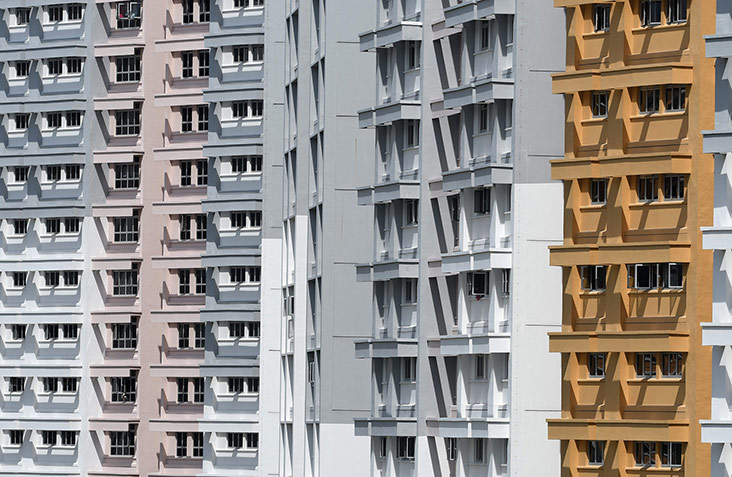
The flats, their food courts, playgrounds and support structures form the basis of most lives in Singapore. Buying an HDB flat is one of the great milestones in the life of a Singaporean. You become eligible for a flat once you are are married or once you are 35.
The focus on marriage illustrates how the HDB is also a tool for the government to implement its social, economic and even moral policies.
Every Singaporean pays part of her/his salary into the CPF (Central Provident Fund) and this fund is primarily used as a retirement saving but funds from CPF can also be used as a down payment for HDB flats.
The remaining loan and mortgage for the purchase of the flat is usually provided by the HDB itself.
Fundamentally this means a large amount of Singapore’s wages and saving are channeled into the HDB. It’s part of the social contract; the government provides affordable housing but citizens help finance the scheme though their payments.
However, the reality is HDB prices have risen to the point where there are questions with regards to the extent of any subsidy and overall affordability. Today flats can change hands for over S$1 million (RM2.96 million).
HDB flats are seen not simply as public housing but as an asset and have been priced accordingly. Even brand new flats sold by the HDB are now priced at hundreds of thousands (when the scheme began in 1960, flats could be had for S$6,000).
This is why recent announcements by the government and HDB that that there will, in most cases, be no renewal or extension of leases on HDB flats and that there would be no large-scale buy back has had such an impact.
Basically when your 99 years is up, your home will revert to the state/HDB and you will need new accommodation. This also means the real estate value of a flat will eventually hit S$0.
People who, in the last few years, paid lots of money for second-hand older and centrally located flats now see an asset that’s depreciating as years on the lease roll by. Young couples who made this decision are paying for a lease that might run out in their lifetime.
Older people who were looking to sell their HDB flats and use the capital gain for their retirement find their 40+ year old flats are no longer attractive to buyers.
This really impacts everyone.
Singaporeans today are not the village dwellers of 50 years ago; they are largely middle-class savers and for this group seeing their nest eggs and asset base shrink in value is a crisis.
Of course the HDB has always been a public housing scheme and all over the world, these tend to be lease based. There’s no expectation, for example, that a private condo owner buying a 99-year lease is going to get a renewal or a buy back.
But in Singapore an HDB flat is seen as more than public housing; it’s a home, an asset and is even viewed as a “birthright.”
So the idea of homes reverting to the state and asset values going to zero within decades (in some cases) is anathema to many. More and more people are looking to sell their older flats but this has a negative impact on HDB and broader property prices — with a knock on effect to the economy.
However, a lot of these moves are premature; the very oldest flats are 50 years old meaning there are still decades left on the lease. New HDB flats with a 99-year lease can still serve as homes for generations. The government also has many policy tools it can deploy to mitigate the current disquiet.
There’s already a lease scheme where elderly HDB owners can sell part of their leases back to the government. The government could potentially extend this scheme and offer loans to those whose leases are about to run out so they can buy new Flats. It could allow the purchase of additional lease years.
But all of this is for the future. For now, Singaporeans are feeling insecure about the very roofs over their heads and are waiting for a clear government directive explaining what will happen at the end of the 99 years.
* This is the personal opinion of the columnist.


