


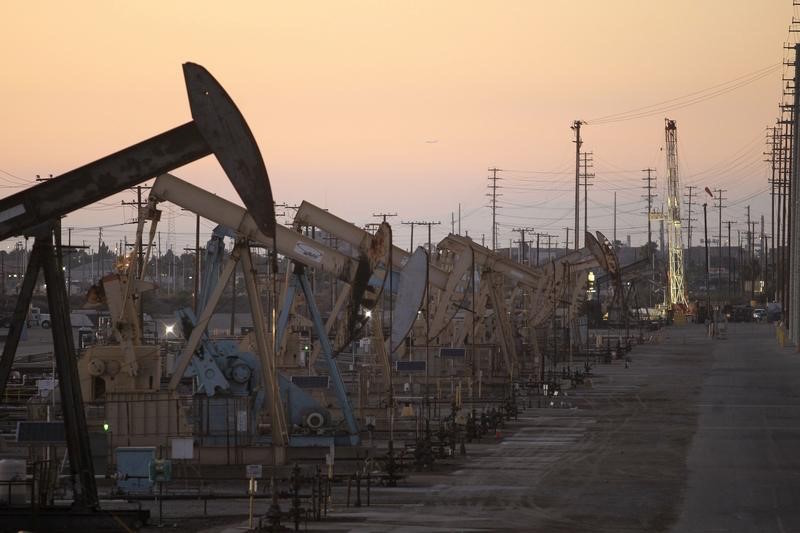
LONDON, May 10 — World stocks hit a three-week high today and turned positive for the year as rising oil prices gave energy firms a shot in the arm that countered the effects of increased political uncertainty.
Brent crude rose to another 3-1/2 year high of US$77.89 (RM312.74) overnight amid fears of supply disruptions after President Donald Trump withdrew the United States from a 2015 nuclear accord with Iran and ordered sanctions be re-imposed.
The dollar meanwhile eased slightly from 2018 highs ahead of US April inflation numbers on Thursday and as currency markets eyed the Bank of England’s policy meeting and inflation report.
“It’s difficult to know what the principal drivers are given there’s a whole host of events, but it could well be that the effect of oil prices on resources companies is outweighing negatives elsewhere,” said Investec economist Philip Shaw.
“But I think the main thing the market is looking out for is whether growth in the global economy has peaked and is slowing down,” he said, citing reduced growth data in the euro zone and Britain as examples.
Energy shares led Asian stock indexes higher, pushing the 47-country MSCI world equity index to its highest level in three weeks. It is now positive on the year, up 0.3 per cent from its starting level on Jan. 1.
European shares largely took their cues from Asian and US peers and rose, but the gains were tempered as British phone company BT reported disappointing results and Italian political worries weighed on sentiment.
The pan European STOXX 600 Index started on the front foot but was 0.2 per cent lower around midday, pulled down by Italian stocks, which fell 1.5 per cent.
Italian government debt also sold off sharply, with 10-year yields hitting a seven-week high as Italy’s 5-Star Movement and the far-right League moved closer to forming a government of anti-establishment parties.
A crucial obstacle was removed late on Wednesday when former prime minister Silvio Berlusconi, the League’s main ally, gave a green light to the talks, accepting a demand from 5-Star that his Forza Italia party take no part in the next government.
In Malaysia, meanwhile, an alliance of opposition parties spearheaded by Mahathir Mohamad won the general election, putting the 92-year old strongman on course for a return to the prime minister’s office he occupied for 22 years.
Over the past day the Malaysian ringgit has slid nearly 3 per cent in the one-month non-deliverable forward market and the cost of insuring the country’s debt against default has risen.
BOE's holds rates
Britain’s FTSE 100 index was flat on the day after the Bank of England kept interest rates on hold. It said weak growth during the snowy start to 2018 was likely to be only temporary, but that it wanted to see a pick-up in the next few months before raising borrowing costs.
The British central bank had until recently been expected by investors to hike rates this month.
The BoE also cut growth and inflation forecasts for the coming years, pushing sterling lower.
The US Federal Reserve now remains the only major central bank that appears to be on course for rate hikes, with New Zealand’s Reserve Bank saying it will keeping the Official Cash Rate (OCR) at 1.75 per cent “for some time to come”.
The New Zealand dollar retreated to a five-month low of US$0.6915.
Earlier, MSCI’s broadest index of Asia-Pacific shares outside Japan advanced 0.6 per cent, while Japan’s Nikkei climbed 0.3 per cent. South Korea’s KOSPI rose 0.5 per cent and Shanghai SSEC was 0.2 per cent higher.
Brent crude futures were up 0.8 per cent to US$77.66 a barrel, the highest since November 2014 and building on gains of about 3 per cent on Wednesday. US light crude futures were up 0.6 per cent at US$71.59. — Reuters


