


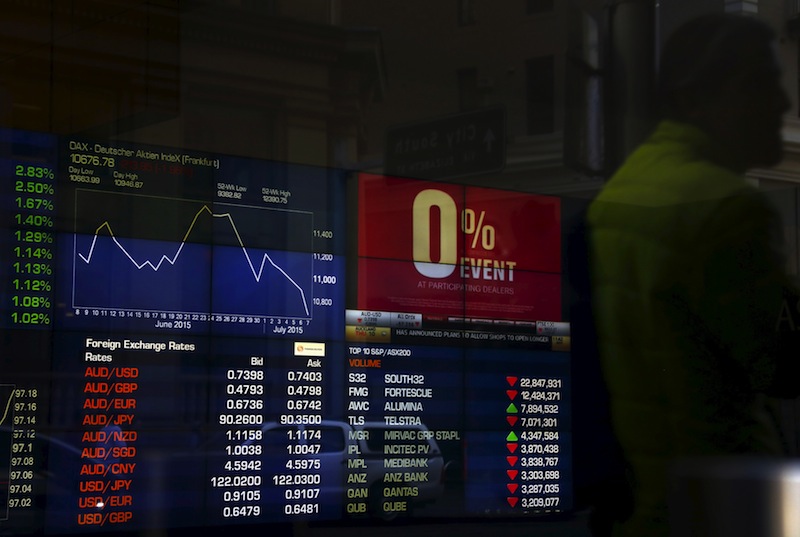


SHANGHAI, July 8 — China’s benchmark Shanghai stock index was down nearly four per cent by midday today, with additional government moves failing to shore up the tumbling market as contagion spread globally.
Chinese sentiment was hurt as trading halts expanded to cover more than 1,300 listed companies to prevent further falls in their stock prices.
The benchmark Shanghai Composite Index dropped 3.88 per cent, or 144.62 points, to 3,582.50 at the end of the morning session, having fallen as much as 8.20 per cent.
The Shenzhen Composite Index, which tracks stocks on China’s second exchange, slid 3.27 per cent, or 63.27 points, to 1,869.56. It fell as much as 4.20 per cent.
“Selling of blue chips dragged down the Shanghai market this morning,” Zheshang Securities analyst Zhang Yanbing told AFP.
“Investors started selling heavyweight blue chips as there is no liquidity left in the small company stocks, which means there are very few of these companies they can sell,” he said.
The latest falls came despite the government announcing new measures to support the market, including allowing insurance companies to invest more assets in stocks and a programme to buy the shares of smaller companies.
Hong Kong equities had plunged 4.20 per cent by midday and Tokyo was down 1.52 per cent, as contagion spread into regional markets and on fears about Greece’s future in the eurozone.
“China’s stock market rout is now spreading to other financial markets, creating a sweeping sense of panic and liquidity crunch,” said Zheng Ge, an analyst at Wanda Futures Co.
New measures
By midday, Shanghai was down by more than 30 per cent from its closing peak on June 12, when it had risen by more than 150 per cent in 12 months.
Analysts say the falls were mainly triggered by new restrictions on margin trading and accelerated by concern about overvaluations.
Among the latest interventions by Beijing, the insurance industry regulator said Chinese insurance companies will be able to invest up to 10 per cent of their assets in a single “blue chip” stock, up from the previous five per cent.
Separately, the state-backed China Securities Finance Co. will “increase” stock purchases of small- and medium-sized companies, the securities market regulator said.
The People’s Bank of China, the central bank, also pledged to support the “stable development” of the stock market by helping the China Securities Finance Co. raise funds, according to a statement on the bank’s website.
On Sunday, the government said the central bank would provide funds to the China Securities Finance Co. to help “protect the stability of the securities market”.
In the wake of the stock market slump, at least 1,301 companies have halted trading on mainland Chinese exchanges, locking up US$2.6 trillion (RM9.922 trillion) of shares, or about 40 per cent of the market’s capitalisation, Bloomberg News reported.
“With so many companies suspending trading, it will hurt market liquidity and cause the risks to collect in the rest of the firms still trading,” Yingda Securities analyst Li Daxiao told AFP.
At the weekend, the China Securities Regulatory Commission said there would be a temporary halt to initial public offerings, which tend to drain funds from the rest of the market, hurting prices and sentiment.
China’s 21 largest brokerages said on Saturday that they would invest at least 120 billion yuan (RM73.655 billion) in so-called “blue chip” exchange traded funds. — AFP


