
















SEOUL, Oct 7 — South Korea’s biggest companies, Samsung Electronics Co and Hyundai Motor Co, are losing their sway over the nation’s US$1.2 trillion (RM3.91 trillion) stock market as export earnings slow and the government supports smaller businesses.
The combined market value of the Galaxy smartphone maker and the manufacturer of Sonata sedans shrank by US$44 billion this year to US$194 billion as of last week, even as Korean equities added US$8.2 billion. The companies’ proportion of the nation’s exchange has dropped to a three-year low of about 16 per cent and their correlation with the broader market is the weakest since 2008.
Samsung is facing stiffer competition from Apple Inc. and Hyundai’s overseas sales have been squeezed by a stronger won, just as Korea’s President Park Geun Hye seeks to curb the economy’s reliance on family-run conglomerates known as chaebol. Equity analysts tracked by Bloomberg have cut ratings on the two companies to the lowest levels since 2009, while all of their most-favoured stocks have market values below US$2 billion.
“Hyundai and Samsung are both good companies and certainly are not expensive, but they do lack growth and earnings visibility,” said Sam Le Cornu, whose Macquarie Asia New Stars Fund focuses on smaller companies in the region and has outperformed 98 per cent of peers tracked by Bloomberg in the past five years. “It may be the higher growth nature of these other businesses compared to the exporters or cyclical names that investors are looking for.”
Small-cap rally
Dongwon F&B Co, a Seoul-based producer of processed food, and Pyeong Hwa Automotive Co, a maker of auto parts, are among analysts’ top picks in Korea, with unanimous buy ratings. Le Cornu favors Hotel Shilla Co, a US$4.3 billion operator of duty- free shops that gets most of its sales from Chinese tourists, he said in an e-mail interview from Hong Kong on October 3.
Korea’s small-cap Kosdaq Index has climbed 13 per cent this year, while the Kospi slid 2.1 per cent. The won has strengthened 2 per cent against the yen, weighing on Korean exporters who compete with Japanese producers of electronics and cars.
The yield on the government’s three-year notes has dropped about 59 basis points, or 0.59 per centage point, this year to 2.29 per cent as the central bank cut its policy rate to the lowest in more than three years. Asia’s fourth-largest economy will probably accelerate to 3.7 per cent this year from 3 per cent as government spending rises and lower borrowing costs support domestic demand, according to forecasts from the finance ministry.
‘Serious problem’
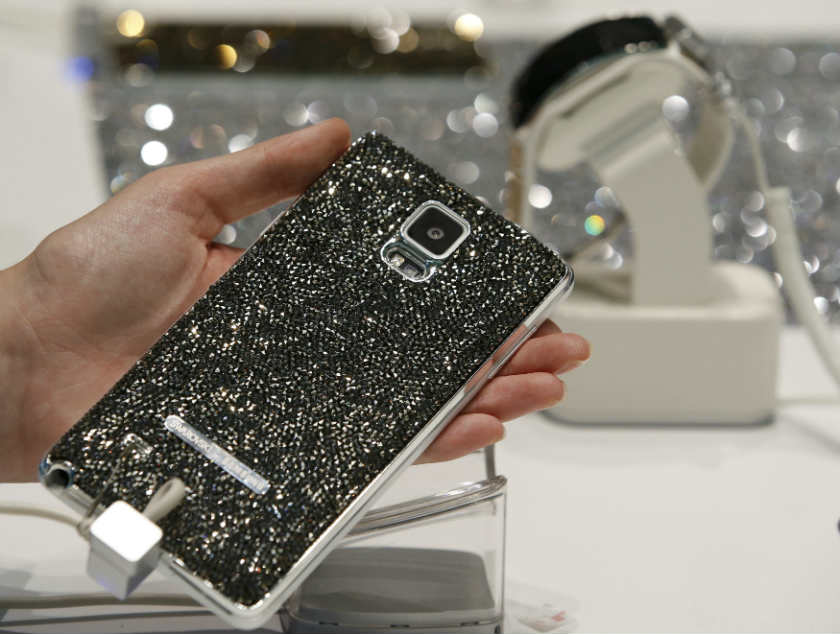
Samsung, the world’s biggest maker of smartphones, retreated 16 per cent this year through yesterday and touched a more than two-year low on Oct. 3. The Suwon, South Korea-based company posted third-quarter earnings that missed analysts’ estimates today.
Hyundai Motor, Korea’s largest automaker, reported a 6.5 per cent drop in second-quarter net income as the strengthening won eroded earnings from overseas. The stock has retreated 8.8 per cent this year, weighed down by Hyundai Motor Group’s decision to pay US$10 billion for a plot of prime real estate in Seoul, or triple the property’s assessed value.
“The yen has become a serious problem for Korea Inc.,” Mark Matthews, the Singapore-based head of Asia research at Bank Julius Baer & Co, said by phone on Oct. 2. “Samsung appears to be willing to sacrifice margin to maintain its market share. It will obviously not be good for the share price.”
Foreign outflows
The press offices of Samsung Electronics and Hyundai Motor declined to comment. Samsung shares increased 1.7 per cent at 9.46am in Seoul, while Hyundai dropped 0.5 per cent. The Kospi rose 0.5 per cent.
Most foreign investors tend to ignore Korea’s smaller companies because they’re focused on stocks such as Samsung and Hyundai that comprise a large proportion of benchmark indexes, Daphne Roth, the Singapore-based head of Asian equity research at ABN Amro Private Banking, said by phone on October 2. Samsung’s common shares make up 15 per cent of the Kospi and Hyundai has a 3.6 per cent weighting. The companies comprise 21 per cent and 4.7 per cent, respectively, of the MSCI Korea Index.
International money managers have sold a net US$1.3 billion of Korean shares in October, following US$536 million of outflows last month. Japanese shares lured about US$5 billion in September, according to data compiled by Bloomberg.
The 120-day correlation of changes in the combined value of Samsung and Hyundai versus the wider market dropped to 0.62 on Sept. 30, the lowest since October 2008, down from almost 0.9 at the end of last year, according to data compiled by Bloomberg. Readings of 1 signal they’re moving in lockstep.
Investor confidence
Buy ratings on Samsung account for 83 per cent of total analyst recommendations, the smallest proportion since June 2009, and 86 per cent for Hyundai, the least since December 2009. Samsung’s per-share earnings are projected to fall 27 per cent this year and another 4.6 per cent in 2015. Hyundai’s will increase 5.9 per cent in 2014 and 6.4 per cent the following year, analyst estimates compiled by Bloomberg show.
Dongwon F&B’s profit is projected to surged 51 per cent this year and 10 per cent next year. For Pyeong Hwa Automotive, analysts estimate gains of 9.9 per cent and 22 per cent.
“The current trend of growing influence from the small caps will help improve the Kospi market’s healthiness and resilience,” Huh Nam Kwon, the Seoul-based chief investment officer at Shinyoung Asset Management Co, which oversees about US$12 billion, said in an October 6 phone interview. “The long-term trend of small-cap stocks growth will continue as more investors are beginning to have confidence in them.” — Bloomberg