


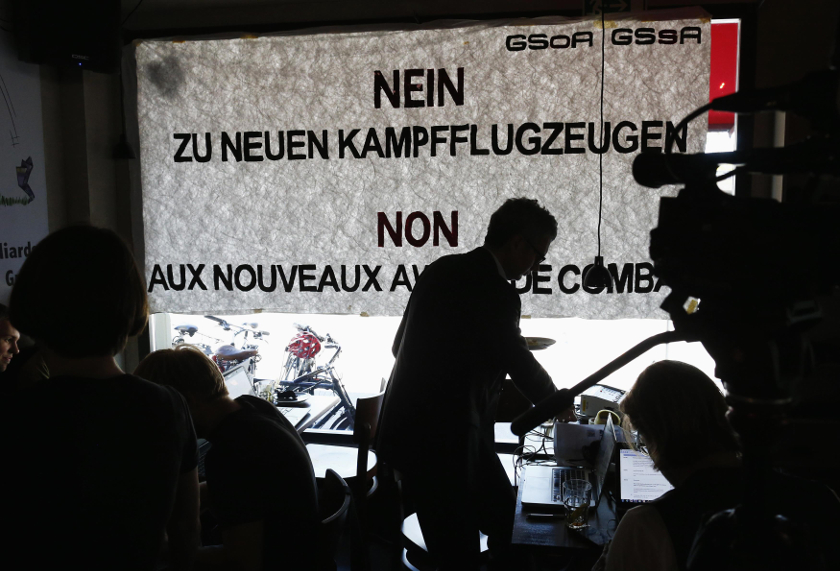
GENEVA, May 18 — Swiss voters rejected a 3.1 billion-franc (RM11.2 billion) order for Gripen fighter jets, dealing a setback to Swedish defence company Saab AB.
The 22-plane contract, which Switzerland awarded 2 ½ years ago, was opposed by 53.4 per cent of voters, the government in Bern said on its website today. An initiative for a national minimum wage of 22 francs per hour — the world’s highest — was rejected by 76.3 per cent. Polls had predicted that outcome.
Gripen opponents had argued that the plane would cost 10 billion francs over its lifetime, money that could be deployed elsewhere. Supporters of the purchase, including the government, said neutral Switzerland needed the Gripen to defend its airspace.
“The people have spoken,” said Susanne Leutenegger Oberholzer, a Social Democrat member of parliament. “We surely don’t have the money for such unnecessary acquisitions.”
Saab clinched a three-way contest to replace Switzerland’s fleet of Northrop Grumman Corp. F-5 Tigers in November 2011, edging out offers from France’s Dassault Aviation SA and from the Eurofighter consortium of BAE Systems Plc, Airbus Group NV and Italy’s Finmeccanica SpA.
In addition to the Swiss order, Saab beat out Boeing Co. to develop fighters for Brazil’s air force in a deal worth US$4.5 billion (RM14.5 billion). Those two countries are the first after Sweden to pick the next-generation Gripen E, whose development is contingent on an export order of at least 20 aircraft. Thailand and South Africa operate older C-model jets made by the manufacturer of Gripen, which is the Swedish word for griffin.
‘Not unexpected’
A rejection is “negative for Saab, but not exactly unexpected given the opinion polls,” Mats Liss, an analyst at Swedbank AB in Stockholm, said in an e-mailed response to questions today. While the Brazilian order is more important than that from Switzerland, today’s rejection means there will be “a period of uncertainty until the Brazil order is finalized.”
Saab Chairman Marcus Wallenberg told Switzerland’s Tages- Anzeiger earlier this week that failure of the Swiss Gripen deal “won’t mean the end” of the Gripen’s development.
The company aims to sell around 400 Gripens over the next 20 years, said Lennart Sindahl, head of the Saab Aeronautics unit. Saab is in “serious talks” with 10 nations which could yield agreements in the near term and “a very significant country” recently made an approach, he said.
Decision respected
“Today’s result requires a thorough analysis,” Defence Minister Ueli Maurer told reporters in Bern today. “An initial one this evening would be premature.” The Swiss Defence Ministry, which initiated the Gripen purchase, has repeatedly said that it will honour the vote’s results.
Supporters of the Gripen who argued that Switzerland needed to maintain its aerial defences saw their contention undermined in February after a hijacked Ethiopian Airlines Enterprise plane landed in Geneva. It had to be escorted by French and Italian jets because the Swiss air force wasn’t able to operate outside business hours.
“The majority of the Swiss population is behind the army,” said Longchamp. “It wasn’t a question just pro or contra the army, but it was also a question of finances.”
Minimum wage
The hourly national minimum of 22 francs, proposed by trade unions, would have been the world’s highest when adjusted for purchasing power parity, according to 2012 data from the Organization for Economic Cooperation and Development. The initiative, which called for a full-time worker to be paid at least 4,000 francs a month, was opposed by 77 of voters, gfs.bern said.
“In German-speaking Switzerland, especially in the countryside, there’s a strong view that the state shouldn’t get involved too much,” said Laurent Bernhard, a researcher at the Institute of Political Science at the University of Bern. In these regions “campaigns opposing state meddling generally find favour” among voters, he said.
Today’s vote against a minimum wage breaks with a series of plebiscites — including ones on excessive executive compensation and immigration — that companies say make Switzerland a less desirable place to do business.
Swiss voters have also frequently supported free enterprise: In 2001 they backed a constitutional limit on federal government debt, while in 2012 they voted down a proposal for six weeks of paid vacation. — Bloomberg


