
















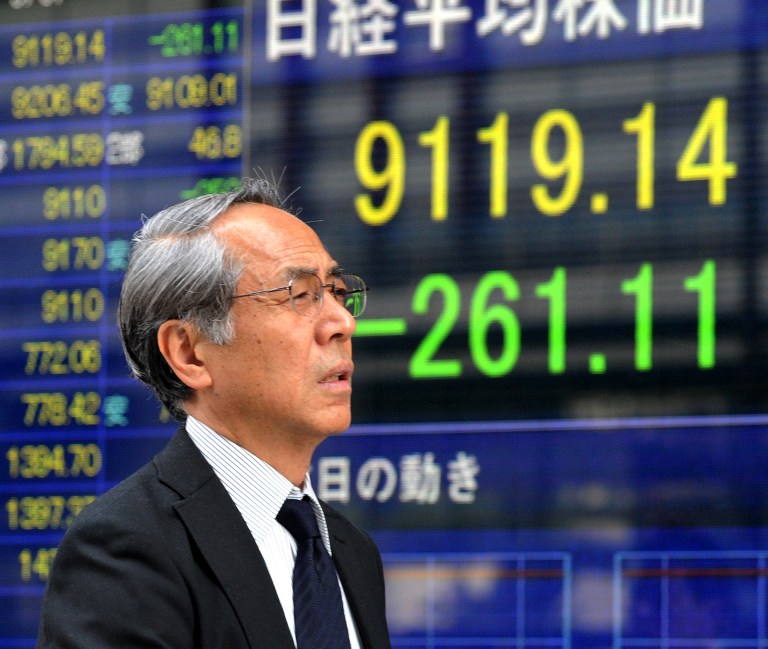


KUALA LUMPUR, June 24 — Equity futures from Japan to Australia fell, signaling stocks may extend last week’s global slump, as investors continued to digest the prospect of reduced Federal Reserve stimulus.
Treasury yields soared June 21, while US shares rebounded after the steepest plunge in 19 months.
Futures due in September on Japan’s Nikkei 225 Stock Average fell 1.3 per cent by 3 a.m. in Osaka, while contracts on the Topix Index lost 0.4 per cent. Hang Seng Index futures in Hong Kong dropped 1.2 per cent and those for Australia’s S&P/ASX 200 Index declined 0.7 per cent.
The Australian and New Zealand dollars gained as the yen weakened versus the greenback.
The Standard & Poor’s 500 Index added 0.3 per cent June 21, trimming its worst weekly drop since April.
Crude oil fell 0.1 per cent to US$93.59 (RM301.15) a barrel, after last week’s 4.3 per cent slide.
The MSCI All-Country World Index sank the most since June last week and almost US$2 trillion was erased from the value of global equities after the Fed indicated it could start paring asset purchases this year should the US economy continue to improve.
Ten-day volatility on the measure of developed-market stocks surged to the highest level since July. The Dollar Index has rallied every day since the Fed’s June 19 statement as investors view it as a haven amid the slump in stocks, bonds and commodities.
“Markets are going to be volatile for some time,” Carrick Lucas, an economics and markets strategist at ANZ Bank New Zealand Ltd., said by phone in Wellington.
“Emerging market and Asian equities have had a pretty good run off the Fed and now we’re seeing a regime shift which will take some getting used to.”
September Tapering
Rallies that have lifted everything from Japanese banks to Italian government debt over the past four years of global central-bank policy loosening are unwinding on signs Fed stimulus through the quantitative easing program, known as QE, is poised to slow. Fed Chairman Ben S. Bernanke said last week that policy makers may taper monthly purchases of US$85 billion in assets later this year and halt them in 2014 as long as the world’s largest economy performs in line with the central bank’s projections.
The Fed may cut its monthly bond purchases by US$20 billion to US$65 billion in September, according to economists surveyed by Bloomberg last week.
MSCI’s Asia Pacific Index slipped 2.3 per cent last week. The gauge of regional equities traded at 11.73 times estimated earnings for member companies June 20, the lowest valuation since November. The Bloomberg China-US Equity Index of the most- traded Chinese stocks in New York added 0.9 per cent June 21, paring a weekly decline of 2.9 per cent.
Treasury Yields
Ten-year Treasury yields climbed above 2.5 per cent for the first time since 2011, jumping 12 basis points to 2.54 per cent June 21 to cap the biggest weekly increase in a decade.
Thirty- year US bond yields jumped eight basis points to 3.59 per cent, the highest level since August 2011 on a closing basis. Two-year rates increased four basis points to a 14-month high of 0.36 per cent.
The yen retreated 0.2 per cent to 98.06 per dollar by 7:06 a.m. in Tokyo, and was little changed at 128.55 per euro.
The so-called Aussie added 0.1 per cent to 92.25 US cents, while the kiwi gained for the first time in seven days to add 0.1 per cent to 77.60 cents.
The Dollar Index added 0.2 per cent 82.514.
US equity trading volume surged to the highest level since October 2011 last week and the S&P 500 is down 4.6 per cent from a record reached May 21, the day before Bernanke told Congress the Fed could begin to taper asset purchases should the job market continue to stabilise. The index has trimmed its year-to-date gain to less than 12 per cent.
Emerging Markets
The Stoxx Europe 600 Index capped its biggest weekly decline in 13 months, losing 3.7 per cent last week, as Greek Prime Minister Antonis Samaras lost one of his two coalition partners.
The index trades at 12.4 times projected company earnings, the cheapest valuation since April, according to data compiled by Bloomberg.
The MSCI Emerging Markets Index slumped 5.6 per cent last week, its sixth consecutive weekly slide, and the worst weekly retreat in more than a year.
China’s overnight repurchase rate dropped 442 basis points, or 4.42 percentage points, to 8.43 per cent in Shanghai, according to a daily fixing compiled by the National Interbank Funding Center. The seven-day rate fell 227 basis points June 21 to 8.50 per cent, the largest decline since January 2012.
The People’s Bank of China used reverse-repurchase agreements to inject funds into selected banks, Hexun reported at the end of last week, citing an unidentified person close to the central bank.
DeMark’s Call
The Shanghai Composite Index of domestic Chinese stocks slid 4.1 per cent last week, the third weekly slump and the steepest retreat in the measure since February. The gauge will rebound about 12 per cent in the next few months because the recent decline has exhausted sellers, according to Tom DeMark, the creator of indicators to show turning points in securities.
The index will climb to 2,323 after producing a buy signal June 21 on the Combo chart, which is designed to identify market tops and bottoms, DeMark said in an e-mail that day. The chief executive officer and founder of Market Studies LLC has spent more than 40 years developing market-timing indicators. – Bloomberg