















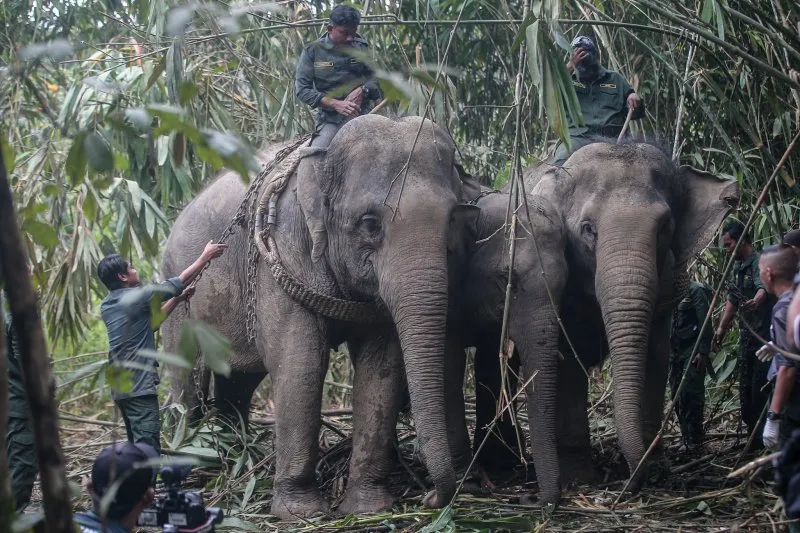
KUALA TERENGGANU، Nov 19 — The Terengganu government plans to establish a wildlife sanctuary modelled on an African-style savanna as a long-term measure to address human-elephant conflict in the state.State Agriculture، Agro-based Industry، Food Security and Commodities Committee chairman Datuk Dr Azman Ibrahim said the proposed sanctuary would provide elephants and other wildlife with a dedicated habitat where they could roam freely، helping to reduce encounters with humans.He said the Department of Wildlife and National Parks (Perhilitan) was currently implementing several measures to manage human-elephant conflict، including the installation of the Elephant Electric Fencing System (SPEG)، the use of warning shots to drive elephants away without harming them، and capture-and-relocation operations.“However، these measures become increasingly difficult to implement when elephants move in large herds. Just yesterday، I was informed by the Air Putih Assemblyman that a herd estimated to comprise 80 elephants had been spotted in the area.“This means the elephants are moving in a large group، making the situation particularly challenging to manage، ” he said.Dr Azman was responding to a supplementary question from Ghazali Sulaiman (PAS-Bukit Besi)، who sought clarification on measures being taken or already implemented to mitigate crop losses caused by wildlife incursions، a problem expected to worsen over time.He explained that capture-and-relocation operations were considered a last resort، undertaken only when other measures، such as electric fencing and deterrent techniques، proved ineffective.He added that relocation was also costly، with the expense ranging from RM40,000 to RM50,000 for a single elephant. Such operations were generally more practical for individual elephants than entire herds.Meanwhile، Dr Azman said Perhilitan data showed that Terengganu’s elephant population was estimated at 200، while forests accounted for 42 per cent of the state’s total land area، providing a natural habitat for the animals.He stressed that human-elephant conflict was not solely attributable to insufficient natural habitat but was also driven by factors that attracted elephants out of the forest in search of food.Among these was the development of agricultural farms along forest fringes، which provided elephants with an easily accessible food source and encouraged them to venture beyond their natural habitat.“When farms are established along forest fringes، they become readily accessible sources of food for elephants، ” he said.Dr Azman also highlighted an increase in the area of agricultural land damaged by wildlife incursions over the past three years.In 2024، approximately 0.7 hectares of cultivated land were damaged، resulting in losses estimated at RM20,800. The affected area increased to 1.1 hectares in 2025، with losses amounting to RM32,000.By 2026، the area of damaged crops had risen further to 1.6 hectares، with losses exceeding RM49,000.He said farmers who reported losses to the Terengganu Agriculture Department and Perhilitan could receive assistance through the Terengganu Agricultural Disaster Fund، as well as support provided by Perhilitan.“Perhilitan also provides Property and Crop Loss Assistance to help farmers whose crops have been damaged as a result of human-wildlife conflict.“Farmers can benefit from both forms of assistance to help them recover from their losses and resume their agricultural activities، ” he said. — Bernama