


IPOH, Oct 18 — For five years, a wheelchair was Salinah Osman’s constant companion, confining the once-active massage therapist to a life far removed from the independence she had enjoyed before suffering a second stroke in 2021.
The 58-year-old, originally from Bukit Mertajam, Penang, still remembers the morning she tried to stand up from a seated position, only for both legs to suddenly give way and her right hand to grow weak.
Unlike her first stroke about two decades earlier, the second robbed her of the strength and mobility she needed to practise her profession, which had brought relief and comfort to hundreds of clients through her home-based spa business.
It also kept her away from the community and volunteer work she loved, leaving her dependent on her husband, Md Rasid Mehat, 66, for daily care while she grappled with other health problems, including heart failure and chronic asthma.
“The ordeal was difficult. I could no longer go out to do charity work, and watching my friends continue with it was heartbreaking. From then on, I had to depend on my husband to take care of me,” she told Bernama.
Despite the setbacks, the mother of two refused to give up, seeking traditional treatments and hospital care while praying for a chance to regain her independence.
Her breakthrough came when she learnt about the rehabilitation benefits available to contributors of the Social Security Organisation (Perkeso) who had suffered strokes, prompting her to submit an application.
In a turn of events she had hardly imagined, contributions she had made while working in a factory more than 20 years ago became the key to accessing the treatment she needed. Although she had long left factory work to become a self-employed massage therapist, her past contributions continued to entitle her to protection under the scheme.
In April, Salinah was offered an intensive rehabilitation programme at the Sultan Nazrin Shah Perkeso Rehabilitation Centre in Meru here, with the cost fully covered by Perkeso.
She spent nearly four months undergoing treatment and staying at the centre, supported by her case manager, medical officers and other staff, while using advanced rehabilitation equipment to help her regain movement and strength.
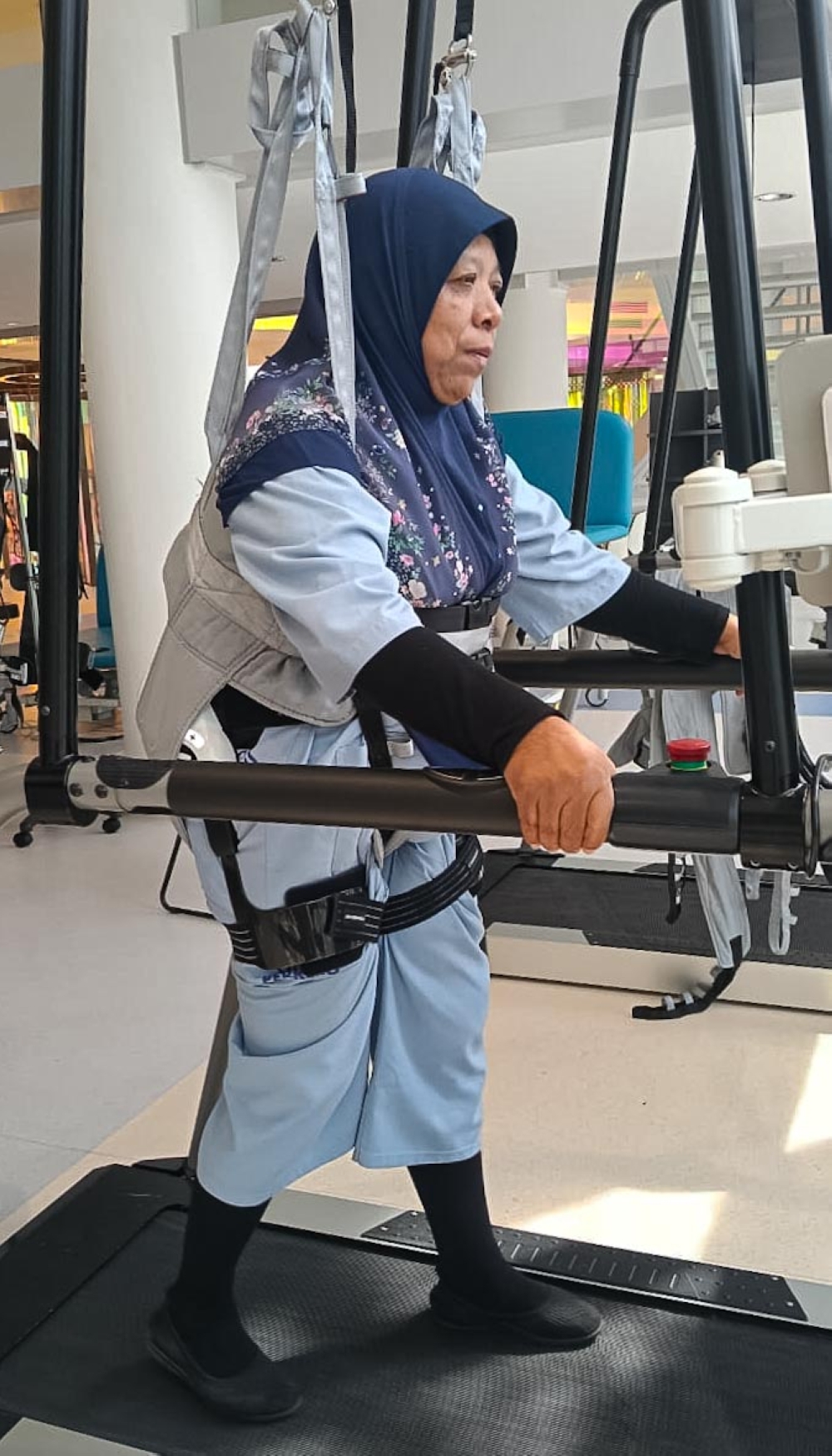
“The desire to get back on my feet kept me going. At first, I had to train for hours every day despite my asthma, and I wondered whether I could do it.
“But one day, I began to move my hand and feel my leg again. That was when I became confident that I could recover here,” said Salinah, who has also been receiving a Perkeso Invalidity Pension since November 2006, which has risen from RM269 to RM573.69 a month.
In the final months of her rehabilitation, she progressed from relying on a wheelchair to taking steps with a walking stick. She also completed a computer networking course to help improve her business when she is ready to resume work.
Salinah was discharged on September 3, and just a week later, while at home, she was able to discard the walking stick and walk without it.
Having gone from being bedridden and fully dependent on a wheelchair to regaining her mobility, she is now working towards rebuilding her massage business and returning to the community service that once formed a major part of her life.
Perkeso chief executive officer Datuk Seri Dr Mohammed Azman Aziz Mohammed said the centre offered comprehensive stroke rehabilitation combining clinical expertise, various therapies and advanced technology, adding that it was open to everyone who required stroke rehabilitation, not just Perkeso contributors.
“For insured persons who meet the eligibility requirements, Perkeso will fully cover rehabilitation costs, subject to an assessment of their condition and suitability for treatment.
“Those who do not qualify for Perkeso benefits may still receive treatment at the centre on a self-funded basis, subject to the same assessment,” he said in a statement to Bernama.
Dr Mohammed Azman said treatment costs varied according to each patient’s condition, needs and rehabilitation goals. The centre offers physiotherapy, occupational therapy, hydrotherapy, speech and swallowing therapy, neuro-robotic rehabilitation, psychological support and vocational rehabilitation, including its Return to Work (RTW) programme.
Its advanced equipment includes the Cyberdyne Hybrid Assistive Limb (HAL), Luna EMG, Vibramoov, MetaMotus Galileo platform and Brain-Computer Interface (BCI), as well as brain neuromodulation technologies such as rTMS and tDCS, and NESA.
He said Perkeso also focused on prevention and long-term protection through its Health Screening Programme, introduced in 2013 to help detect non-communicable disease risks early.
Contributors whose ability to work was impaired by stroke could be considered for benefits under the Invalidity Scheme, including a lifelong Invalidity Pension, Invalidity Grant, Constant Attendance Allowance and rehabilitation aids, subject to medical certification and eligibility requirements. — Bernama


