













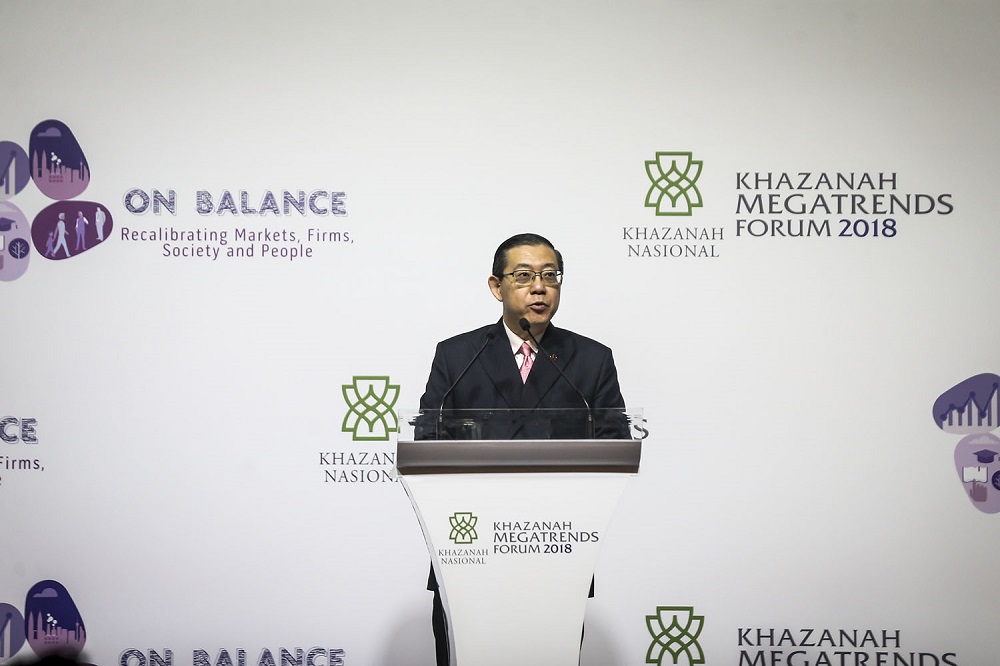


KUALA LUMPUR, Oct 8 — Malaysia is not undergoing “austerity” measures, Finance Minister Lim Guan Eng said today.
He clarified that the Pakatan Harapan (PH) government’s recent belt-tightening measures with regards to public infrastructure projects was an example of smarter spending to be more prudent with its finances after the extravagances of the previous administration.
“All we are doing here is pulling back excesses of the past. What we are calling for is not austerity, but smarter spending.
“Let me stress here that Malaysia is not in austerity mode, we want to see economic growth progressing,” he said in his luncheon address at the Khazanah Megatrends Forum 2018 here.
Lim said the PH administration is now consolidating its financial position by using more competitive methods for government contracts.
“We have adopted a wider application of open tender for government procurements and projects whereas previously, direct negotiations done by the previous administration had led to overspending.
“We are also more selective in making public investments,” he said.
But he indicated that the government was not parsimonious and would spend where necessary.
“If there are key priority areas that require spending, we would be more than happy to spend — especially when it leads to long-term sustainable growth that improves the well-being of the rakyat.”
In the same speech, Lim also cited the government’s success in saving over RM15 billion through renegotiations of the LRT3 railway project, and a further RM5.22 billion from the MRT2 rail project.
Lim said Putrajaya was also currently reviewing projects and concessions under the public-private partnership scheme (PPP).
“At the moment, 48 of them have been approved to proceed, on the condition that it goes through a strict vetting process, among others open tender benchmarked against international practices.
“So while we are reviewing more PPP projects, we do not intend to cancel them, but to change the format and the mechanism to implement it. No direct negotiations and should be replaced by competitive tender,” he said.
Lim said that the government was aware that economic growth may be affected if fiscal consolidation was done “too much and too fast” to achieve fiscal sustainability, noting that a reasonable growth level was also required for sustainable finances.
“Our current efforts at fiscal consolidation are focused on prudence — cutting out the excesses of the past while building a strong foundation for government finances to pursue smart and responsible fiscal policy moving forward,” he said.
He also spoke of the government’s willingness to support the private sector in leading Malaysia’s economic growth and helping the country to achieve high-income status.