















KUALA LUMPUR, Aug 13 — Datuk Seri Najib Razak claimed yesterday that the previous Barisan Nasional (BN) administration had laid out far superior policies to aid the low income group than the present government.
The former prime minister said in a Facebook post directed at Finance Minister Lim Guan Eng that the BN administration kept petrol pump prices much lower when global crude prices exceeded RM400 a barrel, while it would have also doubled the direct cash handout under the BR1M programme.
Najib, who was also previously the finance minister, made the comparison as a critique on Lim’s assertion that the Pakatan Harapan (PH) government is pro-people. Both leaders have launched incessant public attacks against each other since PH took power in May.
“I was surprised to read Lim Guan Eng’s statement trying to prove that he is defender of the poor. I was shocked while in laughter actually,” he wrote.
“First he said the PH government had taken the step to give RM400 to the B40 group under the Cost of Living Aid (BSH) programme.
“This payment is actually BR1M money that was approved by the BN government under Budget 2018. It was also the initiative of the previous administration,” he added.
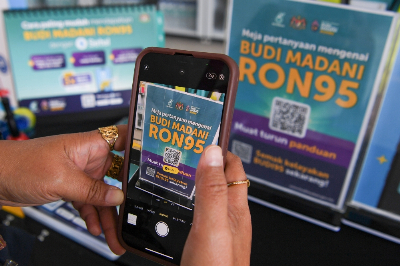
On petrol subsidies, Najib said Lim’s assertion that the PH government was helping low income earners by keeping the price of RON95 at RM2.20 a litre was “laughable”.
The former BN chairman said his government did better by keeping RON95 price at RM2.10 a litre in 2013 despite global crude prices hovering around RM400 a barrel, or close to RM130 more than the present price level.
“At that point Guan Eng had vocally criticised the RM2.10 petrol price as being too high and cruel for the poor even when global crude price was much higher than now.
“And many also forgot that RON95 was as low as RM1.50 to RM1.70 in 2015 and 2016. The people were gifted with a much lower price,” he wrote.
Najib then took aim at Lim’s justification of abolishing the Goods and Services tax (GST), saying the consumption levy’s removal only benefited tax-evading businesses and facilitated illicit money outflows.
The unpopular GST was seen as among the primary factors that caused the Najib administration’s downfall, but the former prime minister has never apologised for introducing the tax.
Until now, Najib has insisted that the broad-based GST was a good policy move that helped increased government tax collection and sustain public spending.