


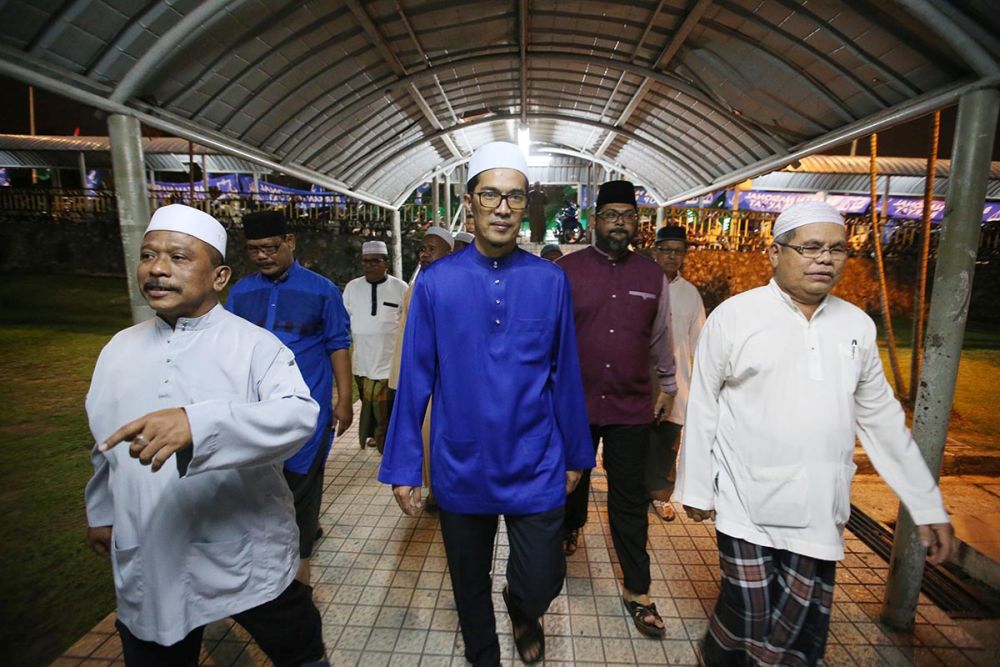
.JPG "PKR's Datuk Kamarudin Jaafar thinks the working-class Malays are ready for change. u00e2u20acu201d Picture by Azinuddin Ghazalinn")
KUALA LUMPUR, May 4 — They are among the city’s poorest. For some, a month’s rent for a tiny boxy two-roomed Public Housing Project (PPR) flat is unaffordable.
It costs just RM125 a month to rent a unit, cheaper than a pair of China-made Converse sneakers.
And for those fortunate enough to afford the rent, the comfort is short-lived. Facilities at the many PPR flats are often either broken or dilapidated.
To add insult to injury, their salaries are stagnant and their buying power has plunged.
Most feel they have no escape or the means to alleviate themselves from poverty. Naturally, many of Bandar Tun Razak’s mostly urban poor voters are incensed.
Pakatan Harapan, having helmed Bandar Tun Razak for two terms, has made it clear its intention is to harness this frustration to drive support and secure the bloc a third consecutive victory on May 9.
And with mere days to polling, the PKR-DAP-PPBM-Amanah coalition is confident that they will.
Its candidate for Bandar Tun Razak, PKR’s Datuk Kamarudin Jaafar, told Malay Mail that Malay support for the pact has increased; most significantly among the poorer constituents.
“We can feel the difference this time around, it’s very visible,” the former Tumpat MP for PAS said.
“In Bandar Tun Razak we can see more Malays are warming up to the idea of political change, and I believe it is the same nationally.”
Lower income Malays in the major cities and rural areas traditionally form Barisan Nasional’s core supporter base, but that has changed in recent years as the community became more exposed and open to progressive politics engendered by rapid urbanisation and access to information through social media.
Two days ago, independent pollster Merdeka Center released a midway survey indicating increased Malay support for the federal Opposition coalition as of May 1, with the numbers expected to increase further as polling nears. Current Malay support stood at 19.4 per cent.
The race card
Support from lower-income Malay households is politically significant for a federal Opposition coalition that has mostly relied on middle-class Malay and minority votes — it indicates growing trust in the coalition’s politics, even when they espouse policies that may appear threatening to their interest.
Barisan Nasional’s campaign seems aimed at tapping that insecurity. While their primary messages mostly focus on the pledges listed under their Federal Territories manifesto, local party leaders have also launched attacks with communal overtones, mainly targeted against PH’s predominantly Chinese component party, the DAP.
The ruling coalition’s choice of candidate underscores the strategy. In picking 42-year-old lawyer and former prosecutor Adnan Abu Seman, a charismatic but humble Bandar Tun Razak native, BN believes Malay communalism would draw the community back into its fold, observers have said.
BN suffered a humiliating defeat in the 2013 elections when their MCA candidate Tan Kok Eng lost by a 11,832-vote margin to Tan Sri Khalid Ibrahim, a PKR leader then but sacked in 2015.
But Adnan himself has so far stayed away from race-baiting throughout the campaign, choosing instead to play up his local roots and access to federal government leaders.
Through him, voters will have a representative who genuinely understands local problems but most importantly, his link with the federal government will give constituents direct access to funds and development, he pledged
“I know what you feel, I have felt it too,” he told the audience in a programme at Seri Kota, one of the many PPR housing areas there.
“A local knows better and as I am a BN member, your voice will reach the government quicker.”
In the opposite camp, Kamarudin, a Kelantanese, said he is aware of BN’s attempt to raise doubt about his origin. But they would be mistaken, he added, as the former Tumpat MP pointed out that he had serviced Bandar Tun Razak as PKR co-ordinator for the past three years.
“Even Datuk Seri Najib raised that when he came here the other day,” Kamarudin said, referring to the speech delivered by caretaker prime minister and BN chairman Datuk Seri Najib Razak in a visit he made there earlier this week.
“But it’s not an issue. They know me because I have done my groundwork for the past three years.”
Poverty trumps politics
Kamarudin took over from PKR vice-president Nurul Izzah Anwar as the party’s main go-to person in the constituency in 2015, after the party sacked the incumbent MP Tan Sri Khalid Ibrahim in a messy political affair that dented the Opposition’s credibility.
.JPG)
But from the dozens of Bandar Tun Razak voters Malay Mail spoke to, Khalid’s sacking appears to be a thing of the past. Like most urban poor or lower-income voters in the capital city, concerns over cost of living pressure and socio-economic problems trump politics.
And much of the backlash is directed towards the federal government, who many felt made life harsher through the Goods and Services Tax, increased tolls and public transit fares.
Poor housing is also a huge issue among voters there. The majority of the seat’s Malays are poor families who live in the PPR flats. Many of them are two-bedroom units, usually measuring no bigger than 650 square feet, or about the size of a standard five-star hotel toilet.
BN in its FT manifesto pledged to address the problems by building 3,000 homes, including PPRs, but it is uncertain if they would all be built in Bandar Tun Razak.
Regardless, voters that Malay Mail spoke were dismissive of the pledge. Some felt the promises were mere baits to win and questioned why the government has not implemented the projects in the first place. Others just laughed.
“They keep blaming the Opposition for our problems, but know that Bandar Tun Razak’s welfare falls under federal purview,” said a 60-year-old PPR dweller.
Bandar Tun Razak has 83,650 registered voters, about 7,000 fewer than in 2013, a decrease that came after the controversial redelineation that Opposition leaders alleged was gerrymandering.
.JPG)
Malays form the bulk of the electorate at 61 per cent followed by the Chinese at 29 per cent and Indians 8 per cent. In 2013, the Malays totalled just over half while the Chinese made up a third of total voters.
PH leaders believe the redelineation was meant to ship Chinese voters, the majority of whom are staunch Opposition supporters, out of the seat to secure a win for the ruling coalition. The Election Commission denied the allegation.
The redrawing also included some 5,000 army voters from the Sungai Besi camp into Bandar Tun Razak. Army voters are traditionally loyal BN supporters.
The change in racial composition from the redelineation has prompted contesting parties to focus efforts on wooing Malay support, more so since three parties — BN, PKR and PAS — are vying for the seat.
Kamarudin said the majority of Chinese and Indian voters are firmly behind PH; the coalition only needs around 30 per cent Malay support to retain Bandar Tun Razak.
Even with talk that some of PH’s Malay votes could go to PAS, a former ally, the former Tumpat MP doubts the Islamists can muster enough support to do any significant damage.
“I think they have no realistic chance to win here because they have shipped most of their hardcore supporters in seats that they previously contested,” said Kamarudin, himself a former PAS member who defected after the party leadership was taken over by hardliners.
“Because they never contested here they never focused on beefing up their machinery. As far as I can tell, the real contest is between PH and BN.”


