


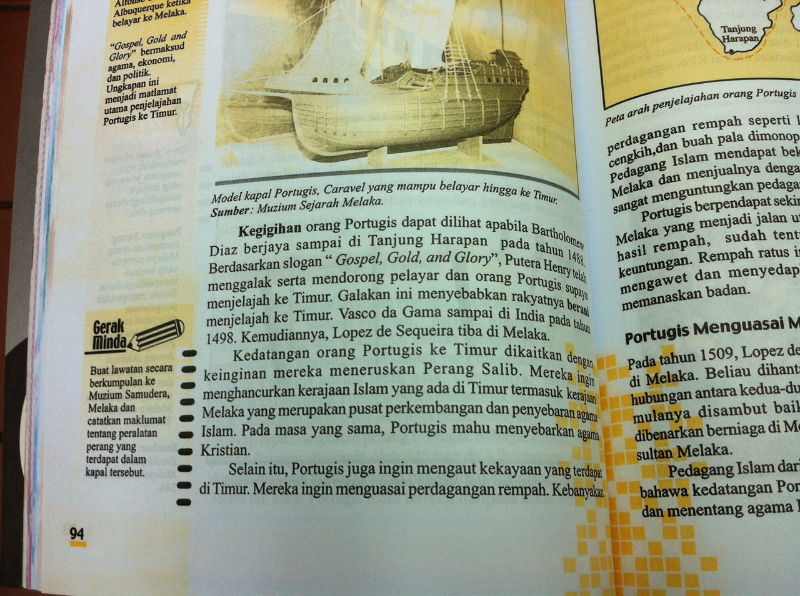


KUALA LUMPUR, July 7 — A government historian’s admission of factual error in a textbook’s claim that the Portuguese came to Malacca in the 16th century to continue the Crusades is in dispute, after an author of historical books said the assertion was not wrong.
Amid a storm over a contentious entry in the current edition of the Form 1 History textbook, Ranjit Singh Malhi confirmed that the former European powerhouse’s “desire to continue the Crusades in the East was mentioned in the earlier textbooks” that date back to the 1960s.
“The main reason for the Portuguese conquest of Malacca was to gain control of the valuable spice trade. The other reasons were to spread Christianity and to weaken Islam (besides attaining glory).
“These reasons have been mentioned in the previous textbooks dating back to the 1960s, including those by N. J. Ryan and J. Kennedy,” the author of history books told Malay Mail Online last week in an email interview.
“Hence, there’s nothing really inaccurate about the facts stated in the Form One textbook except to note that the primary reason for the Portuguese capture of Malacca was to gain control of the spice trade,” he added.
Ranjit was asked to comment on a disputed paragraph in the Form 1 History textbook, which was written by Ahmad Fawzi Mohd Basri, Mohd. Fo’ad Sakdan and Azami Man.
Previously, Malay Mail Online reported historian Dr Sivachandralingam Sundara Raja conceding there had been a factual error in the current schoolbook entry on the reasons for the Portuguese quest for Malacca in the 16th-century.
However, the associate professor from the University of Malaya’s History Department who sits on the Education Ministry’s oversight panel on history books said the error was unintentional and there is no government conspiracy to subvert Christians in the country today.
“Yes, the fact is wrong and it is being looked at. This should not be assumed to be a covert agenda of the Education Ministry to spread such ideologies. That is not their intention and such an assumption is wrong,” Sivachandralingam told Malay Mail Online when contacted last week.
The educationist also said the correction will be reflected in the new edition of the history textbook to be released in 2017.
The issue was cast into the spotlight recently after local writer Uthaya Sankar SB highlighted the paragraph from the textbook’s 2009 edition, expressing concern over the alleged “incorrect” portrayal of the Crusades and religious conversion of Malacca’s Muslims as the Portuguese empire’s main reason of conquest.
“Kedatangan orang Portugis ke Timur dikaitkan dengan keinginan mereka meneruskan Perang Salib. Mereka ingin menghancurkan kerajaan Islam yang ada di Timur termasuk kerajaan Malacca yang merupakan pusat perkembangan dan penyebaran agama Islam. Pada masa yang sama, Portugis mahu menyebarkan agama Kristian,” read the paragraph.
[Translation: The Portuguese arrival to the East was associated with their desire to continue the Crusades. They wanted to destroy the Islamic governments in the East, including the Malacca government that was a centre for the expansion and propagation of Islam. At the same time, the Portuguese wanted to spread Christianity.]
The Crusades, which saw Christian armies engaging in a “holy war” with Muslims in the Middle East, is traditionally regarded by historians as having started in the 1095 and ending in 1291 or the late 13th century.
The same Form 1 history textbook states that Lopez de Sequeira arrived in Malacca with the Portuguese navy in the year 1509. The Portuguese captured Malacca in 1511.
The history textbook also includes the Portuguese desire to gain control of the spice trade as one of their motivations for coming to Malacca.
Malay Mail Online is awaiting a written response from the Ministry of Education’s textbook division.


