













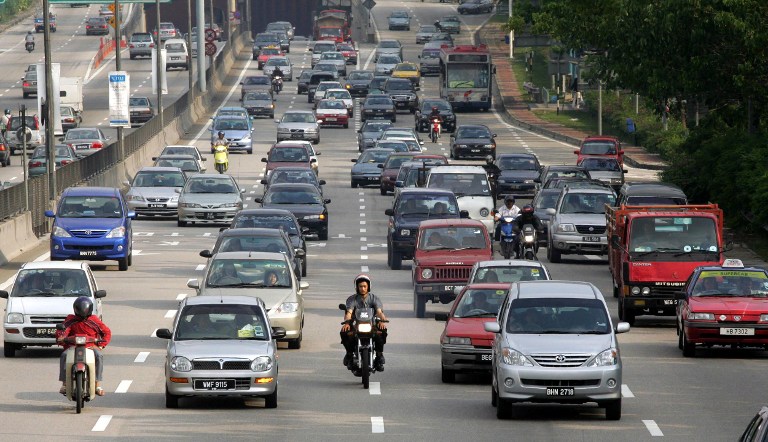


PETALING JAYA, May 6 — About six thousand lives are lost on our roads annually and we still have the highest number of road fatalities in the region.
 Road Safety Department deputy director-general Abdul Haris Lakar said the department’s latest statistics, from 2013, show there were 6,915 road fatalities that year.
“Besides enforcement, advocacy and awareness are important too, even from the pre-school level,” Abdul Haris said.
Abdul Haris said parents should keep their children safe using seatbelts and helmets.
“Although there’s no law for child safety seats in cars, we do encourage their usage,’’ he said after the third United Nations’ Global Road Safety Week at SJK(T) Kajang yesterday.
According to a 2013 World Health Organisation (WHO) report, Malaysia has 25 deaths on the road per 100,000 people.
“There’s indication there may have been some improvement but it’s still too high. No one should die on the road,’’ said WHO head of mission and representative to Malaysia, Brunei Darussalam and Singapore Dr Graham Harrison.
“Accidents happen because of a combination of factors, but it comes down to the person in the driver’s seat.
“How many times have you seen people tailgating even though you’re already driving at the speed limit?’’ he asked.
A road safety expert said constant surveillance and continuous enforcement will help prevent fatal road crashes.
Universiti Putra Malaysia’s Road Safety Research Centre director Assoc Prof Dr Hussein Hamid said closed-circuit television (CCTV) cameras installed on major roads would be efficient deterrents for reckless drivers.
“We have all the education and training in place — ideally, this would be enough for people to ‘self-regulate’ their behaviour on the road.
“But not all use this knowledge when they drive, so more enforcement is needed,” he said.
He said people tend to behave themselves when there was a threat of getting caught.
“’We cannot expect policemen to be stationed at every street corner at all hours of day, so we should make use of CCTVs.”
Dr Hussein said CCTVs would be more effective than the Automated Enforcement System, as the latter only captured speeding offences.
“CCTVs would also capture other common reckless behaviour, like drivers suddenly changing lanes without signalling, and misuse of emergency lanes.
“Enforcement should be immediate. For example, perhaps users have to report to the nearest police station within 24 hours of getting their summons or risk paying higher fines.
“We may also need to review our traffic laws to include stricter penalties,” he said.