


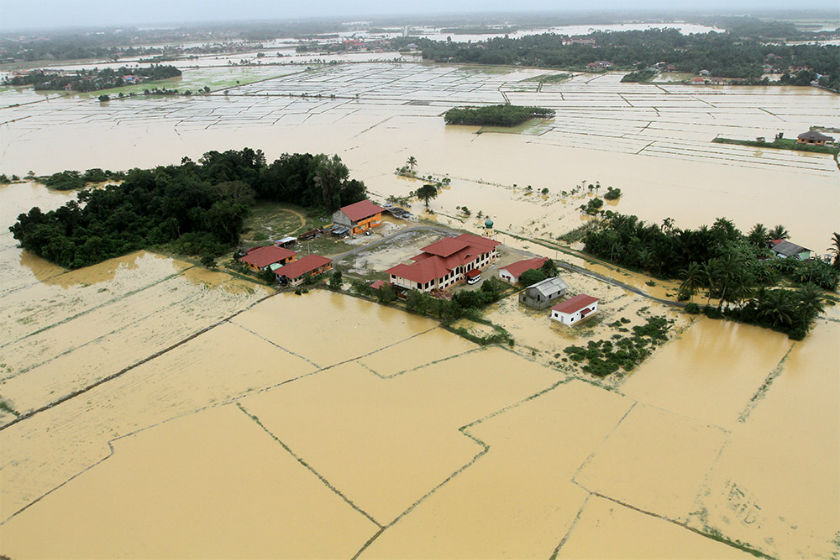
KOTA BARU, Dec 29 — Some areas within Kelantan's interiors still remain cut off from major towns but water levels in the state capital have dropped significantly throughout the day, marking what authorities have described as the beginning of the end to the state's major flood crisis.
Badly hit locations like Tanah Merah, Pasir Mas, Kuala Krai and Gua Musang are still far from drying up but authorities say the magnitude of the floods there have dwindled significantly compared to just last night, where water levels were still dangerously high.
Previous scenes of houses and cars submerged in the murky brown water of the Kelantan River were nowhere to be seen this afternoon when Malay Mail Online’s team joined an operation to drop off supplies to victims, although many of the smaller orchards and forests surrounding villages still remain flooded.
"Water is already receding in most parts. Of course we have areas that are still filled with water but we don't have houses submerged and all. Just roads cut off.
"I think the flood is nearing its end but we are still on alert about so-called third wave (of heavy downpour)," Royal Malaysian Airforce Major General Datuk Mohd Shukri, who oversees the relief efforts operations in the Kota Baru and its vicinity, told Malay Mail Online.
In the semi-rural Pasir Mas constituency where today's aid drop off operation was carried out and followed by the Malay Mail Online, flood victims remain in good spirits despite having to survive on low food stocks and no basic amenities like water and power.
But save or one or two locations, the floods in most villages in the constituency have completely receded, making it easier for residents to begin their massive clean up.
However, the severity of the floods in the few locations are still at dangerous levels, forcing evacuees to seek shelter on the upper levels of a marooned three-story school, which made it difficult for the air force to drop off supplies.
"Because of the bad location, some supplies had to be chucked from inside the helicopter and this can result in damaged food products.
"But of course we try our best to avoid this," Shukri said.
The TUDM major general also said with the receding flood, it was easier to distribute supplies throughout the state.
"We have enough supplies now. It is not a problem".
Earlier today, Malay Mail Online reported that while the flood has receded, life for locals remain far from normal as food remains scarce and key services such as banking are still unavailable.
The scarcity has forced of the locals to rely on aid from the state government or to ration whatever supplies they managed to get at the initial stage of the flood.
Residents here say staples such as rice and wheat have long been exhausted out while other stocks including bread and eggs are disappearing from the market shelves fast.
But barely a few hours after, businesses are beginning to operate again with markets and fast-food outlets seen open and consumers slowly resuming shopping.
"I think things are beginning to normalise again. They forecasted rain but it has not come. I think we are seeing the end of the floods," a staff from fast-food chain Burger King told Malay Mail Online upon resuming business.
A total of five deaths from the floods were recorded in Kelantan, three in Pahang and two in Terengganu to date, according to data from the National Security Council published on its website.
The extent of the worst flooding in decades has been such that Deputy Prime Minister Tan Sri Muhyiddin Yassin, who is overseeing the government’s flood relief efforts, has warned that floods are worse than anticipated, saying that assets currently deployed were inadequate to face the floods of such proportions.
As at 8pm tonight, the total number of evacuees stands at 94,435 across six flood-hit states, according to the NSC.


