On Thursday, the Badang Health Clinic in Kota Baru, which Dr Afiq Rahim is attached to, was cut off from the rest of the world because of the floods and then water started flowing into the clinic.
In an instant, Dr Afiq’s world was turned upside down, as he was worried for his patients.
“I had five critically ill patients with me and I needed to get them to safety, in the fastest time possible,” Dr Afiq said yesterday.
There was no leaving the clinic with water levels reaching knee-length inside the premise and waist-length outside.
“We had no choice but to stay in the clinic for the night,” he said.
News came the next day (Friday) that help would come — in the form of a military helicopter that would transport the patients to Universiti Sains Malaysia Hospital in Kubang Kerian.
“We raced through flood waters to get to a higher point — a nearby school field,” he said.
But it was getting dark and the helicopter could not locate their truck because of the rain and floods.
“We could see them, but they couldn’t see us,” he said.
As night came, Dr Afiq breathed a sigh of relief when the helicopter landed and residents helped to carry the patients aboard.
“I felt as if a weight had been taken off my shoulders,” he said.
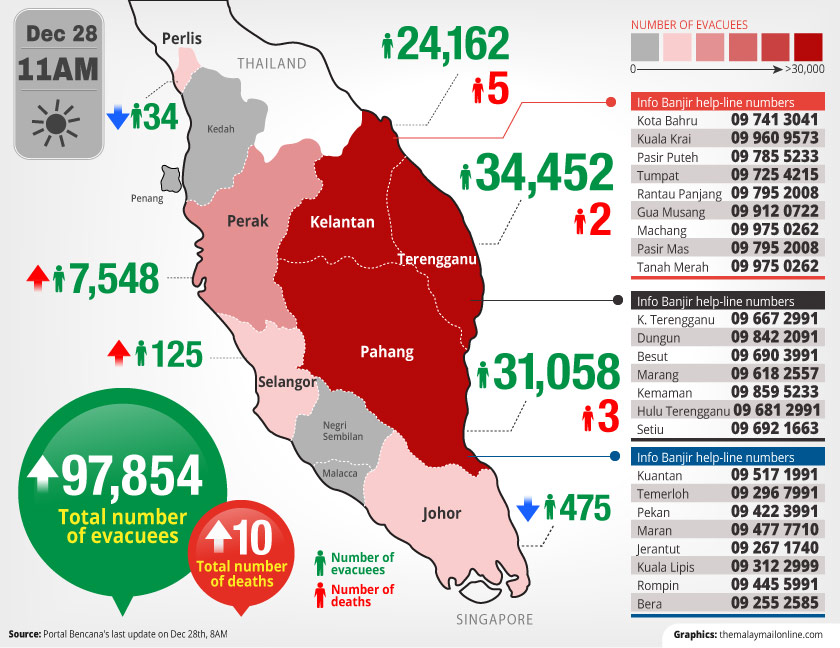
Now, Dr Afiq as well as two other doctors and 12 medical staff face a tougher challenge — attending to almost 2,140 flood victims at the Kijang relief centre — while also caring for the patients still based in the clinic.
Fresh water supply has been cut in the relief centre and Dr Afiq is worried about possible spread of cholera disease.
“I’ve seen two children who are already suffering from vomiting and diarrhea, and I fear the number of cases may increase,” he said.
Dr Afiq and his team of medical staff are shuttling back and forth from the clinic to several relief centres, providing assistance to the flood victims.
“Another three relief centres were flooded, the authorities were forced to cramp the victims into two centres — which are becoming overcrowded.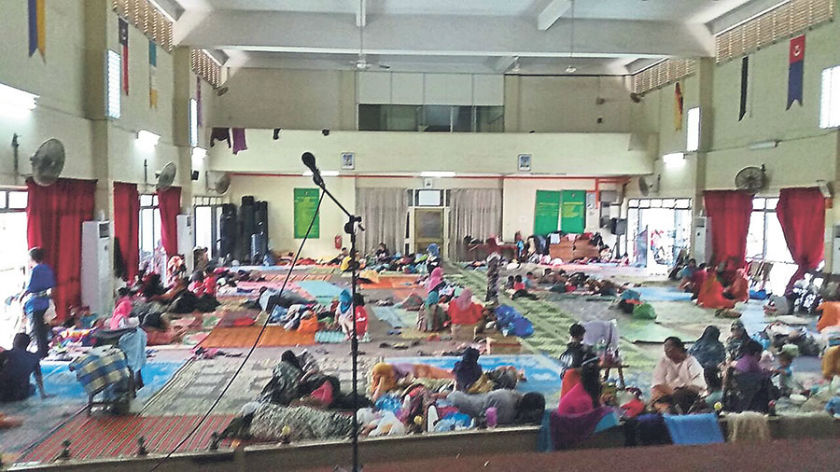
“This centre was designed for just 500 to 1,000 people and now there is more than twice the number of evacuees here.”
The dire situation led Dr Afiq to write on his Facebook seeking aid and assistance, which drew the public’s attention.
“I decided to share pictures and stories of the situation so people would know what was really going on,” he said.
“The problem is that the media have yet to report the reality of the situation.”
Dr Afiq’s posts have been shared 4,414 times as of 5pm yesterday.
However, the worst is far from over.
He said it was still raining in Badang and water levels continue to rise.
Food and medical supplies are running low and he is worried that it will run out within hours.
On the morning of the floods, Afiq called his father and his wife, informing them of the situation (Afiq’s wife and children had relocated to Semerak a week ago).
“My wife asked me why I hadn’t saved myself when I had the chance,” he said.
“I told her my job was not just to save myself but also others. That was my ambition.”
Health Minister Datuk Seri Dr S. Subramaniam said 35 patients from Kuala Krai Hospital had been transferred to Universiti Sains Malaysia Hospital to continue treatment.
Dr Subramaniam said the patients would be transferred via a helicopter from either the Royal Malaysian Police or the Malaysian Armed Forces, and if needed, the ministry would rent a helicopter for the purpose.