


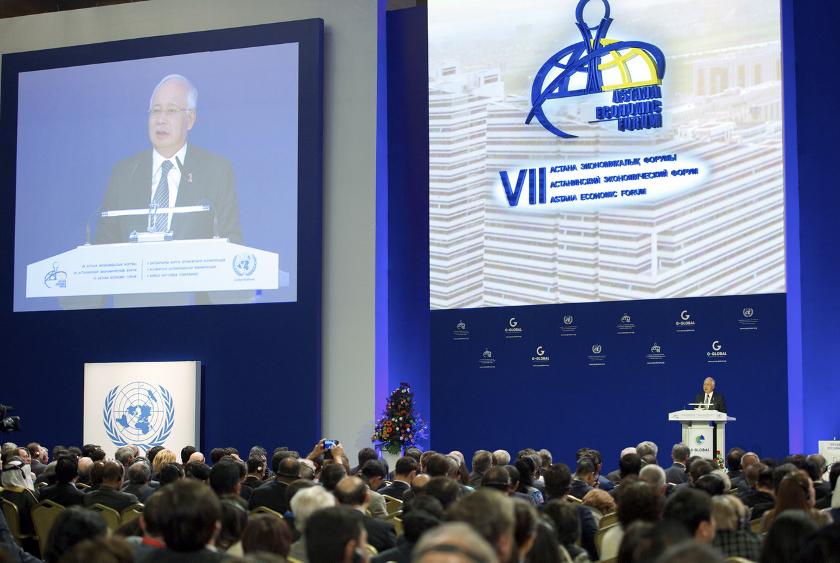
ASTANA (Kazakhstan), May 23 — Prime Minister Datuk Seri Najib Razak said Asia must come to terms with greater economic integration to help increase the power of middle nations and raise the living standards for all in the era of globalisation.
Simultaneously, he said Asian citizens must also be given greater equity and greater equality in order for the region to prosper truly.
Delivering his keynote address at the 7th Astana Economic Forum and the 2nd World Anti-Crisis Conference here today, the prime minister said the two imperatives were critical for Asean, Asia and beyond.
Najib attended the forum as a special guest of Kazakhstan President Nursultan Nazarbayev.
“The integration of Asian economies can help developing nations climb the ladder and ensure fewer citizens were left behind, as common standards and entry requirements filter back into domestic policy,” he said.
Najib said Asian economic integration would significantly benefit the region as it provided them with the ability to negotiate together.
“I believe Asian states must build a stronger, more lasting economic connection, both within the region and with the outside world, including new markets such as the proposed Eurasian Economic Union between Kazakhstan, Russia and Belarus serving more that 170 million people,” he said.
Emphasising on the importance of the economic integration for Asia, the Prime Minister quoting McKinsey, a global management consulting firm, said cross-border trade in 2012 accounted for a third of global Gross Domestic Product and by 2015 the figure could reach half.
“In the past 20 years, emerging economies have more than doubled their share of cross-border goods, services and finance, but are still lagging far behind developed markets,” he said.
Najib said Asia’s future success depended on broader and more diverse economic development as rapid growth at a time of globalisation and technological change had exposed emerging Asia to widening inequality.
The Prime Minister said intensified globalisation over the last three decades had not only brought immense gains in growth, employment, poverty reduction and greater opportunities but also greater risk.
The problems, he said were well rehearsed, like the on-going distress in key economies, the way unconventional monetary policies were unwound, the persistence of income disparities, and there must be a commitment to resolve the issues quickly and together.
“International collective action and coordination is vital to manage the impact of these risks on the global economy. Key economies must communicate their intentions early and effectively, to prevent excessive market volatility.
“Those with high fiscal deficits and debts need measured adjustment strategies rather than abrupt remedies. And, developing economies must strengthen their fiscal, monetary and policy positions to enhance their resillience,” he said.
Najib also said in each case, other economies could learn from Asia’s experience in handling the 1997 financial crisis where it had embarked on deep structural and financial reforms to build resilience against external shocks.
The reforms, he said, had left Asian states with better fundamentals, deeper and more diversified financial markets and, well-capitalised financial institutions.
Najib said Malaysia had responded to the 1997 financial crisis by consolidating and improving the banking sector and bond market.
It also made a strategic decision to develop Islamic finance as an alternative to excessive risk-taking.
“We began working to diversify our economy and bolster domestic demand and we undertook measures to strengthen government finances, imposed deficit targets, rationalised subsidies and broaden revenue base.
“As a result, Malaysia remains on track to achieve developed nation status by 2020. Our economic fundamentals remain strong, with a current account surplus since 1998. We have strong national savings, manageable inflation and low unemployment,” he said.
Najib said Malaysia’s experience was not unique as developing Asia had grown by 7.8 per cent from 2000 to 2013, significantly outpacing the global growth rate of 3.8 per cent. — Bernama


