


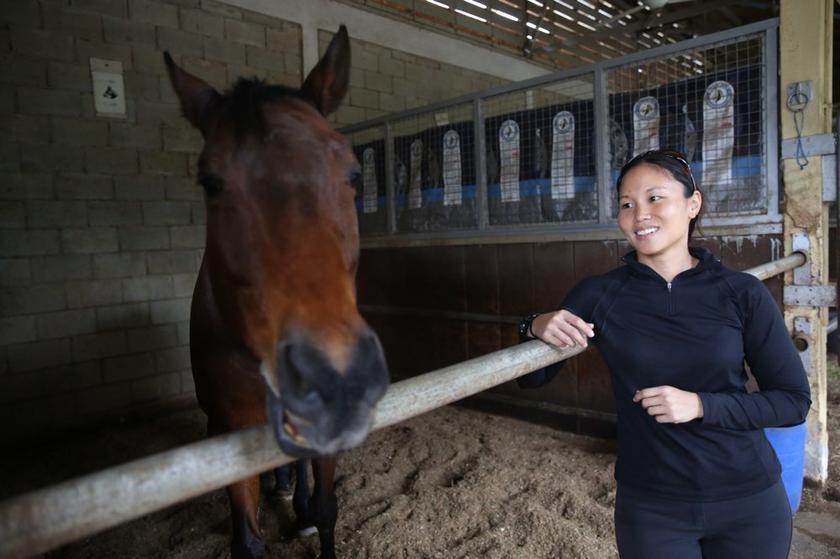
KUALA LUMPUR, Feb 2 — Once worth almost half a million ringgit each, most racehorses are worth nothing when they retire.
After about three years of running fast for gamblers hoping to win another bet, they are often given away for free.
Not your typical pet, finding a home for retired racehorses is a challenge. Worse, many also come with injuries or have unpredictable temperaments.
“People always say we’ll get the horses a good home, but good homes are hard to find for horses, there is a lot more to it,” equine coach and trainer Ong Wan Ming told The Malay Mail Online.
She runs the Ex Race-Horse Rehabilitation Programme at the Selangor Turf Club, which rehabilitates and retrains retired racehorses, turning them into steeds suitable for riding classes or beach and trail rides.
“The horses we get for free, usually no one wants them anymore. When they’re free, there’s usually something wrong with them,” Ong said, adding the retraining is difficult work that could take up to a year.
The horses are also expensive to maintain. It costs the club a minimum of RM1,000 a month to feed, train and care for each horse.
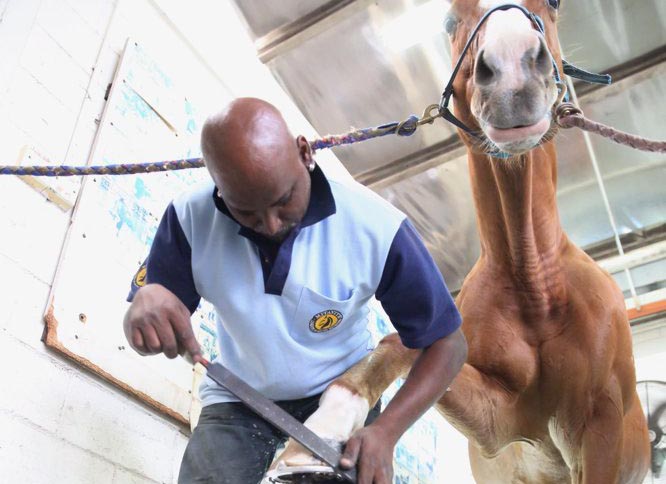
“There are a lot of hidden costs, veterinary costs, shoeing, and they can’t just live on grass, they need hay or specially chopped-up dry grass or grains,” she said.
Additionally, the horses’ teeth must be examined every six months. If the teeth grow sharp, they must be rasped to make them even.
Despite the obstacles, Ong said the rehabilitation programme has successfully retrained 18 racers to become riding mounts.
Space constraints also meant that the Selangor Turf Club’s rehabilitation programme can only take about five horses at a time.
Horses are individuals, too
When her schedule permits, Ong sometimes “lunges” the horses. Lunging is an exercise in which the trainer tethers the horse with a long rope and walks them in a round pen.
Ong said the exercise is good for horses to learn voice commands and for them to work off their high energy levels.
During The Malay Mail Online’s visit , Baba’s Gift , a horse enrolled in the rehabilitation programme, started his exercises gracefully but began to gallop and rear on his hind legs when he realised that Ong’s attention was not fully devoted to him.
He ended up right in front of the camera, posing for an impromptu portrait.
“Horses are individuals, and he is obviously having a good day today,” said Ong.
A big part of the learning process for retired racehorses, she said, is just to stand still and learn to be led properly without dragging the rider or the trainer away.
“A lot times racehorses don’t have any basics; they just know how to run fast,” Ong added.
She then brought Baba’s Gift to the rolling box, an enclosure where the horses get to lie on their backs and roll around like dogs and stand back up on their own.
“I think it’s sort of like a massage for them, it feels good,” she said.
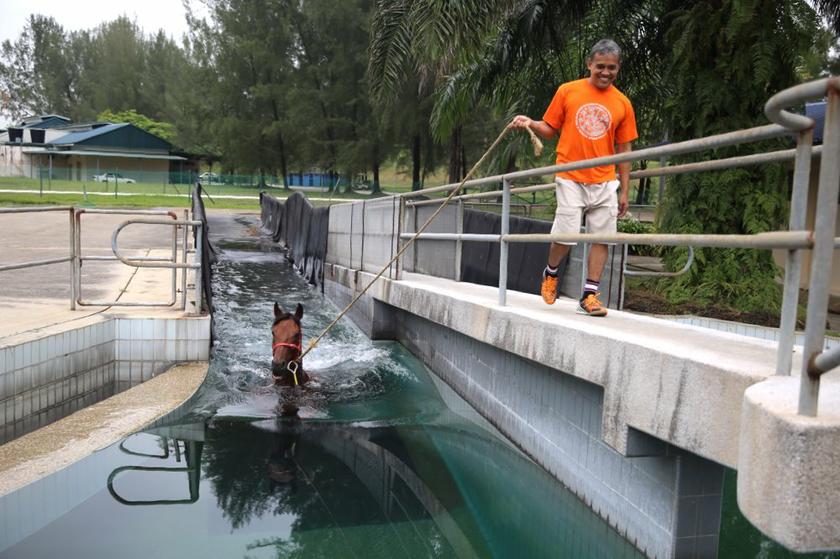
At different times during the day, the horses are released into paddocks where they roam freely and graze. A few times a week, the horses also get to swim in a pool specially made for them.
Equestrian supervisor Nigel Chong said the pool is 12-feet deep but most horses are shorter. Five-time Class 5 winner, Sango, is only 6-feet tall.
Ong said thoroughbred horses usually start racing when they are about two or three years old and are given away when they reach between five and eight years old—a good age for equestrian training—and the horses usually peak when they reach 12 and 13.
“The older they are, the more accustomed they are to the slower pace of life,” she said, adding that many horses have to be put down by the time they are about 25 years old even if they have been given the best care.
The trainer who has worked at the club for the past 13 years, also said some of the horses get shipped to Thailand for races that are less competitive but added that those usually are not given the best care.
The turf club now has 46 riding horses; of that, six also lead the horses out during a race in a position known as starter hacks.
The horse betting industry is worth more than RM5 billion annually in Malaysia alone, according to the Selangor Turf Club.
Meanwhile, the National Stud Farm, the official breeder for racehorses here has sold over 970 Thoroughbreds since 1969.


