
















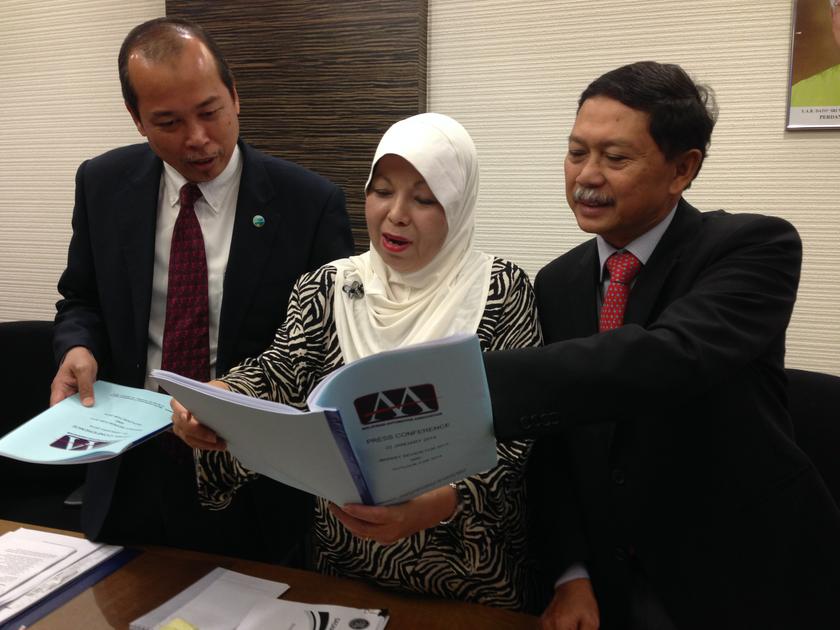


PETALING JAYA, Jan 22 — Rising costs are expected to drive car prices higher and force Malaysians to opt for cheaper models, the Malaysian Automotive Association (MAA) said today despite Putrajaya’s pledge to make cars more affordable this week.
Its president, Datuk Aishah Ahmad, said this was because consumers were already “tightening their belts” despite projections for continued economic growth for the country.
“Everything has gone up in price, car prices have gone up, and people cannot afford to buy expensive (models),” she said, adding that “mid-range” buyers were likely to be most affected.
“More likely people will be buying, downsizing as far as car purchases and all that, because it’s affordability,” she said during a press conference at the MAA office here.
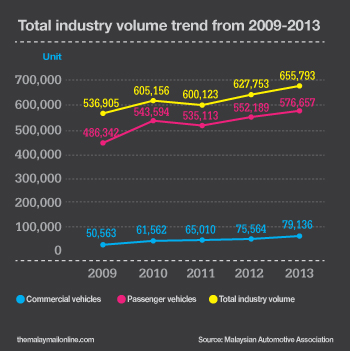
The MAA added that vehicle sales growth was expected to slow this year, despite breaching the 600,000 mark for the fourth consecutive year and recording 4.5 per cent growth last year.
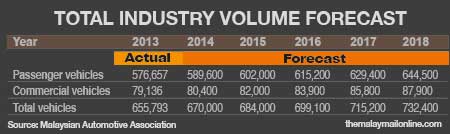
Besides rising costs, the association said stricter loan conditions instituted by Bank Negara Malaysia will see automotive sales growth moderate to 2 per cent, or approximately 670,000 vehicles in total for 2014.
 While MAA was not certain if Bank Negara is tightening regulations, Aishah said: “But especially for now, we know the lower income group find it more and more difficult to get loans because they are more stringent in approving loans.”
MAA also revealed that the production of new vehicles in 2013 recorded an increase 5.6 per cent to reach a total of 601,407 units from the year before, the first time exceeding the 600,000 mark.
Yesterday, International Trade and Industry Minister Datuk Seri Mustapha Mohamed reiterated the government’s electoral pledge to reduce car prices by up to 30 per cent in five years.
The minister also announced a series of fresh incentives to attract more foreign and domestic producers of energy efficient vehicles (EEV) and hybrid cars, hoping to restore the country’s status as Southeast Asia’s automotive hub.
The government is set to extend the exemption of excise tax and import tax for locally-assembled hybrid cars and electric vehicles until December 31, 2015 and December 31, 2017 respectively.
The government is expected to offer aid in the form of grants, pioneer status, research and development, lower taxes through Industrial Adjustment Fund (IAF), training, infrastructure, and loans.
Today, Aishah said the government pledge would very much depend on individual companies, market forces as well as competition.
 She said car prices can only be cut if companies offered lower specifications, reduced production costs and the cost of each car unit, as well as manufactured the vehicles domestically, which would translate to lower taxes.
“Market forces and competition will determine how much will be reduced but we are not saying everybody will reduce,” she said.
Aishah pointed out that the EEV incentives would be better because it is customised and will vary depending on each car company.
“Malaysia wanted to make it very flexible to say that so anybody can come in, so they don’t have any targets.
“They think by having no targets, it will make it easier for investors,” Aishah said.
However, she argued that the converse was true as local companies had to convince foreign investors that Malaysia was the right place to pour their money besides persuading the government on a one-on-one basis.
“But for sure what is good is that they are opening up the market,” she said.
The government had previously suspended the issuing of manufacturing licences for vehicles with engines at 1.8 litres capacity or below.
It will now be open to companies that locally assemble EEVs.