

PETALING JAYA, July 7 — Malaysia’s priciest infrastructure project, the Mass Rapid Transit (MRT) rail, has fewer economic benefits than the North-South Expressway (NSE) but is the springboard to the nation’s growth into the first world, several economists have said.
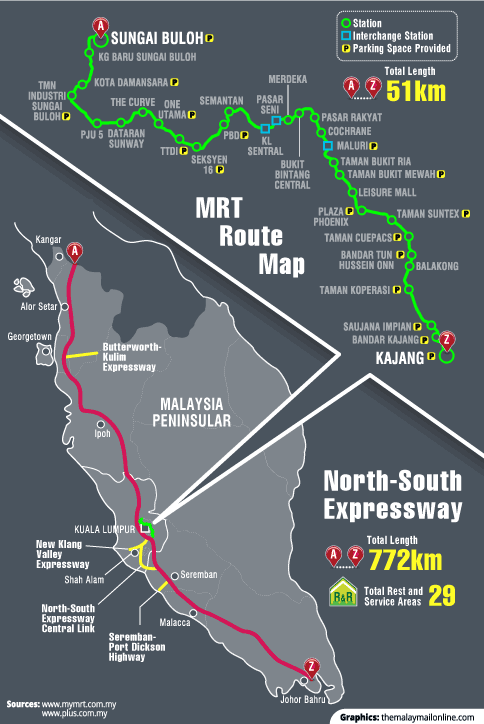
The reason, they said, is due to the limited service area covered by the RM50 billion MRT compared to the existing NSE that has spurred development up and down the length of Peninsula Malaysia by reducing the cost of transport as it links the towns and cities from Bukit Kayu Hitam, Kedah bordering Thailand southwards to Johor Baru and the gateway to Singapore.
In contrast, the MRT covers a 51km stretch within the Klang Valley, from Sungai Buloh to Kajang.
“The North-South highway, in terms of economic benefits, is far greater,” Kenanga Investment Bank economist Wan Suhaimie Saidie told The Malay Mail Online in a recent interview.
“In that sense, the multiplier effect is much higher, compared to the MRT which has yet to be proven,” he added.
Wan Suhaimie noted that the 772-km NSE, which was opened in 1994, brought development to major towns like Ipoh, Kuantan and Johor Baru, as well as the northern state of Penang.
“What’s more apparent is the growth in the existing bigger towns because of efficient transportation,” said the senior vice-president of research in Kenanga Investment Bank.
The NSE, which was developed by PLUS Malaysia Berhad, is the longest expressway in Malaysia that is dubbed the “backbone” of the west coast of the peninsula, replacing the old federal route and slashing travel time.
The NSE currently connects to the North-South Expressway Central Link and the Malaysia-Singapore Second Crossing.
RAM Holdings chief economist Dr Yeah Kim Leng pointed out that industrial parks, business centres and even oil palm plantations have popped up over the decades along the NSE.
“It allows the creation of new businesses and allows other regional towns and cities to develop and flourish along the North-South highway, for example Ipoh, Taiping, Kuantan. It improved logistics, lowered transport costs, and allowed easier access,” Yeah told The Malay Mail Online.
He noted that the benefits of the MRT, on the other hand, are “concentrated in the Klang Valley”.
“If we can afford it, we should enhance the infrastructure network throughout the country,” said Yeah.
The economist stressed, however, that the MRT was necessary to address traffic congestion in the Klang Valley, the hub of development in Malaysia, as the country strives to achieve high-income status by 2020.
“The MRT will help create a modern metropolis to attract more foreign investment,” said Yeah.
“The economy booms because of more efficient transport that creates a more dynamic business environment,” he added.
Other developed nations like Singapore, the UK and the US already have mass transit systems running through major cities.
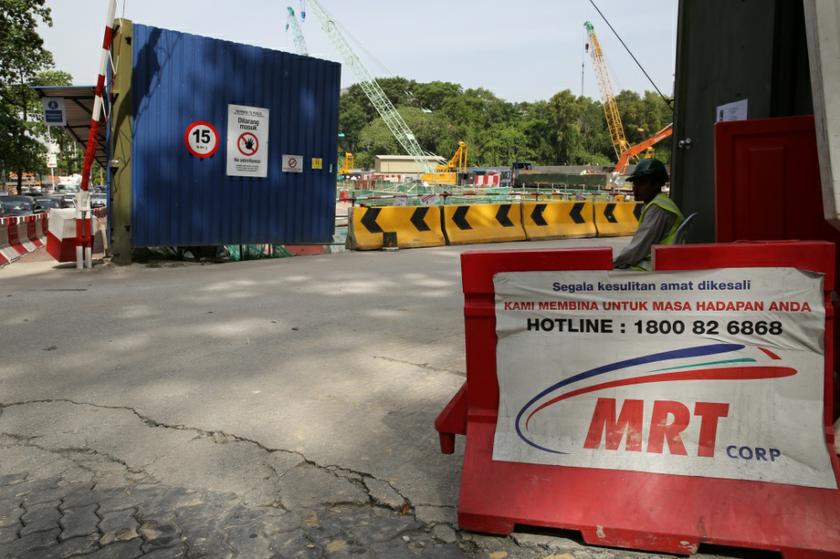
Malaysia’s MRT project, however, was only kick-started last year, with the first phase of the 51km Sungai Buloh-Kajang line to be completed by December 2016 and the second phase by July 2017.
The first phase is for the Sungai Buloh-Semantan line, while the second phase is for the Semantan-Kajang line.
Maybank Investment Bank chief economist Suhaimi Ilias, however, differed with his counterparts and said that the NSE did not necessarily have greater economic benefits than the MRT.
“MRT is more to cater for the need to move a massive number of people in the Klang Valley as the roads and highways are choked with vehicles,” he said.
“The aim is also to make KL a liveable and efficient city and to promote it as a growth centre, given that KL easily accounts for one third of the country’s GDP”.
Suhaimi also noted that the MRT did not just benefit the construction industry, but had spillover effects on other sectors of the economy, such as “finance (bank loans, bond issuance), logistics, manufacturing (building materials), professional services (mechanical, engineering, legal)”.
Wan Suhaimie similarly said that the MRT project would create jobs, besides enhancing real estate along the rail lines.
“In any infrastructure project, the main intent is to stimulate the economy,” he said.