







BANDUNG, Nov 21 — Nestled in the highlands of West Java, Bandung has long captivated visitors with its cool mountain air, colonial-era architecture and romantic charm, earning it the nickname ‘Paris van Java’, or the Paris of Java, during the Dutch colonial era.
Yet, beneath the city's romantic allure lies another love story - one that began in a modest family courtyard six decades ago and has since grown into a major centre for the production and promotion of traditional bamboo musical instruments, with its reach extending beyond Indonesia to countries including Malaysia and Japan.
At the heart of this musical journey is Saung Angklung Udjo. Its name incorporates the Sundanese word saung, meaning a traditional hut or shelter. The cultural centre's public relations officer, Erika Rizky, recalled how the late Udjo Ngalagena, affectionately known as Abah Udjo, and his wife, Uum Sumiati, founded the centre in 1966.
"Before we had 600 performers here, the first to perform were his 10 children,” she told Bernama during a familiarisation trip for Malaysian journalists and influencers to Jakarta and Bandung, organised by the Indonesian Consulate-General in Kuching in collaboration with Sarawak-owned airline AirBorneo.
The angklung, a traditional Indonesian musical instrument made of bamboo tubes suspended within a frame, produces distinctive notes when shaken. Each instrument contributes a different pitch, with the sounds blending to create harmonious melodies when played together.
Although trained as a physical education teacher, Udjo's passion for music began in childhood and flourished under the guidance of renowned musician Daeng Soetigna, whose development of the diatonic angklung in 1938 broadened the instrument's musical possibilities.
According to Saung Angklung Udjo's official history, Udjo performed with an angklung ensemble during the historic 1955 Asian-African Conference in Bandung before embarking on his own instrument-making venture in 1961. Five years later, he and his wife formally established the cultural centre.
Erika said that in the early years after its establishment, Udjo would cycle through Bandung's Braga and Asia Afrika areas after completing his teaching duties, distributing promotional cards made of bamboo to hotels, travel agencies and tourists to attract audiences to performances held in his family courtyard.
By the late 1960s, the centre had begun attracting foreign visitors, gradually transforming Udjo's modest family initiative into a recognised cultural attraction, according to research published in a journal by the Ministry of Social Affairs.
Six decades later, Erika said the institution had grown to involve about 600 performers, with Udjo's children, grandchildren and even great-grandchildren continuing the family's musical legacy.
For Erika, who has been associated with Saung Angklung Udjo since the age of three, the centre holds special personal significance. It has been part of her life since childhood and remains a place where successive generations come together to appreciate traditional music.
Located in the Padasuka neighbourhood, about seven kilometres from central Bandung, the institution has grown beyond its original family courtyard into a cultural complex featuring performance spaces, angklung workshops and educational activities. Erika estimated that its main grounds cover approximately two hectares.
Visitors can immerse themselves in Sundanese culture through bamboo craftsmanship, traditional dances and interactive musical performances, which also give them an opportunity to try playing the angklung themselves.
Beyond its cheerful melodies, the angklung has a more mystical past, having traditionally been associated with agricultural rituals in honour of Dewi Sri, the rice goddess. Sundanese communities invoked her blessings in the hope of ensuring fertile land and bountiful harvests.
The instrument eventually evolved beyond its ceremonial role, gaining international recognition when Indonesian angklung was inscribed on UNESCO's Representative List of the Intangible Cultural Heritage of Humanity in 2010, nine years after Udjo's death.
Today, Erika describes Saung Angklung Udjo as among the world's largest angklung production centres, supplying handcrafted instruments to overseas markets and drawing on decades of experience in making and performing traditional bamboo music.
"Japan is usually our biggest market because angklung has already been incorporated into school subjects there,” she said, adding that the centre had been exporting its instruments for decades.
Malaysia is also among its export destinations, with Erika describing demand from the neighbouring country as strong. Teachers and other participants from Malaysia have also attended the centre's training-of-trainers programme.
"They come here to learn first, and later apply what they have learned in their respective places,” she said, adding that participants received certificates upon completing the programme.
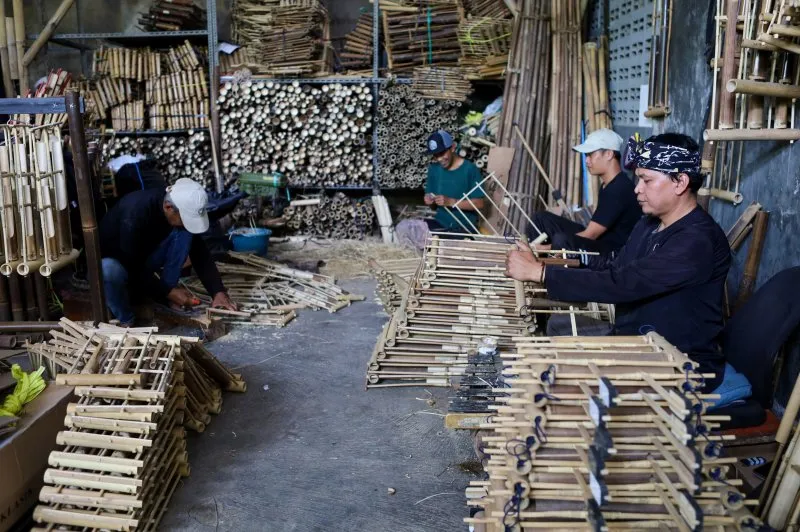
Behind its international reach is a production operation where, according to Erika, a team of seven to 10 craftsmen can produce approximately 20 angklung instruments daily, although output varies depending on demand, particularly overseas orders.
She said the centre also cultivates various bamboo species on its own land, including at a separate site known as Udjo Ecoland, where bamboo preparation and drying activities are carried out. However, additional supplies are purchased to meet production requirements.
For travellers drawn to Bandung by its cool climate and romantic charm, Saung Angklung Udjo offers yet another reason to linger - an opportunity not merely to listen to traditional music but also to discover the craftsmanship, history and cultural heritage behind every note. — Bernama