


JERANTUT, Aug 4 — Living deep in the interior of Pahang in Kampung Gusai, located on the banks of Sungai Tembeling in Ulu Tembeling, more than 100 kilometres from Jerantut, Muhammad Aiman Uyob and his father Uyob Ahmad have proven their remote location is no barrier to success.
Armed with little more than a smartphone, an Internet connection and determination, the father-and-son duo is generating a good income by cultivating cucumbers using the fertigation technique, which Muhammad Aiman, 27, learned through video calls with a friend who was already practising the method.
(Fertigation is the practice of delivering fertilisers to crops through irrigation water, combining irrigation and nutrition in a single, efficient system.)
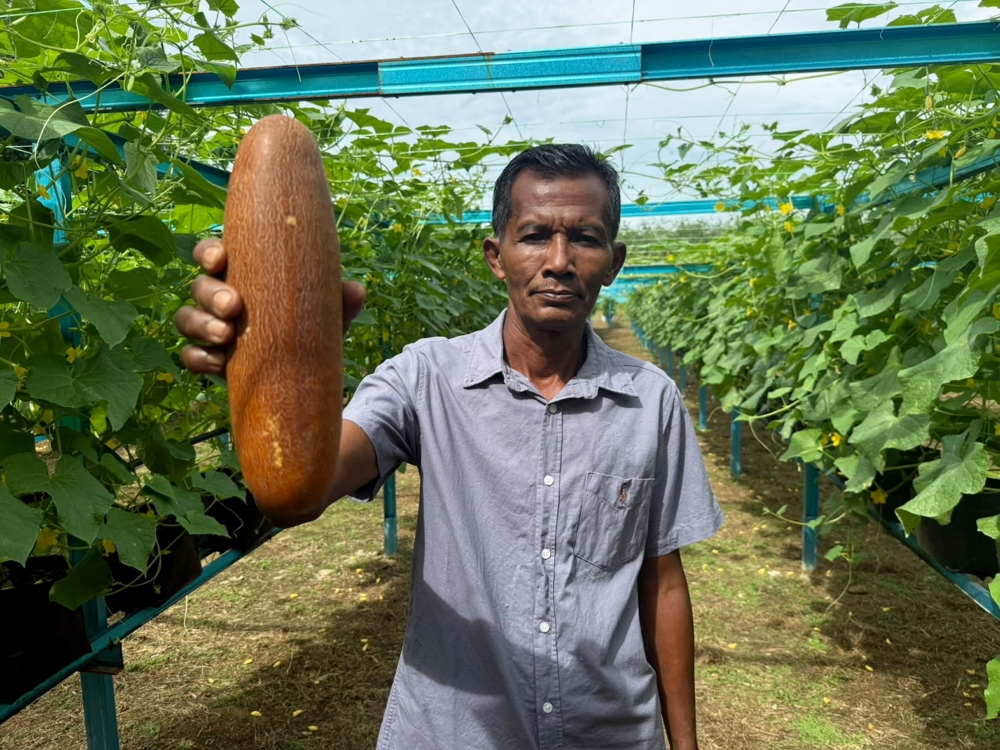
Since venturing into growing old cucumbers (or timun tua) earlier this year, the pair harvested 14,000 kilogrammes from their first crop in February, earning about RM40,000.
Speaking to Bernama, Muhammad Aiman said they learned every aspect of fertigation farming from the video calls, as well as online resources, despite having to contend with an unstable Internet connection in their kampung.
“I learned everything, from fertiliser application to pest control. At first, there was so much I didn’t know, but I kept learning step by step and, thankfully, the results have been very encouraging,” he said.
Interest in agriculture
Muhammad Aiman said he left for Kuala Lumpur in his early 20s to work in a factory, but soon realised city life was not for him.
“Life in the city was very different and I couldn’t adapt, so I decided to return to my village and help my father manage our banana smallholding.
“That’s where I learned the ins and outs of farming and saw its potential to generate a good income,” he said.
However, he soon began looking for alternative crops that would provide quicker returns while also addressing the persistent problem of crop damage caused by wild animals.
“Whenever the banana trees started bearing fruit, monkeys and wild boars would appear. Many of the bananas were damaged before we could harvest them, causing losses for us.
“It became an ongoing problem and we had to consider planting something more suitable,” Uyob, 59, interjected, explaining that the bananas had been a supplementary source of income alongside his rubber smallholding.
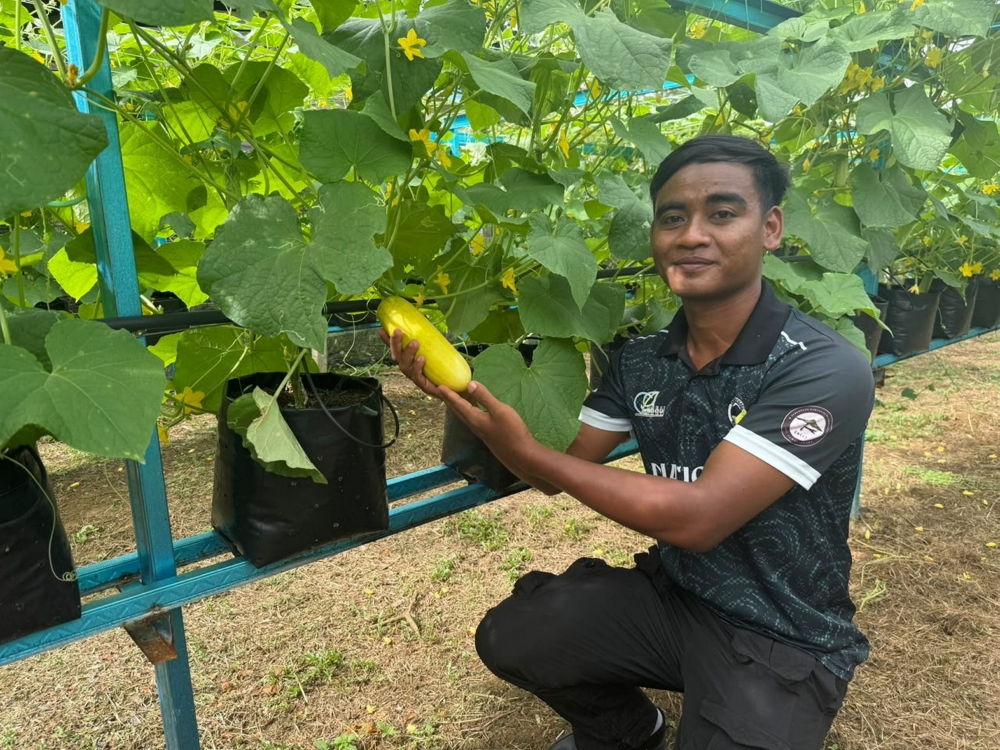
Muhammad Aiman said after doing some research, they found that old cucumbers are a better option because they are relatively easy to grow and can be harvested within 50 to 60 days, much faster than many other crops.
He was determined, however, not to cultivate them using conventional methods. Further research led him to fertigation, which he found ideal because it requires less land and is easier to manage.
Video calls
That decision marked the beginning of video calls between Muhammad Aiman and his father, and the friend who operated a fertigation farm in Pulau Mansok here.
After gathering the information they needed, Muhammad Aiman travelled to Jerantut to buy polybags, fertilisers and seeds before establishing their first plot of 2,000 polybags on a 0.761-hectare site beside their home.
“This system is much easier to manage and the harvest comes much sooner,” said Uyob.
Unlike their friend, who grows a variety of vegetables, including chillies, using the fertigation method, the duo chose to focus solely on old cucumbers.
Uyob said they selected the crop because of its strong market demand and attractive price, which can reach RM5 per kilogramme depending on supply and demand.
“Old cucumbers are widely used in dishes such as tempoyak patin and soups. Demand is consistently high, especially at the Selayang wholesale market in Selayang, so that’s where we send our produce,” he said.
For all their success, transporting the harvest remains their biggest challenge. Because cucumbers are highly perishable, they must be delivered to the market as quickly as possible.
“We first transport them by boat, which takes between 40 minutes and an hour to reach the Kampung Bantal jetty. From there, we load them onto a lorry for the journey of more than 100 kilometres to Jerantut, where arrangements are made to send them to the Selayang wholesale market,” Uyob said.
Looking to expand
Although travelling along Sungai Tembeling carries its own risks, he said it remains the better option compared to travelling on unpaved roads that can only be accessed by four-wheel-drive vehicles.
“But we’re used to it (river transport). We rely on the river because it’s the easier route,” he added.
The father-and-son team’s tenacity despite the challenges of living in a remote village caught the attention of the Sultan of Pahang, Al-Sultan Abdullah Ri’ayatuddin Al-Mustafa Billah Shah, who visited their fertigation project in May after hearing about it from villagers.
The royal visit, coupled with the encouraging returns from the project, has inspired Uyob to expand the operation.
“I plan to increase the number of polybags to double our production. We’ve already entered our third planting cycle, and the next harvest will be ready soon,” he said enthusiastically.
The success of Uyob and Muhammad Aiman demonstrates that even in one of Pahang’s most remote communities, perseverance, resourcefulness and technology can overcome the challenges posed by distance and limited infrastructure.
Their story is a reminder that where there is a will, there is always a way. — Bernama


