


GEORGE TOWN, Nov 7 — The moment Toh Ai Hwa takes her spot on stage in a Teochew iron-rod puppet performance, she will have to remain on stage for the next four hours even when heavily pregnant or sick.
The 76-year-old said her son was almost due for delivery when the troupe leader told her to join a performance in Bukit Mertajam.
“I asked him what if I went into labour and he told me if I go into labour, they will send me to the hospital and it happened that just as the show ended, I went into labour so I dropped the instruments and they took me to the hospital,” she said.
She said there was no such thing as maternity leave during that era so she had worked throughout her pregnancies.
She recounted another time when she had to perform at a temple on a hill and she had to ride pillion on a motorcycle up the hill while pregnant with another child.
“At that time, I asked my boss what will happen if I go into labour on the hill top so he brought a midwife along as a precaution,” she said, adding that fortunately, she did not go into labour on the hill and only delivered a few days later.
Toh said this is the life of performers that were often dictated by the schedules of their shows as her mother was also pregnant with her when performing in a Chinese Opera.
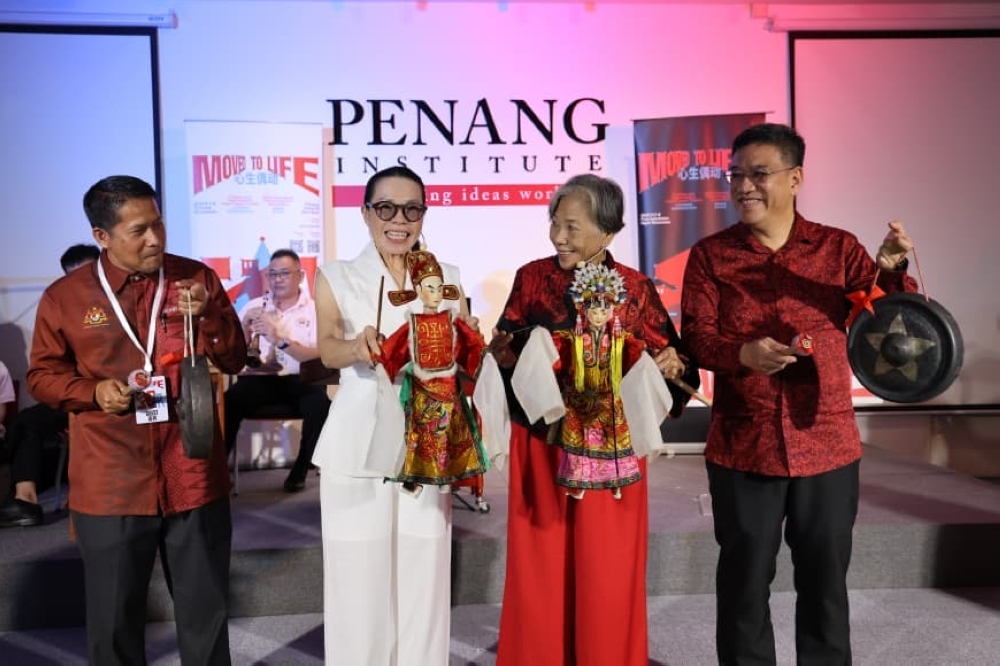
“My mother, who came from China, was a traditional Opera performer here in Penang so she went into labour in the midst of a performance,” she said.
Toh said she came from a long line of performers as her grandmother was also a traditional Opera singer in China and all of her family members have deep interest in performing arts.
She has been in the Teochew iron-rod puppetry field for 64 years, performing even when she was ill and bringing her children and, later, grandchildren along to shows.
“Once, I was so sick, I can only lie down to play the gong and drum during a performance because the show must go on,” she said.
She had taken an apprenticeship in Teochew puppetry at the age of 12 due to her interest in singing and performing.
“It was the 1950s, there were hardly any jobs, I was not educated as my mother didn’t believe girls should go to school, so when I chanced upon the puppetry troupe, I joined them and started learning from the troupe leader,” she said.
She said all apprentices have to learn the art of puppetry first before learning the music and singing.
“The iron-rod wooden puppets were so heavy so I decided to focus on playing the gong and drum, and the singing since I loved to sing,” she said.
When her boss wanted to retire, she said he offered to sell the troupe to her and that was when she took over the Kim Giak Low Choon Teochew Puppet Troupe in 1989.
It was not an easy path to follow in preserving the puppetry tradition as she said at one point, there were hardly any bookings for their performances.
“Sometimes, we only have bookings of one or two performances a month or during some festivals, it was a challenge to earn a living at that time,” she said.
Despite that, she ensured that all four of her children learnt the trade from her so all of them has the skills for puppetry along with playing the gong and drum music.
She said her sister was also a puppeteer and her brother, who was a traditional Opera performer, eventually learnt puppetry from her and set up his own troupe.
“Now, puppetry performances are gaining popularity so there are also other troupes but there was a period when my troupe was the only one in the country because income was low and no one was interested in learning it,” she said.
To ensure continuity of the traditional puppetry performance, Toh said her grandchildren grew up learning the art of puppetry.
One of them is her oldest granddaughter, Goh Sin Ee, 25, who is part of the Gaik Lai Teochew Puppet Show troupe.
Growing up around the troupe, she learnt first how to handle the puppets and later how to sing.
“I have a day job in a factory in Bayan Lepas but after working hours, I spend my time in my family’s puppetry performances,” she said.
She said her younger sister is a full-time performer while her younger brother is a student who is also involved in the troupe.
“All of us learnt the trade from young and all of us can perform, we feel it is important to preserve this family tradition and culture,” she said.
She said the troupe often gets bookings for performances during specific celebrations and festivals such as deities’ birthdays, the Hungry Ghost Month and during the Nine Emperor Gods Festival.
Toh hopes that her grandchildren will continue to pass down the family tradition and culture to their children and grandchildren.
“I hope we can continue this down to the sixth generation or more,” she said.
Apart from the WAKOH recognition, Toh also received the Living Heritage Treasure of Penang award in 2008, a recognition for her lifetime contribution from George Town World Heritage Incorporated in 2020, and the Penang State Arts Icon Award in 2025.
Toh’s Teochew iron-rod puppetry performance was also among 10 traditional trades featured in Penang Global Tourism’s traditional trades campaign this year, held in collaboration with Penang Heritage Trust.


