


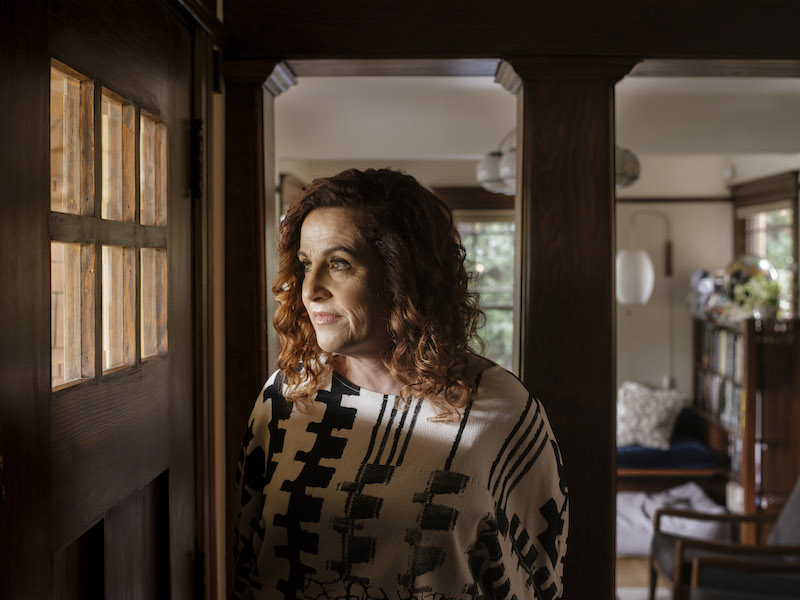
LOS ANGELES, Jan 8 — Ayelet Waldman, a novelist and former federal public defender, recalled the sunny spring morning she rolled out of bed in her Berkeley, California, home and experienced the most curious sensation: She felt alive.
As her husband, the novelist Michael Chabon, slept and her teenage son and daughter slumped over the breakfast table, Waldman did not feel a trace of morning surliness, or of the suffocating depression that had dogged her for months.
Rather, she says, with the perkiness of a morning-show host, she chirped about the loveliness of the blue skies and hummed upbeat ditties as she whipped up banana-strawberry smoothies. She even offered to braid her daughter’s hair. It was all so out of character that her children spoke up.
“Mum, are you on acid?” her daughter asked sarcastically.
Waldman froze. It was not yet the moment, she decided, to answer “yes.”
Waldman had discovered microdosing, an illegal but voguish drug regimen in which devotees seek to enhance creativity, focus and mental balance by ingesting regular, barely perceptible doses of hallucinogens like LSD or psilocybin mushrooms.
Forget “turn on, tune in, drop out.” To recent converts like Waldman, who recounts her microdosing journey in a new memoir, A Really Good Day: How Microdosing Made a Mega Difference in My Mood, My Marriage, and My Life, to be published Tuesday by Alfred A. Knopf, it’s a new psychedelic era. For them, LSD is less a kaleidoscopic mind expander than a humble mood enhancer, as subtle and quotidian as Prozac.
Age of ‘microdosing’
A 52-year-old mother of four whose usual definition of “excess” is a wine spritzer, Waldman may seem an unlikely proselyte for a second Age of Aquarius. Lately, however, the topic of microdosing has gained currency outside drug-enthusiast circles.
In 2011, James Fadiman, a Bay Area psychologist who studied under Timothy Leary, published The Psychedelic Explorer’s Guide: Safe, Therapeutic, and Sacred Journeys. Since then, microdosing has been embraced by a subculture of boundary-pushing (and law-flouting) career-minded people as something of an illicit, chemical form of yoga — an alternative health regimen intended to bring mental balance, as well as enhance productivity.
Influential podcasts like Reply All and The Tim Ferriss Show helped popularise the concept, which has caught on in Silicon Valley, where some were already receptive to the concept of psychedelics. This may be thanks to Burning Man, the annual bacchanalia-cum-tech mixer held in a western Nevada desert, as well as Steve Jobs’ revelations about his youthful psychedelic forays.
And the message has spread. One microdosing forum on Reddit has more than 11,000 subscribers, and the practice has been picked up as a trend du jour in publications as diverse as Vice, Marie Claire and Inc, which tend to profile a handful of anonymous professionals who say they have achieved an enhanced “flow state” at work through the practice.
Waldman, however, was drawn to microdosing not so much as a career propellant, but as a last-ditch attempt to find mental equilibrium. Countless prescription pharmaceuticals had failed to stabilise her chronic mood disorders, including depression and Bipolar II disorder, and, more recently, her premenstrual dysphoric disorder, a particularly disabling form of premenstrual syndrome.
Her tempestuous psyche, she said, was tearing apart her marriage and raising thoughts of suicide.
“I didn’t do this on a lark,” she said during a recent visit to New York. “I did this because I was afraid I was going to kill myself.”
Downward spiral
From the outside, such an admission may seem surprising given Waldman’s bona fides. After starting her career as a corporate lawyer in New York, and later working as a public defender in Southern California (she graduated from Harvard Law School in the same class as Barack Obama, in 1991), Waldman, who was born in Israel, transitioned to a writing career. She has published seven instalments of her Mommy-Track Mysteries series, along with four other novels, including Love and Other Impossible Pursuits, which was adapted into the 2011 Natalie Portman film The Other Woman.
Nevertheless, her mood swings in recent years had become so serious with the hormonal changes of premenopause that she was open to anything, Waldman said. And that is when she found Fadiman’s book. (She declined to discuss the exact timing of her microdosing foray, citing statute-of-limitations concerns.)
The idea behind microdosing is to take regular “sub-perceptual” doses of hallucinogens (in the case of LSD, about 10 micrograms, roughly one-tenth of a standard recreational dose) once every four days. The levels ingested are intended to be too small to inspire Technicolor hallucinations, but large enough to enhance a sense of mental flow.
In an interview, Fadiman said that hundreds of microdosers who have sent him written accounts of their experiences while on his regimen — hardly an exhaustive medical study, to be sure — have reported decreased anxiety, depression, even migraines. Others said they have experienced improvements in creativity, diet, sleep and sex.
A good trip
On the first day of what became a 30-day experiment, Waldman released two five-microgram drops of the liquid LSD under her tongue and, well, waited.
At first, nothing happened. Ninety minutes later, however, she peered up through a window.
“I have a dogwood tree out my window,” she said, “and it was in bloom, and I thought, ‘Oh, that tree is beautiful.'” She added: “And I was like, ‘Ohhh. ...’ Because I’m not a noticer like that. When I’m in my own head, I don’t stop and smell the roses.”
In Waldman’s experience, Day 2 of Fadiman’s four-day cycle was always the peak, the day when a deep sense of peace and purpose would settle over her.
“Day 2 is just smooth and awesome,” she said. “I think the Dalai Lama is on a perpetual Day 2.”
Writer’s block, long a problem, seemed to vanish.
“I found it much easier to get into that state of creative flow that is so elusive to the writer,” Waldman said. “It happens, how often, every year or two where you have one of those days where you look up and it’s seven o’clock and you’ve been writing all day and it’s like magic? That happened to me a number of times during that month.”
In some ways, the effect was similar to Ritalin, the pharmaceutical stimulant, but without the downside. With Ritalin, “I did have that zoomed-in laser focus,” she said. “I got my work done but also had a blinding headache and was a raging bitch.”
“Microdosing,” she added, “allowed me to work intensely with an exhilarated focus, to make all these connections that I may not otherwise make, and have a blast doing it.”
After a month, however, the bottle ran out. Terrified of being arrested, Waldman has not acquired or used the drug since, she said.
Occasionally she has found herself researching countries around the world that have more permissive drug laws, she said.
“I mean, look, I’m happily married and not dead,” she said. “I’ve been prescribed so many medications over the years, and this worked better than any of them.” — The New York Times


