


KUALA LUMPUR, Aug 16 — The phrase “ugly delicious” gets thrown around a lot to describe dishes from our part of the world.
It’s meant as a self-aware compliment: this won’t look good on Instagram, but it’s tasty. It’s real. Authentic.
And yet, it’s never sat right with me. Why are some dishes — sometimes entire cuisines — deemed “ugly,” and others not?
More pressingly: why do “our” dishes make up so much of that first category?
Any wannabe food stylist can turn a charcuterie board or a pasta tray bake into a boring Pinterest tablescape.
But a well-loaded plate of nasi kandar from Deen Maju, splashed with colour and kuah, looks to me like a Jackson Pollock piece; a glistening, jet-black plate of Hokkien mee at Mun Wah could rival the best of Pierre Soulages. No styling necessary.
Beauty is in the eye of the beholder, I suppose.
But why we’re so quick to call our food “ugly” in the first place is a conversation for another day.
What I can do today is point to a cuisine that seems to have been granted an exemption: Japanese.
With the exception of natto — it’s the smell and stickiness that get you, not the look — sashimi, sushi, ramen are all apparently good for the ’gram.
And then there’s monjayaki. If okonomiyaki is Japan’s idea of savoury pancakes, monjayaki is what happens when you abandon the idea of a pancake altogether.
The batter is loose — closer to a thin, starchy gruel than anything resembling pancake mix — poured onto the teppan with cabbage and whatever else you fancy, then left to sizzle and spread into a shapeless, bubbling mass.
There’s no clean flip, no golden crust. You scrape at it with a small metal spatula as it cooks, coaxing it into a crispy-edged, gloopy heap that looks — there’s no kinder way to put it — like cabbage slop.
Tokyo’s Tsukishima area has an entire street dedicated to it, and it has now landed in KL.
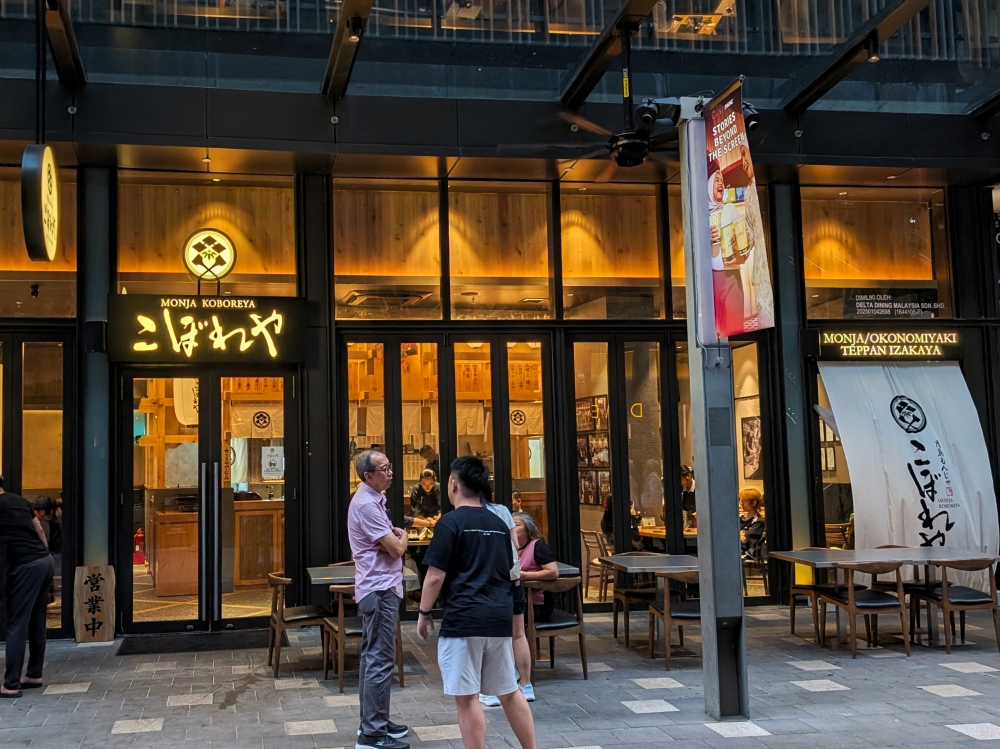
Koboreya, the monjayaki specialist with seven outlets across Tokyo, recently opened its first Malaysian branch at LaLaport BBCC in Bukit Bintang.
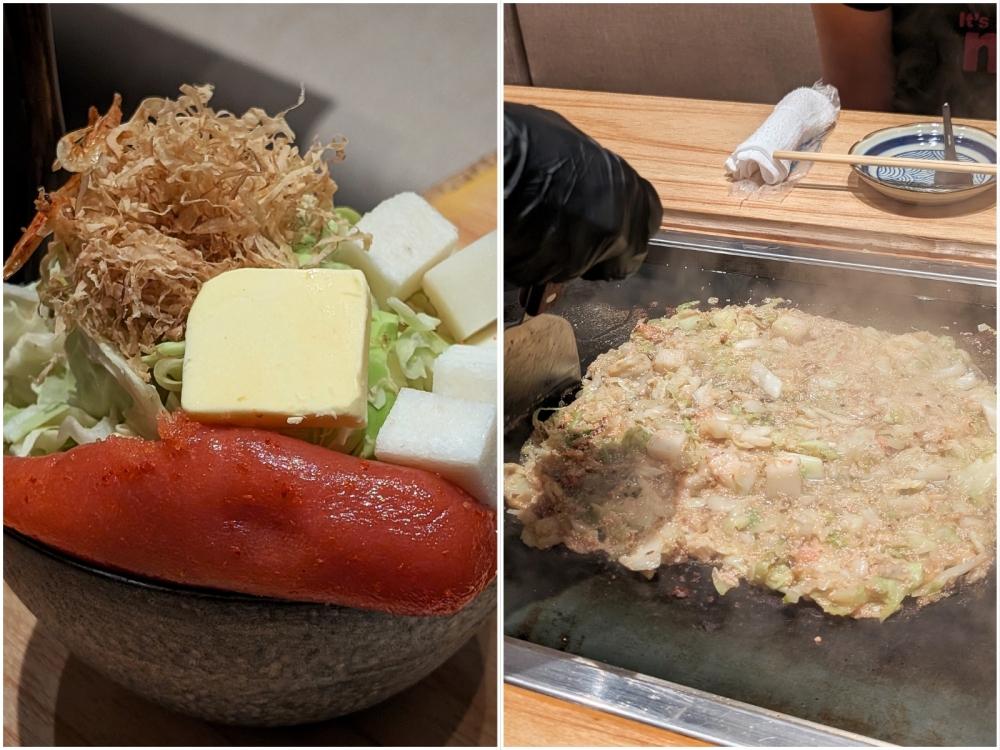
The signature Mentaiko Mochi Monja (RM35) arrives as a neat bowl of cabbage, dashi batter, and its namesake toppings — mochi cubes and mentaiko, pollock roe.
A server does the work first: separating the toppings, including a block of butter, then oiling the teppan, then pouring the cabbage and dashi mixture over it in a thin rectangle.
Halfway through, it looks less like food than a spill: a grey, sloppy puddle threatening to run off the edge of the griddle.
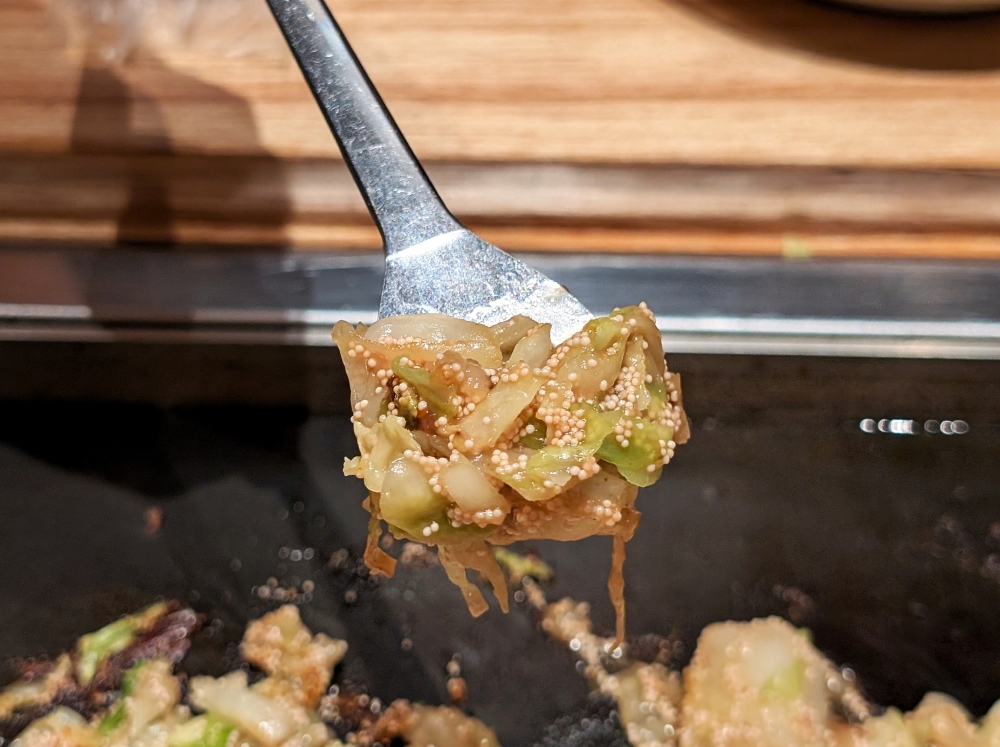
The liquid reduces as the cabbage cooks and caramelises; only then does the mentaiko get chopped up and folded back in with the mochi and butter.
From there, it’s up to you and the small metal spatula — a gooey scoop, or a firm press to really brown and crisp things up.
The mochi responds particularly well to the latter, taking on a toasty edge; the bites are fishy and savoury overall, rich with umami.
I enjoyed the Koboreya Seafood Monja (RM40) slightly more. Shrimp, squid, asari clams, scallops, oysters and conger eel are cooked along the cabbage and dashi mixture, giving it a much sweeter, richer seafood flavour that doesn’t have any of the fishiness of mentaiko.
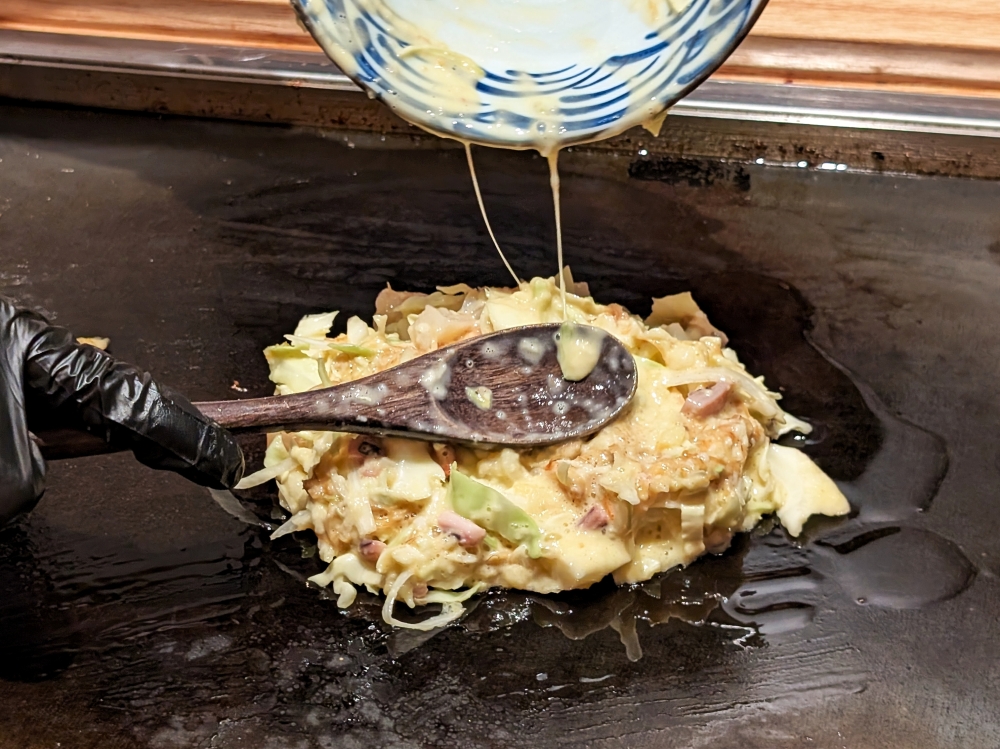
One thing to note: monjayaki isn’t terribly filling. Even shared straight off the griddle, cabbage, stock, and a handful of toppings don’t add up to much of a meal, so don’t be surprised if two orders aren’t enough.
Like most monjayaki specialists, Koboreya also serves okonomiyaki, so my friend and I decided to try the more familiar, starchier version instead.
After enjoying the seafood monjayaki, I moved on to the Seafood Deluxe Okonomiyaki (RM30), and on my friend’s recommendation, gave the Green Onion & Cheese Okonomiyaki (RM30) a try too.
Both are made Osaka-style — all ingredients mixed into the batter, no noodles — and finished with a generous amount of okonomi sauce and mayonnaise.
The seafood variant was enjoyable enough, with a healthy dose of shaved bonito on top, but the green onion and cheese combination was revelatory.
I was sceptical about the amount of cheese that went on — a small saucepan’s worth — but the sweet crunch of the Japanese leek inside complemented it well.
The best part was watching the okonomi sauce fuse with the melted cheese and caramelise into a sweet, crispy patch on the griddle.
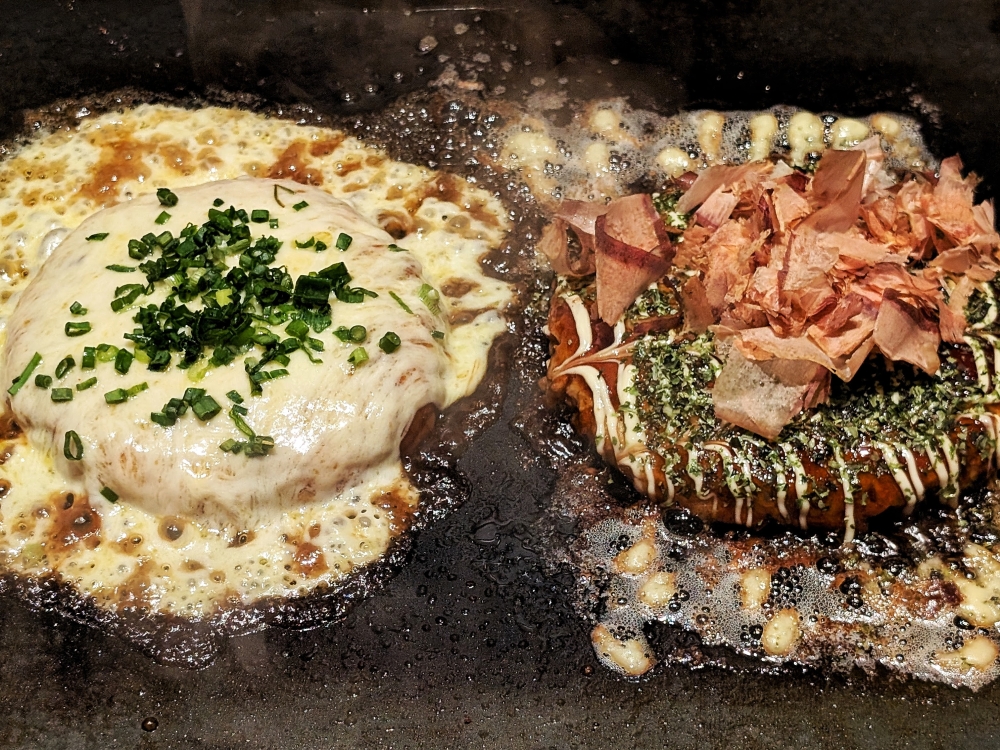
On its own, the sauce splits as it cooks, leaving you with a mouthful of oil and slightly bitter brown solids; the cheese keeps it bound instead, so the sugars caramelise rather than burn. A perfect match.
Monjayaki, in other words, is Japan’s own “ugly delicious.” But in a country so ready to fawn over all things Japanese — omakase, matcha, shio pan — it remains to be seen whether monjayaki will ever be recognised for what it is: a grey, sloppy puddle on the griddle, coaxed into a gooey, umami-rich heap with a spatula and a bit of patience.
I suspect it won’t, even though it objectively should be. Says something about the label, doesn’t it?
Tsukishima Monja Koboreya Kuala Lumpur
G-83, LaLaport BBCC,
Mitsui Shopping Park,
2, Jalan Hang Tuah,
Bukit Bintang, Kuala Lumpur.
Open Tuesday to Sunday, 12-11pm
Tel: 017-295 9314
Instagram: @koboreya_my
*This is an independent review where the writer paid for the meal.
* Follow us on Instagram @eatdrinkmm for more food gems.
* Follow Ethan Lau on Instagram @eatenlau for more


