











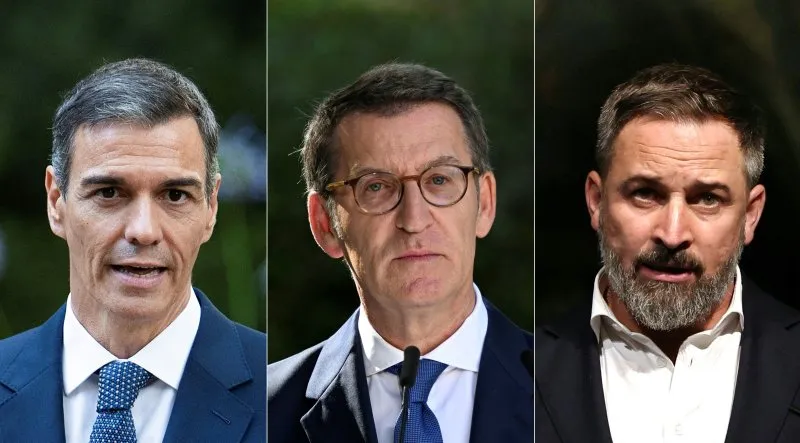


MADRID, Nov 23 — Socialist Prime Minister Pedro Sanchez seeks to thwart grim polls as polarised Spain holds an election on Sunday that could propel the opposition conservative Popular Party (PP) and the far right to power.
The outcome will be closely watched across Europe as it opens a cycle of elections over the next 12 months that could reshape the balance of power within the European Union.
Sanchez, who has become one of Europe’s best-known left-wing leaders after eight years in power, urged supporters this weekend to “vote, win and govern for four more years”.
But opinion polls still place him behind 65-year-old PP leader Alberto Nunez Feijoo, albeit by a narrowing margin.
“Spain needs change and together we are going to achieve it,” Feijoo told supporters, while urging them not to trust opinion polls.
The PP is predicted to win the most seats but fall short of a parliamentary majority, in a repetition of the hung parliament following the last general election in 2023.
Polls suggest its route to power lies with far-right, anti-immigration party Vox, parliament’s third-largest force, which could almost double its seats and make its leader Santiago Abascal a kingmaker.
Vox has campaigned heavily on immigration, with Abascal accusing migrants of living off benefits “that Spaniards need”.
Vox has formed coalitions with the PP in regional governments, but its presence in a national administration would be unprecedented for the far right since General Francisco Franco’s dictatorship ended in 1975.
Further complicating the situation for Sanchez is the weakness of other leftist parties whose support proved crucial to keep him in power in 2023.
Sanchez “must go now, out of decency and respect for the Spanish people. I don’t know if Feijoo is the right candidate, but we need a change”, businessman Pedro Suarez, 64, told AFP in Madrid.
Sanchez believes he can defy the predictions again. He has made escaping seemingly hopeless positions a hallmark of his career.
Spain ‘has moved forward’
His campaign has highlighted the dynamism of the European Union’s fourth-largest economy as well as social gains, notably for feminism and LGBTQ rights, that Sanchez says a PP-Vox coalition would reverse.
“This country has moved forward a lot in the past few years. A huge amount of things have been achieved on a social level,” said Pilar Sanchez, a 64-year-old former Madrid metro employee who intends to vote for the incumbent prime minister.
Sanchez has been described as Donald Trump’s nemesis, with Spain the only NATO member to defy the US president’s push to hike the alliance’s defence spending target to 5 per cent of GDP.
He is also the most senior Western leader to have sharply criticised Israel’s wars in Gaza, Lebanon and Iran, earning him admiration in the Middle East and elsewhere in the Global South.
President of the Socialist International, Sanchez is one of few leftist leaders in the West and an outspoken champion of immigration as Europe lurched to the right with tougher measures on the hot-button topic.
Sanchez has tried to capitalise on anger over Spain’s chronic housing crisis, which catalysed the calling of a vote that was originally due in 2027, after the right voted down his minority government’s measures for tenants.
The opposition blames his successive governments for failing to stem spiralling housing costs.
‘Regeneration’
Feijoo, who ran the northwestern region of Galicia for 13 years, wants to project an image of experience and competence in his second attempt to win power.
He has spent years lambasting Sanchez over several high-profile corruption scandals, concessions to Catalan separatists and failing to pass a budget.
Other key PP attack lines are the migrant rush into the Spanish north African city of Ceuta in July and two high-speed train collisions this year that together killed 115 people.
Pensioner Victor Diaz, 85, told AFP that he viewed Sanchez as a “thief” but Feijoo as “a worker, like any other, working his whole bloody life without stealing”.
Pablo Simon, a professor of political science at Madrid’s Carlos III University estimated the number of undecided electors at around five million, adding that many were deciding late which way to vote.
But he described as a “myth” that they would swing the vote or that a high turnout automatically benefits the left, predicting more “fragmentation” with “stronger regionalist and nationalist parties”. — AFP