


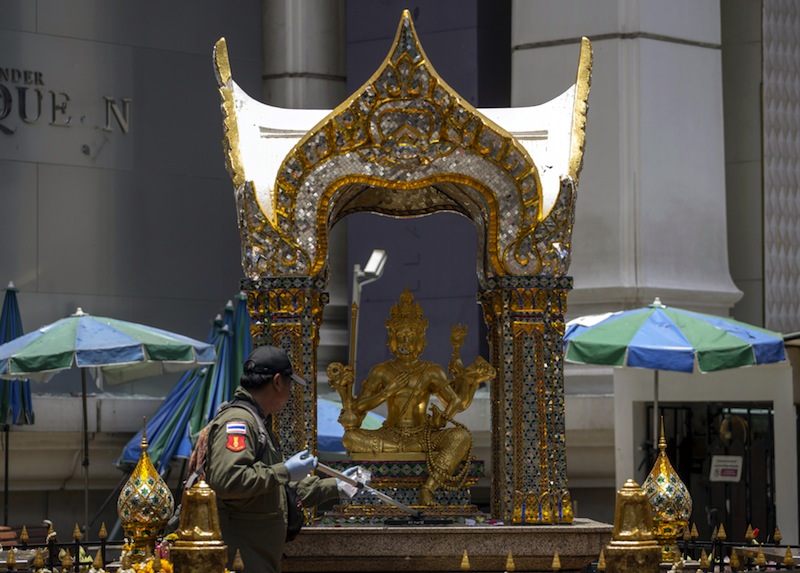


SINGAPORE, Aug, 18 — One Singaporean, Melissa Liu Rui Chum, is among the nine foreigners killed in a bomb blast at a popular shrine in Bangkok last night.
In response to media queries, the Ministry of Foreign Affairs (MFA) today confirmed the death of a Singaporean woman.
“We regret to confirm that a Singaporean woman was among those killed by yesterday’s deadly bomb blast in Bangkok.”
“Deeply saddened” by this development, the MFA reiterates its “strong condemnation of this indiscriminate act of violence, while extending its deepest condolences to the bereaved family for their loss.
“Our Embassy in Bangkok is currently providing consular assistance to the family of the deceased,” the MFA added.
As for the other injured Singaporeans, the MFA updates that “all are receiving medical attention”, while those with light injures have been discharged.
Majority of the registered Singaporeans in Bangkok had been contacted by the MFA, who said they are monitoring the situation closely.
As of this morning, the death toll reached 22. Three Chinese were among the dead, the official Xinhua news agency said.
Two Hong Kong residents, two people from Malaysia and one person from the Philippines had also been killed, officials said. Thai national police spokesman Prawut Thavornsiri said the death toll stood at 22 from the bombing, with 123 people wounded, including many from China and Taiwan.
The blast did not match the tactics used by separatist rebels in southern Thailand, the country’s army chief said.
Thai Officials have yet to blame any group for the bombing at the Erawan shrine last evening, which the government called a bid to destroy the economy. No one has claimed responsibility.
National police chief Somyot Poompanmuang told reporters the attack was unprecedented in Thailand. He said the blast was caused by a pipe bomb.
When TODAY visited Ratchaprasong junction and Rajdamri Road this morning, the streets were unusually quiet for a Tuesday morning. Some schools in the area are closed due to road closures. Thai authorities have urged the public not to speculate while investigations are ongoing.
Paisit Boonratyothin, 30, security officer at BigC mall, less than 100 metres from bomb site, was manning the mall’s entrance this morning to restrict entry only to staff. Mall opens only at noon instead of 9am due to closure of Rajdamri Road. He said: “ Of course I’m worried about safety. But this is not the first time violence has broken out in this area. We are used to it already.”
As of 12.30pm, the Associate Press updated that the central Bangkok intersection where the bomb went off has been reopened to traffic, some 17 hours after the devastating explosion.
Thai forces are fighting a low-level Muslim insurgency in the predominantly Buddhist country’s south, but those rebels have rarely launched attacks outside their heartland.
“This does not match with incidents in southern Thailand. The type of bomb used is also not in keeping with the south,” Royal Thai Army chief and deputy defence minister General Udomdej Sitabutr said in a televised interview.
Police teams were deployed to the blood splattered site early thir morning, with some wearing white gloves and carrying plastic bags, searching for clues.
“Collection of evidence last night was not complete,” Udomdej said.
The Erawan shrine, on a busy corner near top hotels, shopping centres, offices and a hospital, is a major attraction, especially for visitors from East Asia, including China. Many ordinary Thais also worship there.
“The perpetrators intended to destroy the economy and tourism, because the incident occurred in the heart of the tourism district,” Defence Minister Prawit Wongsuwan told Reuters late last night.
Tourism is one of the few bright spots in an economy that continues to underperform more than a year after the military seized power in May 2014.
It accounts for about 10 per cent of the economy, and the government had expected a record number of visitors this year following a sharp fall in 2014 during months of street protests and the coup.
Horrific scene
At the scene last evening lay burnt out motorcycles, with rubble from the shrine’s wall and pools of blood on the street.
“There were bodies everywhere,” said Marko Cunningham, a New Zealand paramedic working with a Bangkok ambulance service, who said the blast had left a two-metre-wide crater.
“Some were shredded. There were legs where heads were supposed to be. It was horrific,” Cunningham said, adding that people several hundred metres away had been wounded.
The government would set up a “war room” to coordinate the response to the blast, the Nation television channel quoted Prime Minister Prayuth Chan-ocha as saying.
Authorities stepped up security checks at some major city intersections and in tourist areas.
Thailand has also been riven for a decade by a sometimes violent struggle for power between political factions in Bangkok.
Occasional small blasts have been blamed on one side or the other. Two pipe bombs exploded outside a luxury shopping mall in the same area in February, but caused little damage.
In Washington, the US State Department said it was too soon to tell if the blast was a terrorist attack.
Spokesman John Kirby said authorities in Thailand had not requested US help so far.
Singapore’s Ambassador to Thailand,s Chua Siew San, had visited the other injured Singaporeans at the various local hospitals earlier this morning.
“Our Embassy will continue to provide consular support for the injured Singaporeans and their next-of-kin,” said the MFA. — TODAY


