














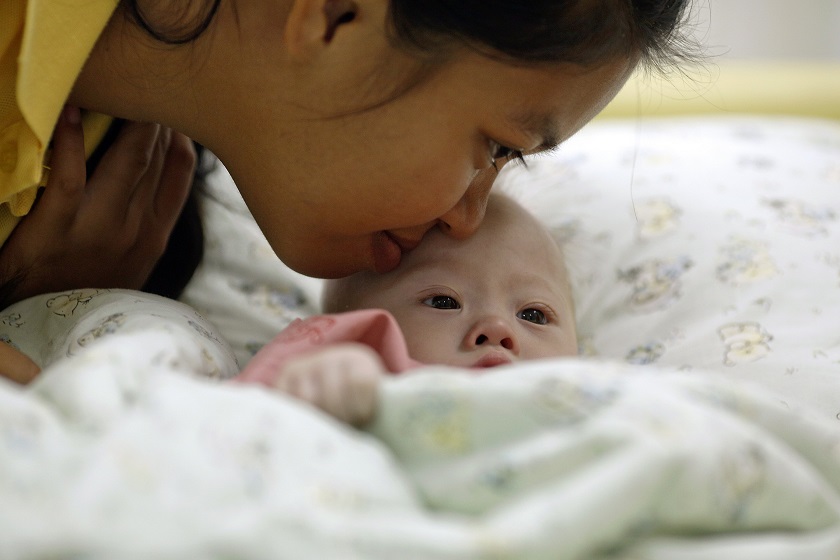


SINGAPORE, Aug 14 — The recent surrogacy controversy in Thailand involving an Australian couple and their Down syndrome son has thrown the spotlight on international commercial surrogacy and its myriad legal, ethical and social issues, such as the enforceability of surrogacy contracts and parental responsibility for the child.
As in several other countries, the legality of surrogacy remains a grey area in Singapore. One agency here is known to provide surrogacy services — matching Singapore parents to overseas surrogate mothers — even though the Ministry of Health prohibits licensed healthcare institutions from providing assisted reproduction services to carry out surrogacy.
Yesterday, Thailand’s military government gave preliminary approval for a draft law to make commercial surrogacy a criminal offence, following a spate of dramatic surrogacy scandals in the past two weeks.
Family law practitioners whom TODAY spoke to felt there was a need for greater clarity, though they were divided over whether commercial surrogacy should be regulated, with some arguing that such a move would allow issues related to the matter to be handled openly.
Ms Ellen Lee, Member of Parliament (MP) for Sembawang GRC, said the Government is right to go slow on the subject, as it comes with a host of issues, such as the exploitation of surrogate mothers who come from poor backgrounds, the idea of “buying a child”, surrogacy for gay couples, to the potential backlash from various religious and social groups.
“The Government wants to tread very carefully and achieve a balance — in the sense that while we will not spearhead anything without knowing what the norms and trends will be ... we will also not actively legalise or outlaw it,” said Ms Lee, who is also a family law consultant at Ramdas & Wong.
Loopholes in the law make it unclear whether it is legal for Singaporean couples to conceive a child through surrogacy performed overseas and whether it is legal to run surrogacy agencies here, family lawyers said.
Amid the grey areas in the legal framework here, Mr Michael Ng has run his agency, Asian Surrogates, in Singapore since 2006 to serve not only domestic clients, but also those from around the region.
Family lawyer Rajan Chettiar said while Singapore might not be ready to promote surrogacy locally, the Government should look into laws that will safeguard and protect couples who are seeking surrogacy services overseas.
“We should have laws in place to protect not only the parents or couple, but also the child’s interest,” he said.
Mr Chettiar added that tackling the controversial issues surrounding surrogacy will require the cooperation of other countries to draft international agreements that can ensure the protection of surrogate mothers and the couples involved in the process, to prevent a repeat of the surrogacy scandal in Thailand, where a young surrogate mother had given birth to an Australian couple’s twins — a boy and a girl — in December. She said the couple took only the girl and left the boy with her after discovering that he had Down syndrome. The couple have since claimed that the Thai woman had demanded to keep the boy.
Dr Chia Shi-Lu, chairman of the Government Parliamentary Committee (Health), agreed that it might be worth considering some form of legislation on surrogacy.
“The problem is that even if you don’t do it here, Singaporeans or people living in Singapore could do it overseas. The world is very small. So, are we doing right by forcing people to do this overseas when it might be better controlled if you allow it in your own country?” said Dr Chia, who is also an MP for Tanjong Pagar GRC.
However, family lawyer Koh Tien Hua from Harry Elias Partnership questioned whether introducing regulations here will help, since the surrogacy process and surrogate mothers, who are the potential victims, are outside Singapore’s jurisdiction.
For Ms Devi Haridas of Sim Law Practice, surrogacy is a very personal and moral issue, and she is of the view that it should not be regulated. “My worry is, if it’s legalised, those who can give birth will take the shortcut and say, ‘Let someone else give birth for me’,” the lawyer said.
Agency owner began Surrogate business due to ‘need for it’
Mr Michael Ng of Asian Surrogates agency started his business as an egg-donation company for in-vitro fertilisation (IVF) procedures, and later ventured into the surrogate business to match clients with surrogate mothers in Thailand.
“There was a need for it. People were asking for surrogates, so I said, ‘Okay, why not,’” he said.
Out of the 10 couples he has matched with surrogate mothers since 2006, only two were Singaporeans.
On top of the S$55,100 (RM140, 592) that Mr Ng charges each couple for matching them with a surrogate mother, his clients also have to directly pay doctors in Thailand for the costs of medical procedures, including the IVF process and embryo transfer.
Following Thailand’s move to speed up new legislation to outlaw commercial surrogacy after the recent scandal, Mr Ng said he has stopped his business temporarily and is looking at alternative countries for surrogate mothers, such as India and Eastern Europe. ― Today